

A broad-based easing in headline inflation suggests that price pressures are moderating more decisively than the Reserve Bank of Australia had anticipated. Softer housing inflation may also signal cooling domestic demand, with potential spillovers to private consumption and growth, further strengthening the case for an extended hold.
Softer-than-expected Australia inflation in 2Q
Australia's latest inflation data has come in softer than expected, with both the June monthly CPI indicator and the second quarter CPI report undershooting market and Reserve Bank of Australia forecasts.
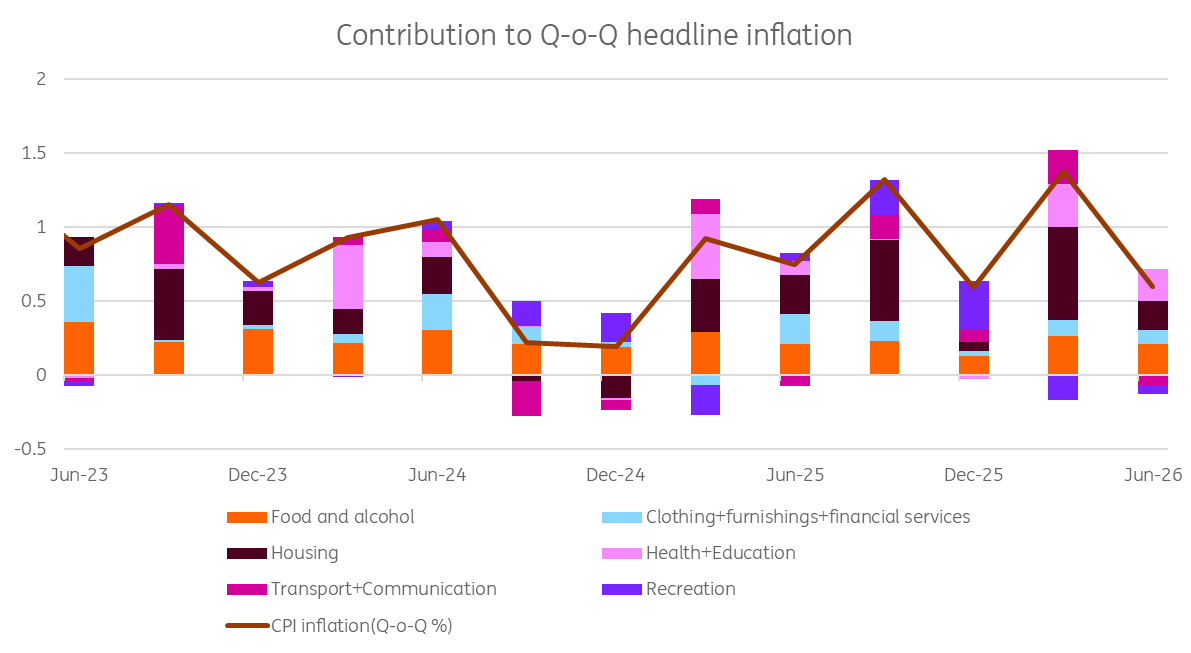
The downside surprise was most pronounced in headline inflation. Annual CPI slowed to 3.9% year-on-year in Q2, well below the RBA's forecast of 4.8% YoY, while quarterly inflation eased sharply to 0.6% quarter-on-quarter from 1.4% QoQ in Q1. The deceleration was driven primarily by softer housing and transport costs, while contributions from most other components either declined or remained broadly unchanged. This suggests the improvement was not confined to a handful of categories but reflected a broader easing in price pressures across the basket.
Importantly, the softness in housing-related inflation may also signal a cooling in housing market activity. Given the central role of housing in household wealth, borrowing and spending decisions, a sustained moderation in housing inflation could have wider implications for private consumption and growth.
Underlying inflation was also slightly softer than expected. The RBA's preferred trimmed mean CPI rose to 3.6% YoY in Q2 from 3.5% YoY in Q1, but remained below the Bank's forecast of 3.8% YoY. While still above the midpoint of the RBA's 2-3% target range, the result suggests underlying price pressures continue to gradually moderate.
That said, inflation is not yet fully tamed. Some areas remain sticky and will likely keep the RBA cautious. Goods inflation slowed to 3.5% YoY in June from 4.2% YoY in May, helped in part by lower fuel prices. However, services inflation continued to trend higher, reaching 4.0% YoY, while non-tradable inflation rose to 4.9% YoY. These developments point to lingering domestic price pressures and suggest that some cost pass-through into services prices is still playing out.
Taken together, however, the overall inflation picture is more benign than the RBA had anticipated. The broad-based downside surprises in both headline and underlying inflation suggest that the disinflation process is progressing faster than envisaged in the Bank's baseline forecasts.
For the RBA, this should provide greater confidence that inflation is moving sustainably towards target. At its previous meeting, the Board acknowledged softer growth momentum but remained concerned about inflation. Since then, risks have shifted lower on both fronts. Growth indicators remain subdued, while the labour market has softened modestly, with the June unemployment rate rising to 4.4%, above the RBA's forecast of 4.2%.
The latest inflation and activity data strengthens the case for the RBA to remain on hold for the rest of the year. While pockets of inflation persistence remain, they appear increasingly outweighed by evidence that price pressures are easing faster than expected.
Housing and transport drove QoQ drop in inflation


Comments
Log in or sign up to join the conversation.