

Efficient warehouse storage is becoming increasingly important as businesses handle larger inventories, wider product ranges, and faster order-processing requirements. One of the most widely used solutions for organizing palletized goods is industrial pallet racks.
Designed to utilize vertical warehouse space while keeping materials organized and accessible, industrial pallet racking can support manufacturing plants, distribution centers, logistics facilities, wholesale operations, and industrial warehouses. Selecting the appropriate rack configuration can improve storage organization, inventory accessibility, and overall warehouse efficiency.
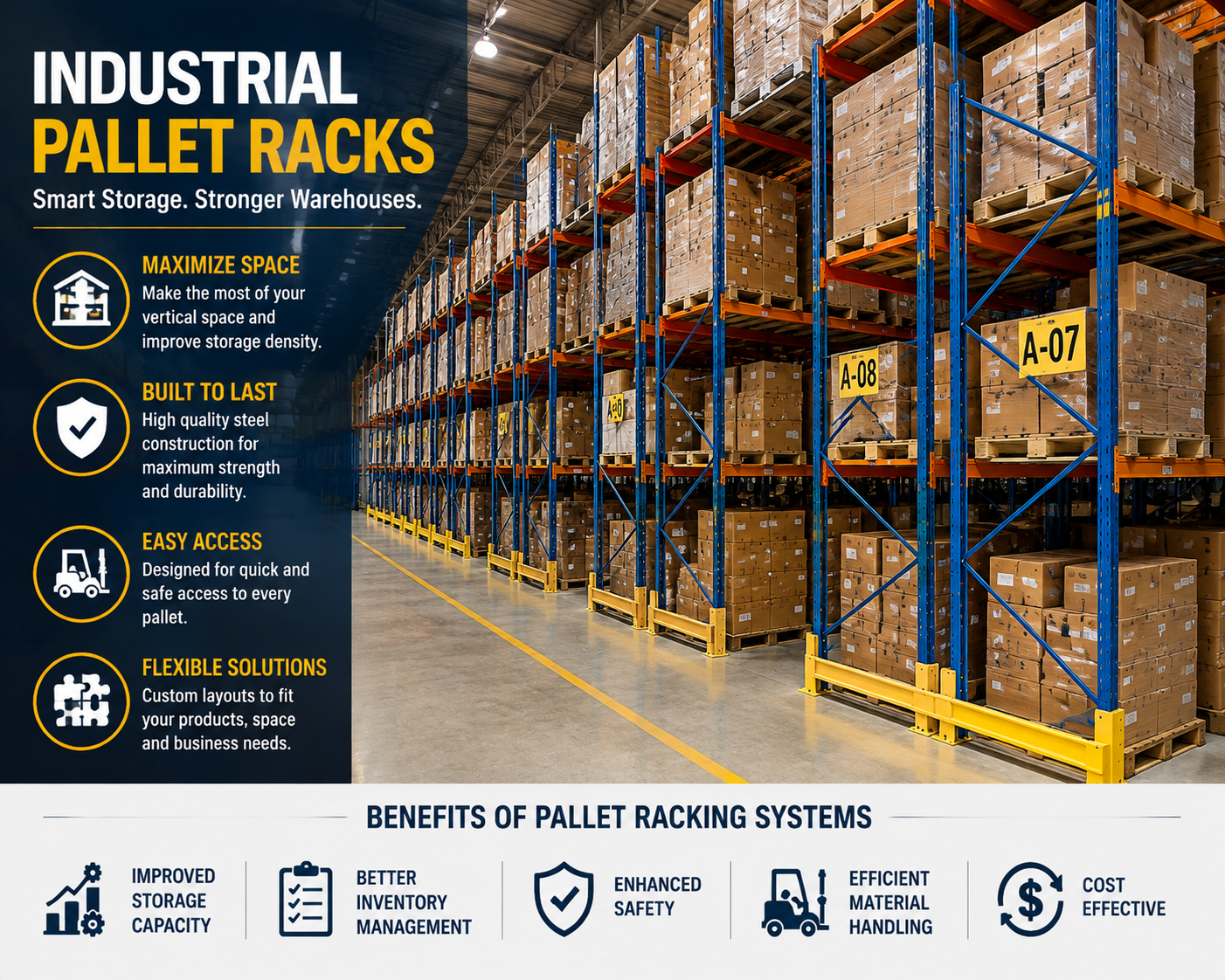
What Are Industrial Pallet Racks?
Industrial pallet racks are structured storage systems designed primarily to hold goods placed on pallets. Instead of storing materials directly on the warehouse floor, pallets are positioned on horizontal beams supported by vertical frames.
Depending on warehouse requirements, warehouse pallet racks can be configured at different heights, bay widths, beam levels, and load capacities. This flexibility allows businesses to create storage layouts based on available floor space, pallet dimensions, material weight, handling equipment, and inventory turnover.
Well-planned pallet racking systems can help warehouses make better use of vertical space while maintaining organized pallet locations for material handling operations.
Why Industrial Pallet Racking Is Important
Warehouse floor space is valuable. Expanding horizontally is not always practical, particularly in existing facilities where building dimensions are fixed.
Industrial pallet racking provides a way to use the vertical height of a warehouse more effectively. Instead of spreading inventory across large floor areas, pallets can be stored on several rack levels.
This can provide several operational benefits:
Improved utilization of warehouse height
More organized pallet locations
Easier inventory identification
Better material accessibility
Reduced floor-level congestion
More structured forklift movement
Flexible warehouse layout planning
These advantages make pallet racks an important component of many warehouse storage racks and material-handling systems.
Industrial Storage Racks vs. Industrial Shelving Systems
Although both solutions are used for storage, industrial storage racks and industrial shelving systems generally serve different purposes.
Pallet racks are primarily designed for palletized goods that are commonly handled using forklifts, reach trucks, or other material-handling equipment.
Industrial shelving systems, in comparison, are often used for smaller products, cartons, tools, spare parts, and manually handled inventory.
Many warehouses use both systems together. Palletized bulk inventory may be stored on pallet racks, while individual items or smaller packages are stored on shelving.
Heavy Duty Pallet Racks for Industrial Storage
Warehouses handling dense, bulky, or high-volume palletized goods often require heavy duty pallet racks.
Heavy-duty racking generally uses robust upright frames, beams, bracing, connectors, and supporting components designed according to the required loading conditions. Rack capacity depends on several factors, including pallet weight, beam span, rack height, number of levels, and overall configuration.
For this reason, heavy duty storage racks should be selected based on actual operational loads rather than general assumptions.
Warehouse planners should consider both the individual pallet load and the total load carried by each rack bay.
Pallet Storage Racks and Warehouse Organization
Properly arranged pallet storage racks can contribute to a more structured warehouse.
Clearly defined rack locations make it easier to assign products to specific storage positions. Warehouses can also integrate location codes, barcode systems, inventory software, and warehouse management systems with physical rack positions.
A structured arrangement can divide facilities into different zones for:
Incoming materials
Raw materials
Work-in-progress inventory
Finished products
Fast-moving goods
Slow-moving inventory
Dispatch preparation
Combining physical storage organization with inventory management procedures can improve the visibility of materials throughout warehouse operations.
Planning Warehouse Racking Systems
A successful warehouse racking system requires proper planning before installation. A well-designed storage layout should not only maximize available space but also ensure safe operations, easy product access, efficient material movement, and future scalability.
Before selecting a racking configuration, warehouse managers should analyze several important factors:
1. Warehouse Dimensions
The physical structure of the warehouse plays a major role in determining the suitable rack layout.
Important considerations include:
Available floor space: The total warehouse area determines how many rack rows and aisles can be installed.
Ceiling height: Higher buildings can accommodate taller racks, allowing better use of vertical storage space.
Columns and building structures: Existing columns, walls, doors, and loading areas must be considered to avoid blocking operations.
Lighting, fire protection, and utilities: Rack placement should maintain access to electrical systems, sprinklers, and safety equipment.
Proper evaluation of warehouse dimensions helps create a layout that provides maximum storage capacity while maintaining safe working conditions.
2. Pallet Dimensions
Pallet size directly affects the design and configuration of the racking system.
The following factors should be considered:
Pallet length and width
Pallet height
Load overhang requirements
Number of pallets stored per rack level
Correct pallet measurements help determine the required beam length, upright height, rack depth, and spacing between storage levels.
A rack designed according to actual pallet dimensions reduces wasted space and improves storage efficiency.
3. Load Requirements
Every warehouse has different storage loads, making load assessment a critical part of rack planning.
The design should consider:
Individual pallet weight
Total weight stored in each rack bay
Number of storage levels
Frequency of loading and unloading activities
Heavy materials may require heavy duty pallet racks with stronger frames and beams, while lighter products may require different storage solutions.
Selecting racks based on accurate load calculations improves safety and helps prevent structural issues caused by overloading.
4. Material Handling Equipment
The type of equipment used inside the warehouse directly influences rack arrangement.
Important factors include:
Forklift dimensions
Forklift turning radius
Maximum lifting height
Required aisle width
Loading and unloading methods
For example, warehouses using reach trucks may require narrower aisles compared to facilities using traditional counterbalance forklifts.
Proper coordination between rack design and material-handling equipment ensures smooth movement, reduces congestion, and improves operational efficiency.
5. Inventory Turnover
Inventory movement patterns should also be considered when planning warehouse storage.
Products that move frequently should usually be placed in easily accessible locations, such as lower rack levels or areas closer to dispatch zones.
Slow-moving inventory may be stored in higher positions or less accessible areas to optimize available space.
Understanding inventory turnover helps warehouses organize products based on usage frequency, reducing picking time and improving workflow.
Selective Pallet Racks
Among the different warehouse racking configurations, selective pallet racks are commonly used where direct access to individual pallets is important.
In a selective system, forklifts can typically access each pallet position directly from the aisle. This makes the arrangement useful when a warehouse stores multiple product types or stock-keeping units that need frequent retrieval.
Selective configurations are often incorporated into industrial pallet racking layouts where accessibility, flexibility, and straightforward inventory management are major considerations.
Although selective racks normally require dedicated forklift aisles, they offer a practical balance between storage density and pallet accessibility.
Importance of Professional Pallet Rack Installation
Correct pallet rack installation is an essential part of developing a reliable warehouse storage system.
Frames should be positioned correctly, beams properly connected, and rack components installed according to the approved layout and applicable requirements. Floor conditions, anchoring, rack alignment, aisle dimensions, and load distribution should all be considered.
Warehouse operators should also inspect racks periodically for damaged beams, bent uprights, loose components, missing safety devices, or impact damage caused by material-handling equipment.
Improving Warehouse Space Utilization
The main purpose of industrial pallet racks is not simply to increase the number of pallets stored in a facility. An effective storage system should balance storage capacity with accessibility, material movement, operational safety, and inventory management.
A properly planned system can help create clear storage zones while maintaining suitable forklift routes and access points.
For many industrial and logistics facilities, combining warehouse pallet racks, appropriate handling equipment, clear aisle planning, and structured inventory procedures can provide a more efficient approach to warehouse space management.
Conclusion
Industrial pallet racks remain one of the most practical methods for organizing palletized inventory in warehouses, manufacturing facilities, and distribution centers.
From selective pallet racks to heavy duty pallet racks, the appropriate configuration depends on pallet dimensions, loading requirements, available warehouse space, handling equipment, and inventory movement.
By carefully planning rack layouts and considering accessibility, load capacity, installation requirements, and future storage needs, businesses can develop warehouse storage systems that make better use of available space while supporting organized material-handling operations.
#IndustrialPalletRacks #IndustrialPalletRacking #PalletStorageRacks #WarehousePalletRacks #HeavyDutyPalletRacks #IndustrialStorageRacks #WarehouseStorageRacks #PalletRackingSystems
Comments
Log in or sign up to join the conversation.