

While our thoughts and prayers remain with the folks in Houston this morning, geopolitical tensions have returned to the center stage. With North Korea’s boy-leader firing a missile over Japan last night, the concern is that retaliatory measures could be taken and the situation could easily escalate. Where this goes is anybody’s guess, but as far as the market is concerned, it appears that traders are taking a defensive stance in the early going today.
But before we get carried away with speculation, let’s turn our attention to our objective review the key market models and indicators and see where things stand. To review, the primary goal of this weekly exercise is to remove any subjective notions one might have in an effort to stay in line with what “is” happening in the markets. So, let’s get started.
The State of the Trend
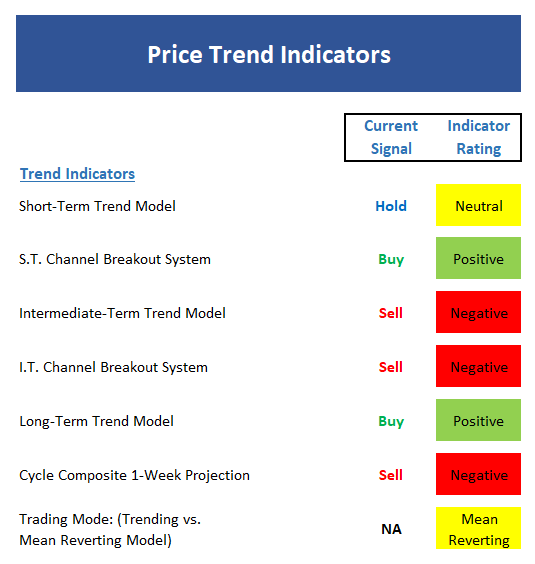
We start each week with a look at the “state of the trend.” These indicators are designed to give us a feel for the overall health of the current short- and intermediate-term trend models.
Executive Summary:
- The short-term Trend Model is currently neutral, due at least in part to the recent sideways action.
- The short-term Channel Breakout System is currently positive but a break below 2417 would flip it back to negative.
- The intermediate-term Trend Model has improved but remains negative.
- The intermediate-term Channel Breakout System will require a move to new highs in order for the signal to go back to positive.
- The long-term Trend Model remains in pretty good shape.
- The Cycle Composite continues to point lower with only intermittent rallies through the middle of October.
- The Trading Mode models agree that stocks are back in a mean-reverting environment.
The State of Internal Momentum
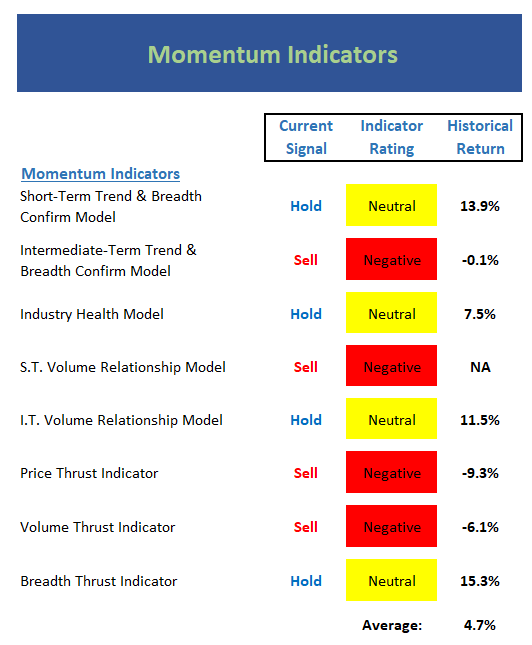
Next up are the momentum indicators, which are designed to tell us whether there is any “oomph” behind the current trend…
Executive Summary:
- The short-term Trend and Breadth Confirm Model has improved to neutral but it won’t take much for this model to return to negative.
- Our intermediate-term Trend and Breadth Confirm Model remains negative.
- The Industry Health Model is still stuck in the neutral zone. I continue to see this as a problem.
- Despite the bounce off the recent lows, the short-term Volume Relationship has continued to weaken as the up volume line is now at the lows of the year.
- The intermediate-term Volume Relationship model is moving in the wrong direction.
- The Price Thrust Indicator, which requires some “oomph” in order to move, didn’t budge during the recent rebound.
- The Volume Thrust Indicator is negative.
- The Breadth Thrust Indicator has upticked to neutral.
The State of the “Trade”
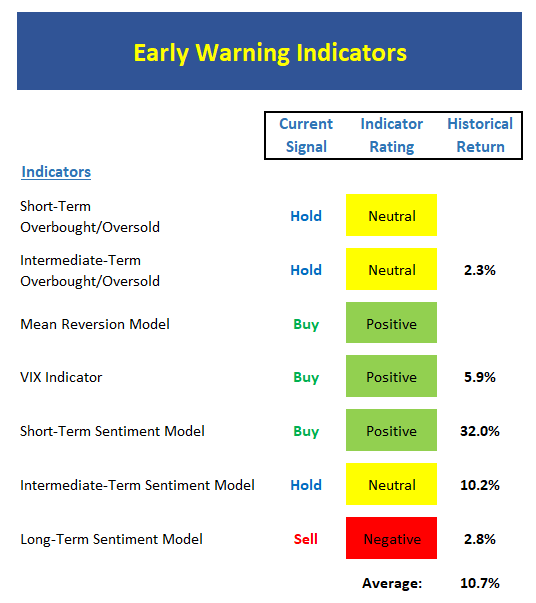
We also focus each week on the “early warning” board, which is designed to indicate when traders may start to “go the other way” — for a trade.
Executive Summary:
- From a near-term perspective, the recent oversold condition has been worked off. Thus, this mean-reversion tailwind is now still.
- From an intermediate-term view, stocks remain in never-never land.
- The Mean Reversion Model is still on a buy signal. However, the model is weakening quickly and the most recent signal looks to have been false.
- The VIX Indicator is technically on a buy signal at the moment. However, the return of tensions in N. Korea could change this quickly.
- From a short-term perspective, market sentiment is now negative, which, is a positive.
- The intermediate-term Sentiment Model has returned to neutral.
- Longer-term Sentiment readings continue to be a negative input.
The State of the Macro Picture
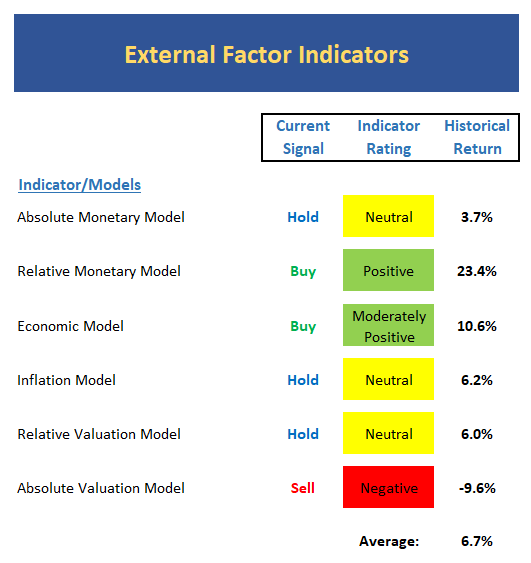
Now let’s move on to the market’s “external factors” – the indicators designed to tell us the state of the big-picture market drivers including monetary conditions, the economy, inflation, and valuations.
Executive Summary:
- Absolute Monetary conditions slipped back to neutral last week.
- The Relative Monetary Model continues to improve and is currently at the highest level seen since last summer.
- Our Economic Model (designed to call the stock market) remains on a buy signal but weakened a fair amount last week.
- The Inflation Model continues to suggest that inflationary pressures are receding.
- Our Relative Valuation Model continues to improve but remains in neutral at this time.
- The Absolute Valuation Model remains resolutely negative.
The State of the Big-Picture Market Models
Finally, let’s review our favorite big-picture market models, which are designed to tell us which team is in control of the prevailing major trend.
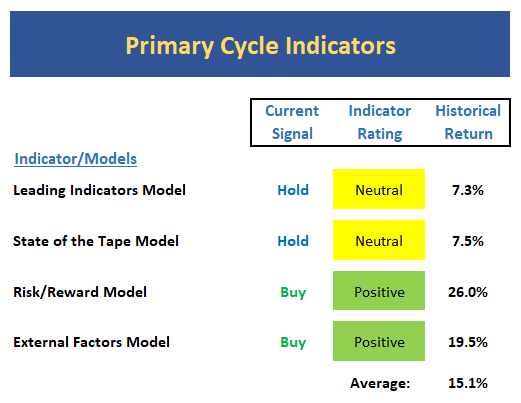
Executive Summary:
- The Leading Indicators model took a dive last week and is now only slightly above negative. This is something to watch closely.
- The Tape continues to be less than robust, which in my book, suggests risks are elevated.
- The Risk/Reward model peeked its head into positive territory and remains there this week.
- The External Factors model also improved enough recently to turn the box green. From a long-term perspective, this suggests that the secular bull is intact and dips should be bought.
The Takeaway…
My key takeaway this week is that from a big-picture standpoint, not much has really changed. Although some of my models have improved, the lack of green on the momentum board is very telling. And given the combination of negative seasonality and renewed geopolitical issues, I would not be surprised to see stocks test their recent lows in the near-term. The question of the day then is, do the bears have enough working for them to get something meaningful going?
Thought For The Day:
Life is 10% what happens to you and 90% how you handle it. -Unknown
Current Market Drivers
We strive to identify the driving forces behind the market action on a daily basis. The thinking is that if we can both identify and understand why stocks are doing what they are doing on a short-term basis; we are not likely to be surprised/blind-sided by a big move. Listed below are what we believe to be the driving forces of the current market (Listed in order of importance).
1. The State of Geopolitics
2. The State of the Economic/Earnings Growth (Fast enough to justify valuations?)
3. The State of the Trump Administration
4. The State of Fed Policy



Comments
Log in or sign up to join the conversation.