

There is a piece of infrastructure running beneath India's financial system that most global investors have never examined closely. It does not trade on any exchange. It issues no earnings report. But without it, India's digital lending boom, its insurance penetration push, and its government benefit delivery at scale would not be possible.
It is called Aadhaar authentication — and as of 2025, it has processed over 15,000 crore (150 billion) cumulative identity verification transactions.
For anyone tracking emerging market fintech, digital banking, or India-focused investment themes, the Aadhaar verification ecosystem is worth understanding in detail — not as a technology story, but as a financial infrastructure story.
The Scale Is Genuinely Unprecedented
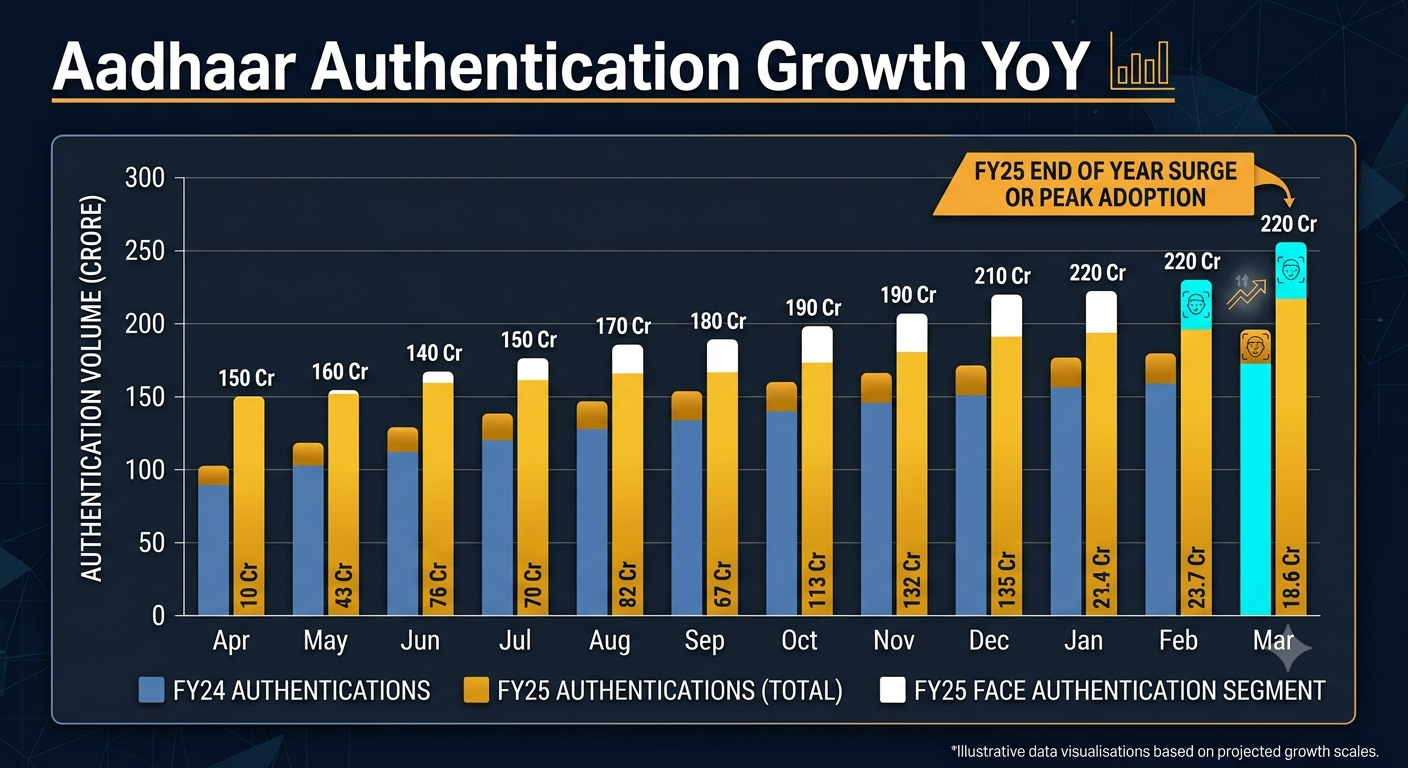
Numbers like "150 billion transactions" can feel abstract. Here is a frame that helps: in March 2025 alone, India processed 246.75 crore Aadhaar authentications — roughly 79 lakh identity verifications every single day. In FY 2024-25, the annual volume crossed 2,707 crore.
For context, that is more identity verifications in a single year than the combined population of China and the United States being verified roughly twice over.
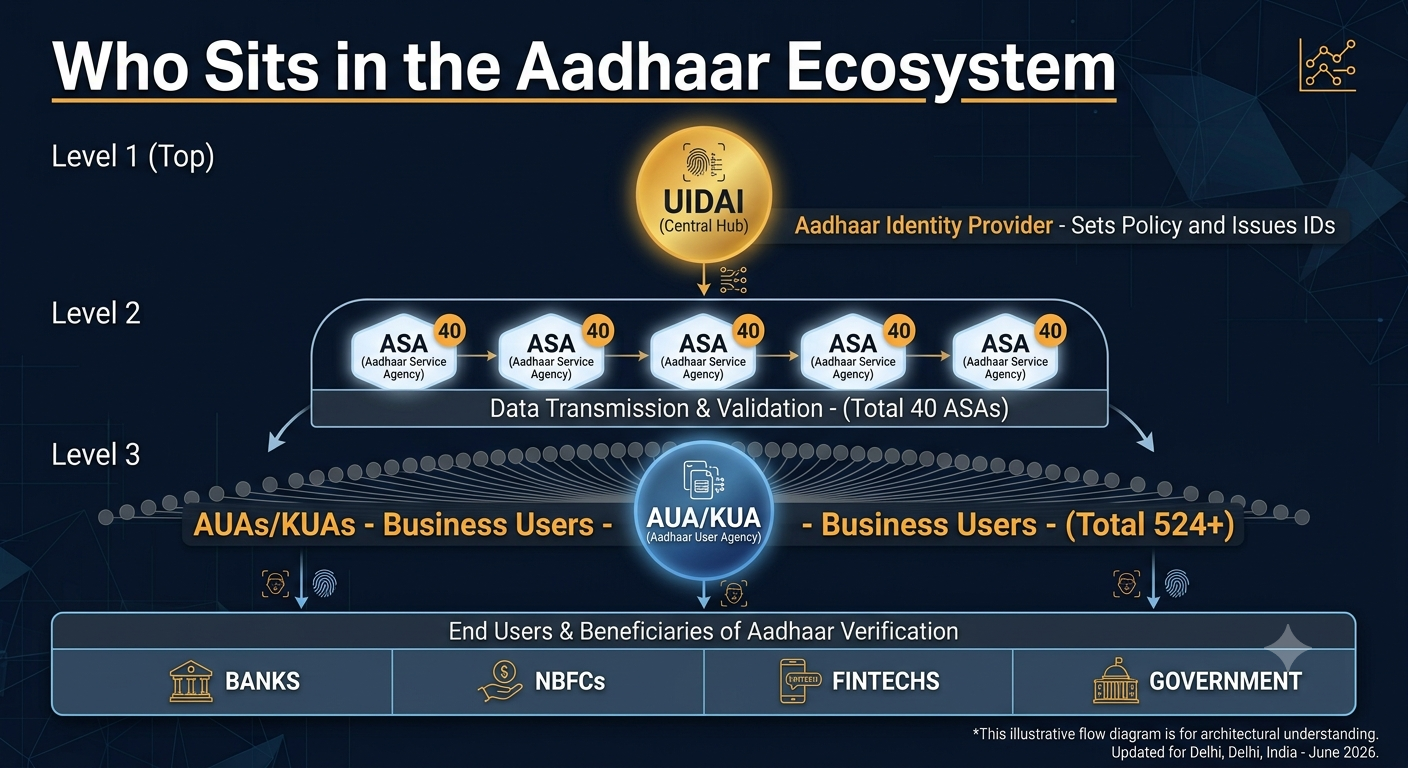
This volume exists because Aadhaar authentication is now embedded in the critical path of financial services delivery in India. Opening a bank account, activating a SIM card, receiving a government subsidy, applying for a loan, filing an insurance claim — all of these touch the Aadhaar system. There are currently 524 active Authentication User Agencies (AUAs) and 40 Authentication Service Agencies (ASAs) connected to UIDAI's infrastructure.
Why This Matters for Financial Markets
The business model implication is significant. Any fintech, NBFC, or bank operating in India that wants to onboard customers digitally must either build or buy access to Aadhaar verification infrastructure. This creates a clear and growing market for Aadhaar verification API providers — companies that sit in the middleware layer between UIDAI's systems and the financial institutions that need them.
India's fintech sector processed over $100 billion in digital payments in FY25. The KYC layer that makes those transactions trustworthy and regulatorily compliant is Aadhaar-based. As India's credit market expands — particularly into rural and semi-urban populations historically excluded from formal banking — the authentication volume will only grow.
Face authentication is one leading indicator of this expansion. In August 2025, face-based Aadhaar authentication transactions reached 18.6 crore in a single month — nearly three times the volume from the same month in 2024. UIDAI received the Prime Minister's Award for Excellence in Public Administration in 2025 specifically for this innovation. The growth is driven by a practical problem: fingerprint biometrics fail disproportionately among older populations, daily-wage workers, and farming communities — exactly the demographic India's financial inclusion agenda is trying to reach. Face authentication solves that access gap.
The Infrastructure Layer Most Analysts Overlook
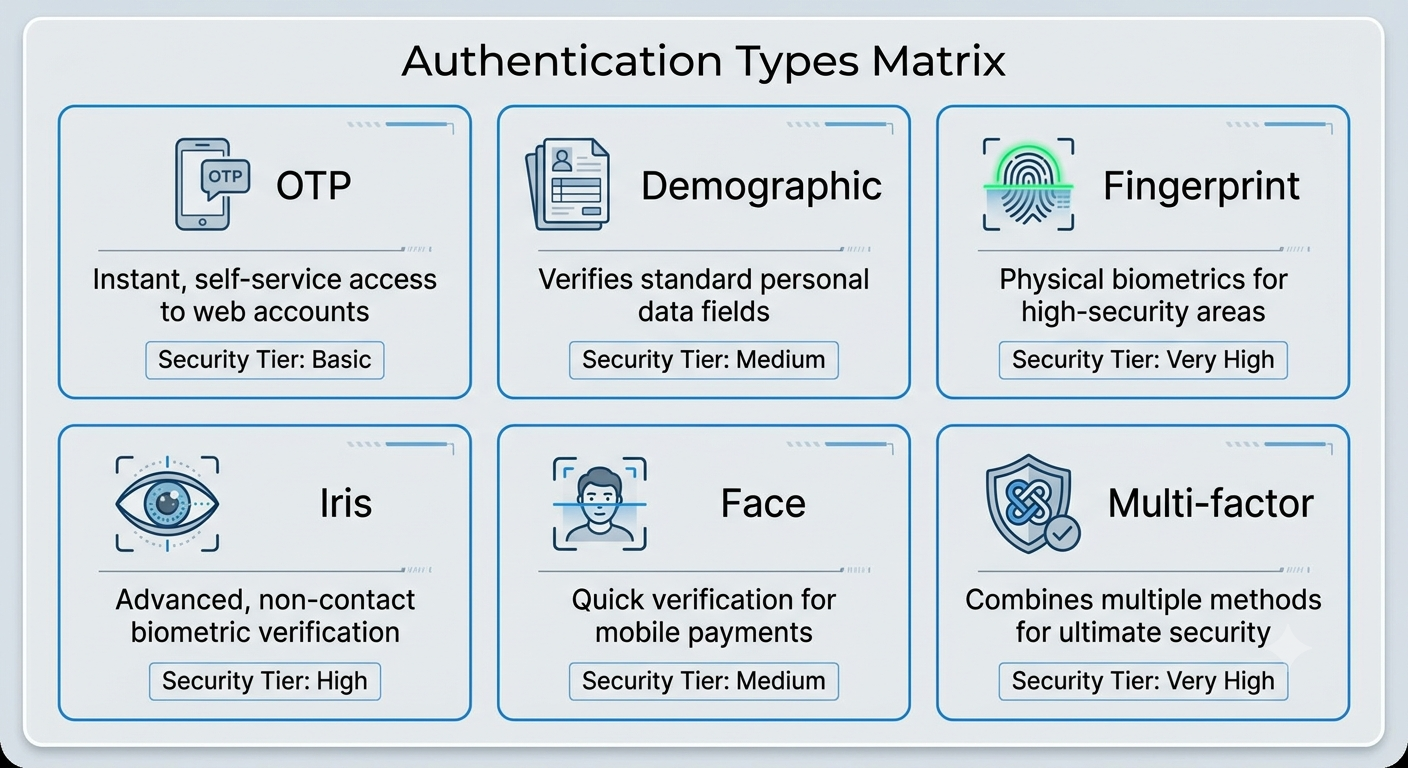
There are six modes of Aadhaar authentication in active use: demographic matching, OTP verification, fingerprint biometrics, iris scanning, face recognition, and multi-factor combinations of these. Each serves a different risk tier and use case.
OTP-based authentication is the workhorse of digital onboarding. Biometric authentication underpins government benefit delivery at scale. Face authentication is the fastest-growing mode and increasingly preferred by banks and insurance companies for contactless, remote verification.
The eKYC layer — which goes beyond simple Yes/No verification to actually share verified demographic data from UIDAI records with consent — processed 44.63 crore transactions in March 2025 alone, with a cumulative total exceeding 2,356 crore. For financial institutions, eKYC eliminates manual data entry errors, reduces fraud exposure, and compresses onboarding timelines from days to minutes.
This is meaningful for credit underwriting. Lenders who can verify identity and retrieve clean demographic data in real time can approve loans faster, at lower operational cost, with better fraud controls. The Aadhaar verification API market is, in this sense, a credit market infrastructure play.
The Investment Angle: Who Benefits?
Several layers of the ecosystem stand to capture value as India's Aadhaar authentication volume grows:
Identity verification API platforms that serve NBFCs, banks, and fintechs as licensed intermediaries are in the strongest position. They collect per-transaction revenue on a volume that is structurally growing at 8-10% year-on-year.
Banks and NBFCs with strong digital onboarding infrastructure benefit from lower customer acquisition cost and reduced KYC fraud losses — both of which flow directly to margins.
Insurance and lending platforms targeting India's underserved rural market are directly dependent on face authentication adoption. Companies that built their product stack around face-auth early are now sitting on a structural advantage as the technology becomes mainstream.
The risks are real too. UIDAI is a government body, and policy changes — to pricing, to permitted use cases, to data-sharing rules — can reshape the economics of this space overnight. The Aadhaar Act has been tested in the Supreme Court, and the regulatory perimeter around commercial use of eKYC data remains an area to watch.
What the Authentication History Feature Tells Us
One underappreciated data point: UIDAI gives every Aadhaar holder access to their last 50 authentication records — a log showing which institution verified their identity, when, and by what method. It is free, accessible via uidai.gov.in, and updates in near real time.
This is not just a consumer privacy feature. It is a transparency mechanism that holds Authentication User Agencies accountable. If a financial institution is triggering erroneous, duplicate, or unauthorised verifications, those show up in the log — and users can file complaints or lock their biometrics immediately.
For investors evaluating India-focused fintech platforms, this transparency layer is a signal of the regulatory maturity of the Aadhaar ecosystem. UIDAI's infrastructure is designed with accountability built in, which reduces — though does not eliminate — systemic fraud risk.
Conclusion
India's Aadhaar verification system is not just a government project. It is the identity layer on which a $500 billion digital financial services market is being constructed. The companies that provide reliable, compliant access to that layer — through robust Aadhaar verification APIs — are quietly becoming critical infrastructure vendors in one of the world's most important emerging market stories.
At 15,000 crore transactions and counting, the network effects are entrenched. The question for investors is not whether Aadhaar authentication matters. It is who is best positioned to monetise the infrastructure that makes it work.
Comments
Log in or sign up to join the conversation.