

Indian share markets trimmed their morning losses and ended flat. At the closing bell, the BSE Sensex finished lower by 19 points. While, the NSE Nifty finished flat. Meanwhile, the S&P BSE Midcap Index ended up by 0.4% while S&P BSE Small Cap Index ended up by 0.6%.
Among individual stocks, Sun Pharma surged over 8%, while Dr. Reddy ended nearly 5% higher on the BSE.
Sectoral indices ended the day on a mixed note with healthcare stocks and information technology stocks leading the pack of gainers. While, power stocks and metal stocks ended the day in red.
Globally, Asian stock markets stepped back from a 2-1/2 month high today as risk appetite soured on bets that Europe's massive monetary stimulus was nearing an end, compounded by uncertainty over trade relations ahead of a key meeting of global leaders. Shares in Hong Kong led the region. The Hang Seng was down 1.8% while China's Shanghai Composite was off 1.4% and Japan's Nikkei 225 was lower by 0.7%.
The rupee was trading at Rs 67.52 against the US$ in the afternoon session.
In the news from the economy. Pointing that Indian government's planned capital infusions are enough to resolve the regulatory capital needs of 21 state-run banks, Global ratings agency Moody's Investors Service in its latest report said that the recapitalization plan, however, will not be sufficient to support credit growth.
The report further estimated that the planned infusion of Rs 650 billion will help all PSBs meet the Common Equity Tier 1 (CET1) ratios exceeding the 8% minimum, by March 2019.
It also added that this development assumes overall credit growth for the PSBs of a modest 6-8% in this fiscal year.
Moody's further noted that capital shortfalls in PSBs are larger than the scale that the government had expected when it had announced the recapitalization in October 2017, on the back of banks failure in raising additional capital from the market. It may be difficult for the banks to raise more capital on the substantial decline in their share prices.
The ratings agency also said that the weak financial performance and a sharp increase in government bond yields have deteriorated the capacity of these PSBs to generate internal capital, which hurt their investment income.
Recapitalisation of PSBs Over the Years
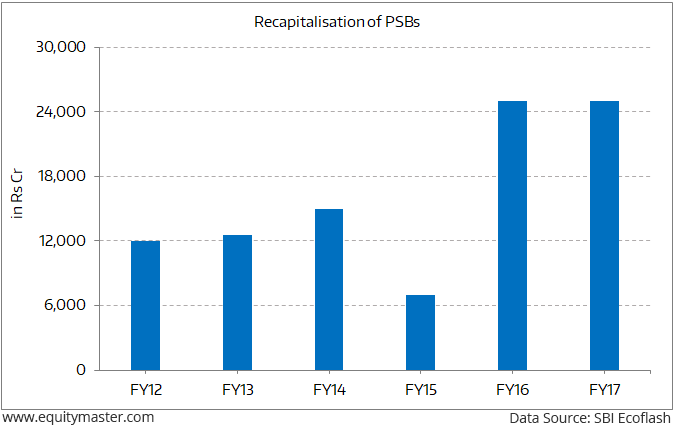
Meanwhile, as per SBI Ecoflash report, subscribing to the recapitalization bonds does not really strain bank finances, because lending to the center is the safest thing.
The report also highlights the advantages of such bonds because these do not alter the fiscal math; the government earns both dividends and market returns on bank shares.
Moreover, the government need not raise immediate tax revenues. And by borrowing directly from the banking system instead of the markets, the centre can avoid crowding out private borrowings or distorting market yields.
However, using recapitalization bonds can only act as a short-term measure to the crisis afflicting Indian public sector banks today. Such a measure will not address the structural issue in the banking system, i.e. the poor standard of lending and poor governance system.
Our big picture editor, Vivek Kaul, talks about moral hazard risk arising out of recapitalization. He writes:
- "If the government bails them around this time around, the banks know that they can count on the government bailing them out the next time around as well. And this means that they can follow fairly loose standards of lending, in order to lend money quickly."
In the news from the pharma sector. As per an article in a leading financial daily, Cipla has entered into partnership with Eli Lilly and Company (India), a 100% subsidiary of Eli Lilly and Company, a global multinational pharmaceutical leader.
Under this agreement, Lilly's Basaglar that is manufactured by Lilly will be marketed and distributed in India by Cipla.
Basaglar is a once-daily insulin glargine therapy for the treatment of patients with type 1 & 2 diabetes above two years of age.
Diabetes continues to be a focus area for Cipla and with the launch of a strong brand like Basaglar, Cipla will be at the forefront of providing a holistic diabetes care with the most comprehensive portfolio across orals and injectables, the company stated.
Further, this strategic partnership leverages Lilly's commitment to bring innovation to people suffering from diabetes in India and Cipla's strong on-ground footprint across the country.
To know more about the company, you can access to Cipla's latest result analysis and Cipla stock analysis on our website.
And to get more updates on share market, click here.



Comments
Log in or sign up to join the conversation.