


The Indian Rupee (INR) extends its previous week’s downfall against the US Dollar (USD) on Tuesday, with the USD/INR rising above 95.90 in the opening session. The Indian currency was expected to continue its underperformance as 10-year United States (US) Treasury Yields have hit record highs of 5% and the prolonged upside in oil prices.
Surging US Treasury Yields have also strengthened the US Dollar. At press time, the US Dollar Index (DXY), which gauges the Greenback’s value against six major currencies, is up 0.15% to near 99.62.
US Treasury Yields have extended their rally to 5.03%, a level never seen in the past 19 years, on the back of firm expectations that the Federal Reserve (Fed) will hike interest rates in the policy announcement on Wednesday.
Hawkish Fed expectations are prompted by hotter-than-projected US Producer Price Index (PPI) and sticky Consumer Price Index (CPI) reports for August. While the Fed is almost certain to raise interest rates, investors will pay more attention to the monetary policy statement and Fed Chair Kevin Warsh’s press conference to get fresh cues regarding the interest rate outlook.
Fed seen hiking in September but stopping after one move
Economists at ING explain that they have "changed their view to a 25bp Federal Reserve rate hike in September in the wake of Chair Kevin Warsh’s address at the Jackson Hole symposium," adding that "the data since then has justified that decision." While they acknowledge that "ordinarily the assumption is that if the Fed hikes, they don’t just go once," and that "financial markets are now pricing two and a half further rate hikes after the all-but-assured 16 September move," the ING team argues that "this time around we think that one and done might be the case," with their projections for jobs and inflation suggesting "no need for a series of hikes."
Oil prices remain higher amid escalating energy supply concerns
In the opening session, the MCX Crude Oil contract expiring on September 21 is up 1.8% to near Rs. 9,900. The oil price is close to its multi-month high of Rs. 10,043 posted on Friday.
Currencies from economies, such as India, which rely heavily on oil imports to meet their energy needs, tend to underperform in a high-oil-price environment.
Analysts at Deutsche Bank highlight that the latest move in the oil price comes “following the precautionary shutdown of a major Saudi pipeline late on Friday following recent attacks, and the postponement of today's planned meeting between Iran and other Gulf states to discuss the creation of a temporary shipping corridor through the Strait of Hormuz.” They note that these developments have reinforced market concerns around regional supply security and key shipping routes.
India’s retail CPI rises at slightly faster-than-expected pace
On Monday, India’s Ministry of Statistics and Programme Implementation reported that the retail CPI grew by 4.82% Year-on-Year (YoY), faster than 4.8% estimates and the previous reading of 4.45%. Still, the CPI data remains inside Reserve Bank of India’s (RBI) tolerance band of 2%-6%.
A faster-than-projected growth in inflationary pressures at the retail level will likely increase expectations of an interest rate hike by the RBI in the near term.
USD/INR Technical Analysis
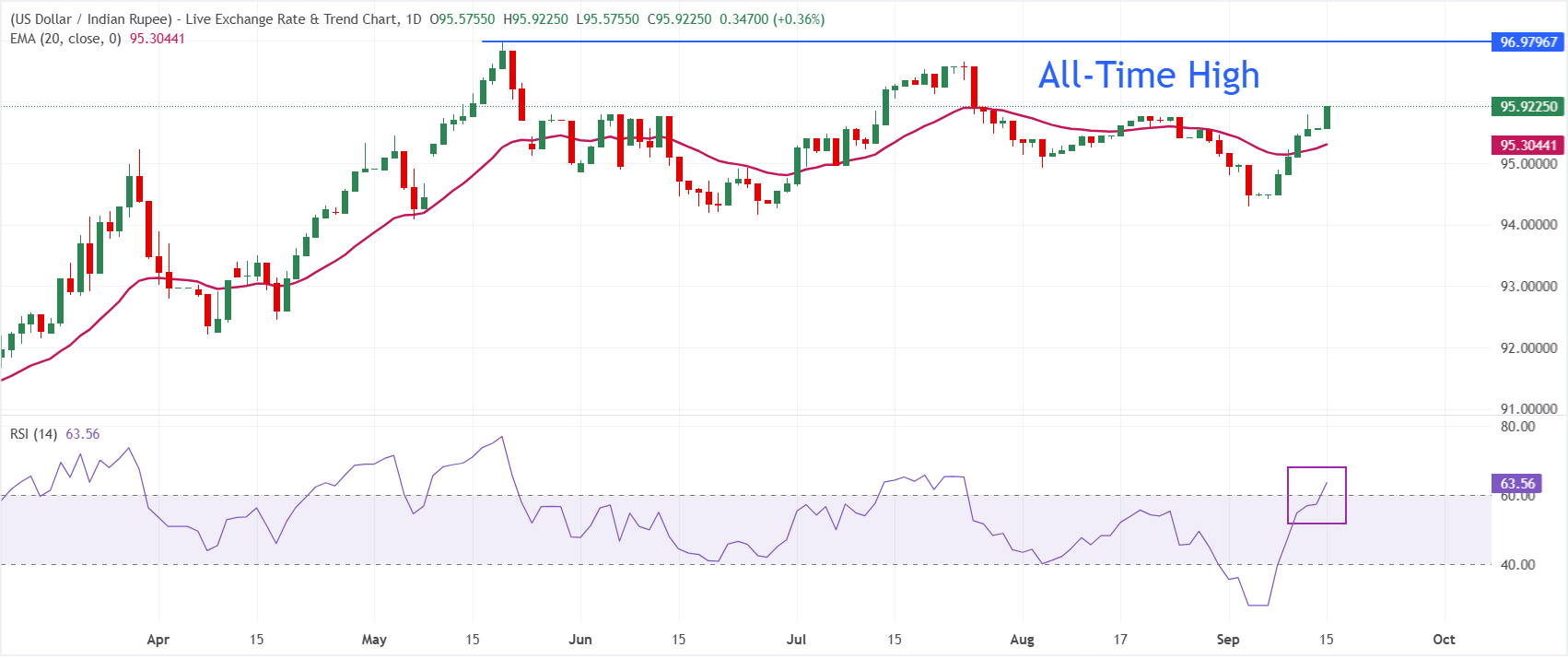
USD/INR trades sharply higher at around 95.92. The pair holds a bullish near-term bias as it trades above the 20-day exponential moving average (EMA) at 95.30, suggesting dips remain supported while buyers maintain control.
The Relative Strength Index (RSI) at 63.56 leans into bullish territory, hinting that upside momentum is firm but not yet overstretched.
On the downside, immediate support is seen at the 20-day EMA near 95.30, reinforcing a deeper demand zone on any corrective pullback, followed by 95.00. Looking up, the pair could aim to revisit the all-time high near 97.10.


Comments
Log in or sign up to join the conversation.