


The Indian Rupee (INR) trades lower against the US Dollar (USD) on Thursday. The USD/INR pair rises to near 95.22 after rebounding from the fresh monthly low of 94.83 posted the previous day.
As of writing, the MCX Crude Oil contract expiring on August 19 trades 1.2% to near Rs. 7,200, but is close to its three-week low of Rs. 7,078 posted on Wednesday.
The Indian currency is expected to resume its upside journey on bearish oil price outlook amid firm expectations that navigation through the Strait of Hormuz, a critical chokepoint for almost one-fifth of global energy supply, will normalize.
Brent holds below $80 as Iran-Oman shipping deal hints at future energy flows
Analysts at Rabobank note that Brent crude prices "held steady just below the $80-level" after Iran announced it had reached an agreement with Oman on a proposed shipping route through the Strait of Hormuz. While they stress that "that’s not the Iran-US deal that Trump had been eyeing," Rabobank argues the accord nonetheless "raises the prospect of more energy flows resuming through the critical waterway," highlighting the potential significance of the arrangement for future regional oil shipments.
Iran and Oman close to finalizing Hormuz framework
Late Wednesday, Iran’s Foreign Ministry spokesperson, Esmaeil Baghaei, said that Iran and Oman are close to finalizing a proposed framework to manage navigation through the Strait of Hormuz. A senior Gulf official said there is a 50% chance that Iran and Oman will reach an agreement on the Strait of Hormuz by Friday.
Iran’s Baghaei has made it clear that the passage reopening depends on Washington fulfilling its commitment to end the naval blockade on Iranian sea ports.
Meanwhile, continuous attacks from Yemen’s Houthis group on Saudi Arabian tankers attempting to pass the Red Sea route are expected to keep energy supply concerns on the horizon.
Houthi military spokesperson Yahya Sarea said in a post on X that Yemen’s forces were able to target the Saudi oil tanker "Daisy" in the Gulf of Aden, adding that the targeting comes within the framework of imposing a maritime navigation ban on the Saudi enemy in accordance with the equation of "siege for siege."
RBI leaves policy rates steady
On Wednesday, the Reserve Bank of India (RBI) left its key Repo Rate unchanged at 5.25%, as expected, for the fourth time in a row. The RBI lowered its inflation forecast for the current year to 5%, but warned that core price pressures could accelerate to 5.9% in the third quarter, citing supply-side pressures from food and fuel.
Meanwhile, investors seek fresh cues regarding how long the RBI’s status quo will continue.
India MPC holds steady for longer as Standard Chartered sees high bar for rate hikes
Economists at Standard Chartered note that India’s Monetary Policy Committee (MPC) “kept the repo rate unchanged at 5.25% in a unanimous decision and maintained its neutral stance, broadly in line with our and consensus expectations.” However, they add that “we were surprised by the relatively dovish tone of the MPC’s statement compared with the April and June policy meetings.”
According to the bank, “while the MPC remains vigilant on future risks, particularly El Niño and crude oil prices, it is inclined to wait for greater clarity on the inflation trajectory and composition before considering rate action.” In their view, “for now, the bar for rate hikes appears high unless inflation materially exceeds expectations,” a conclusion they describe as “consistent with our baseline view of no change in the repo rate in FY27.”
US NFP hogs limelight
This week, the major trigger for global markets will be the US Nonfarm Payrolls (NFP) data for July, which will be released on Friday.
According to TD Securities, July payrolls are expected to show only a mild improvement, with the bank looking for "July NFP picked up modestly to 70k after surprising to the downside with 57k in June." The economists judge that "risks to our payrolls forecast appear balanced," suggesting no strong bias toward either a significant upside or downside surprise. On the unemployment side, TD Securities anticipates that "the UE rate likely went sideways at 4.2% after declining in June," pointing to a broadly steady labor market backdrop.
Technical Analysis: USD/INR strives to return to 20-day EMA
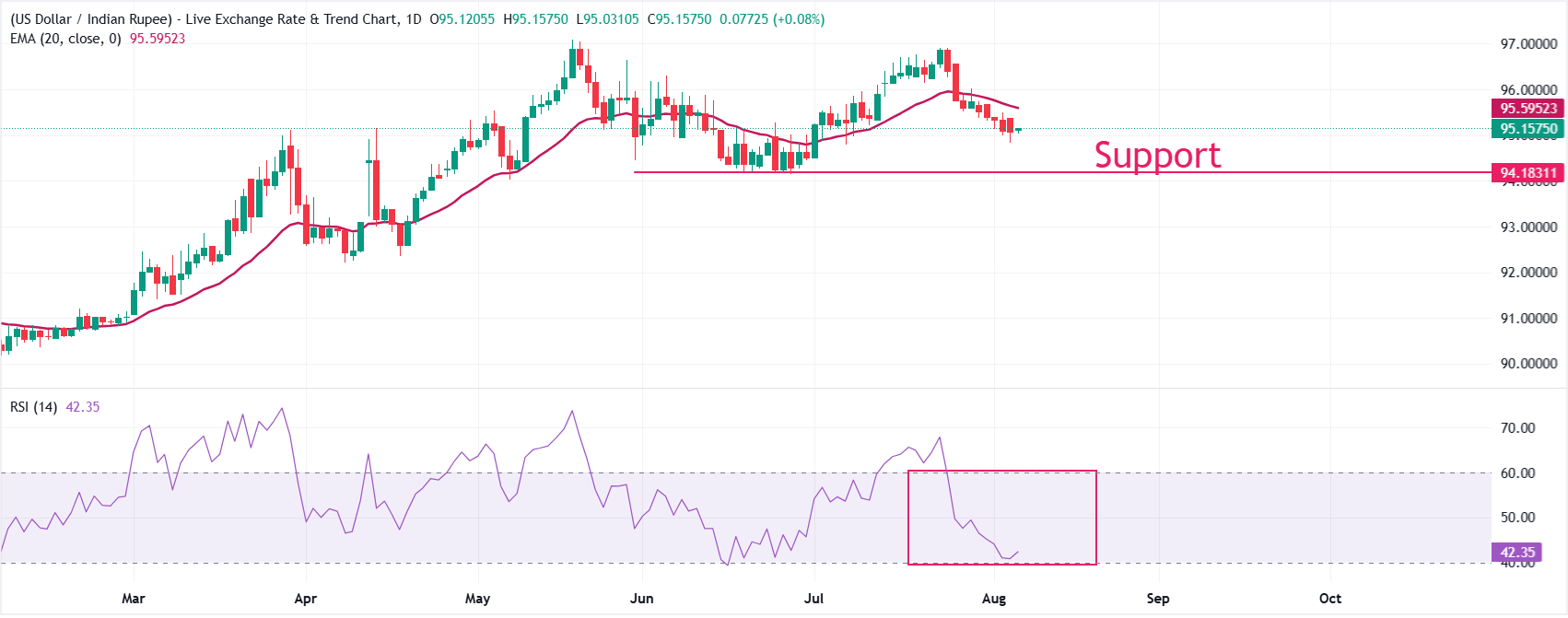
USD/INR trades at around 95.16, keeping a bearish near-term tone as it remains below the 20-day exponential moving average (EMA) at 95.60. The pair has retreated from recent highs, and price holding under this short-term EMA suggests upside attempts are being capped despite the Relative Strength Index (RSI) hovering in a broadly neutral zone around 42, hinting at modest but not extreme selling pressure.
On the topside, immediate resistance is located at the 20-day EMA at 95.60, which is the key barrier that bulls would need to reclaim to ease the current downside bias and open the way for further recovery toward 96.00. Looking down, key support levels are the August 5 low at 94.83 and the June low at 94.15.
Comments
Log in or sign up to join the conversation.