

Stock markets in India are presently trading marginally higher. Sectoral indices are trading on a positive note with stocks in the healthcare sector and telecom sector witnessing maximum buying interest.
The BSE Sensex is trading up 61 points (up 0.2%) and the NSE Nifty is trading up 5 points (up 0.1%). The BSE Mid Cap index is trading up by 0.3%, while the BSE Small Cap index is trading up by 0.5%. The rupee is trading at 64.14 to the US dollar.
In the news from the banking sector, market participants are tracking the Financial Resolution and Deposit Insurance (FRDI) Bill under Parliament's consideration. As per the news, the social media is worried about the bill in that it will put bank deposits at risk and that depositors' money would be used to recapitalize banks.
The one concerning clause in the bill causing concern is the provision for a 'bail in'. In essence, the bill empowers a distressed financial institution to utilise its own public deposits to set its house in order.
Presently, only Rs 0.1 million worth of bank fixed deposits are insured by the Deposit Insurance and Credit Guarantee Corporation (DICGC). What the FDRI Bill proposes is, to utilise deposits above the insurable limit of Rs 0.1 million by converting the funds into shares of the bank. In other words, the FRDI Bill is simply an extension of the DICGC Act and is not draconian as it is made out to be.
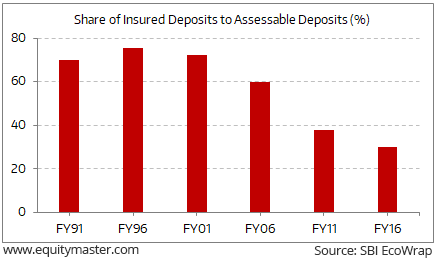
The bill overlooks the truth that the insurance cover for public deposits in India woefully low. The share of insured deposits has fallen drastically from 75% to less than one third in the last two decades, as can be seen in the chart below:
Fixed Deposits Losing their Safety Tag?
In the news from the IPO space, Baring Private Equity Asia-promoted CMS Info Systems - India's largest cash management company - is likely to hit the IPO market in January to raise about Rs 13 billion. As per the news, Baring will dilute about 30% of its stake in the IPO.
CMS is the local market leader in cash management, based on the number of automated teller machines (ATMs) and retail pick-up points. It has a market share of 25.6%, based on the total number of ATMs in India, according to a Frost & Sullivan report cited in the offer document of the company.
Speaking of IPOs, the demand for IPO's has reached sky-high levels this year. Avenue Supermarts was the first company this year to cross the 100-time subscription mark swiftly followed by CDSL and Dixon technologies lately, with MAS Financial Services being the newest entrant to the list.
This euphoria is something similar to what was seen in 2007-08. When everyone around you is clamoring to get a piece of the IPO pie, it makes sitting tight difficult. And, why should you sit tight when stocks like Avenue Supermart lets you pocket a cool 100% gain from day 1 of the listing?
History suggests that these cases are few and far between. More than 70% of the IPOs listed in 2007 and 2008 are in the red, even today when the Sensex is at an all-time high.
A merit-based selection primarily including valuation, business, and management quality is the logical way to go about investing in IPOs. If it means going against the herd, so be it. And going by recent past, this strategy has been proven to be successful more often than not.



Comments
Log in or sign up to join the conversation.