

Share markets in India are presently trading on a negative note tracking weak global cues.
The BSE Sensex is trading down by 386 points while the NSE Nifty is trading down by 110 points.
The BSE Mid Cap index and the BSE Small Cap index are trading down by 1% and 0.8%, respectively.
Sectoral indices are trading on a mixed note with stocks in the finance sector and banking sector witnessing most of the selling pressure, while energy stocks are trading in green.
The rupee is trading at 76.38 against the US$.
Gold prices are trading up by 0.5% at Rs 46,640 per 10 grams.
Speaking of Indian share markets, the coronavirus impact has shaken markets worldwide. Indian stock markets have felt the full impact too.
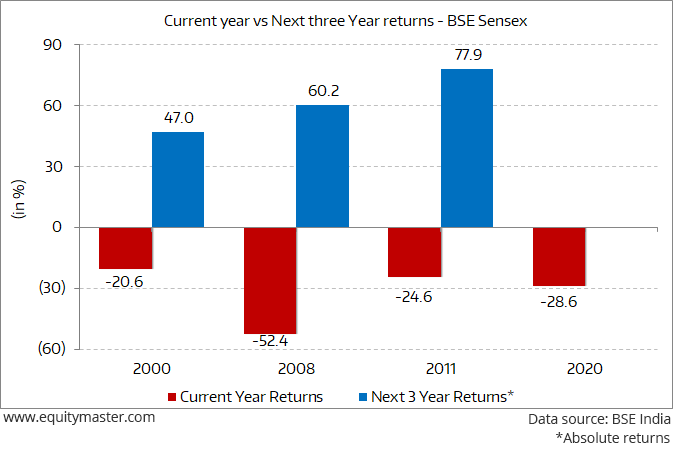
For the BSE Sensex, FY20 was the second worst year post FY08, the year of the global financial crisis.
Good Time to Start Investing Now?
Naturally, there is an atmosphere of fear all round.
Is it time to sell stocks now? Will the correction get worse?
History has shown that after years like the one we had just now, the next 3 years are good for the markets. In fact, these corrections are the rare times when you find businesses with solid fundamentals at reasonable valuations.
If you can find good businesses that can survive the current crisis, you will do well in the long run.
Moving on, market participants are tracking Mindtree share price as the company is scheduled to announce its March quarter results (Q4FY20) later today.
In news from the mutual funds space, Franklin Templeton Mutual Fund on Thursday decided to wind up six of its debt schemes oriented towards high-yield investments with a combined asset base of Rs 258.6 billion citing continued redemption pressure and lack of liquidity in the debt markets amid the coronavirus pandemic.
According to industry sources, Franklin Templeton MF had over Rs 30 billion of borrowing.
The schemes being wound up are Low Duration Fund, Dynamic Accrual Fund, Credit Risk Fund, Short Term Income Fund, Ultra Short Bond Fund, and India Income Opportunities Fund.
Investors will no longer be allowed to make fresh purchases or sales from these funds. The systematic plans, including systematic investment plans, systematic transfer plans and systematic withdrawal plans will also be suspended.
Meanwhile, the markets regulator has eased valuation norms for the mutual fund (MF) industry, allowing valuation agencies to make exceptions if there is a default by a corporate bond issuer because of the lockdown or the loan moratorium permitted by the Reserve Bank of India (RBI).
The regulator's circular said that MFs shall continue to be responsible for fair valuation.
The regulator further said if the delay in payment or extension of maturity is because of the RBI-permitted moratorium causing operational challenges in debt-servicing, valuation agencies may not consider the same as a default for the purpose of valuation.
Note that NBFCs have come under pressure as banks are showing limited willingness to extend the moratorium to them, as well as are showing reservations in extending liquidity to NBFC debt papers through targeted loan term repo operations or TLTRO.
On Thursday, the first tranche of RBI's TLTRO only saw bids worth Rs 128.5 billion as against Rs 250 billion on offer.
In other news, the regulator eased the 12-month cooling-off period that companies have to observe between buybacks and equity fundraising.
A company is restricted from raising further capital for one year from the expiry of the buyback period.
The circular said that "to enable quicker access to capital, it has been decided to temporarily relax the period of restriction provided in regulation 24(i)(f) of the buyback regulations. Accordingly, the words "one year" shall be read as "six months" in the said regulation."
Note that many companies have launched share buybacks amid a sharp fall in their stock prices. Some of these include Motilal Oswal Financial Services, Delta Corp, Dalmia Bharat, and Emami.



Comments
Log in or sign up to join the conversation.