

After logging gap-up opening, Share markets in India turned volatile and erased most of the early morning gains.
The BSE Sensex is trading up by 106 points, while the NSE Nifty is trading up by 51 points.
The BSE Mid Cap index is trading up by 0.5%, while the BSE Small Cap index is trading up by 0.2%.
Sectoral indices are trading mixed with stocks in the metal sector and energy sector witnessing buying interest, while telecom stocks are witnessing selling pressure.
The rupee is currently trading at 72.86 against the US$.
Note that Sensex had logged its second-biggest one-day fall last week on Friday, amid fears that the virus epidemic may turn out to be a bigger threat to the global economy than initially anticipated.
In Friday's podcast, we had shared a special episode from investor hour...
In this emergency episode of the Investor Hour, Rahul Goel talks to Vijay Bhambwani, who he calls India's #1 trader.
Vijay dives deep in this "coronavirus" situation and presents a picture which we believe would be extremely beneficial to any investor or trader.
They talk stocks, commodities, bullion and currency.
For each of these assets, they talk what's around the corner, and how one should position oneself for potential gains.
Whatever you do, don't miss this emergency issue of the Investor Hour!
Listen in here...
Towards the end, Vijay shares a very unique perspective on how to allocate assets. Don't miss that!
In news from the IT sector, Infosys has collaborated with IBM to help enterprises accelerate their digital transformation journey using the IBM public cloud.
The collaboration will help enterprises to transition, modernize and transform their enterprise workloads and applications by tapping into the security, open innovation and enterprise capabilities of the IBM public cloud.
Infosys will also offer its clients access to Red Hat's portfolio of open source offerings on the IBM public cloud.
Meanwhile, the company also said that it has paid Rs 6 lakh as compounding fees in the matter related to severance agreement with former CFO Rajiv Bansal.
Infosys' share price is presently trading up by 0.7%.
Moving on to news from the banking sector, in a meeting between the chiefs of public sector banks (PSB) and the Reserve Bank of India (RBI) officials, RBI pointed out the muted credit growth in the economy and asked them to take steps to increase credit growth.
A public sector bank executive who was part of the meeting said, state-owned banks informed the RBI that after the asset quality review, their staff has been spending considerable time on recoveries and resolutions and there was less emphasis on sales and business development across regions.
Bank credit growth declined to 8.5% in January from 13.5% in the year-ago period led by a sharp slowdown in loans to the services sector, according to RBI data.
Growth in advances to the services sector decelerated to 8.9% from 23.9% in January 2019.
Bank loan growth to non-banking financial companies (NBFCs) slowed to 32.2% in the reporting month from a growth of 48.3% a year-ago.
The discussion was also focused on the resolution of stressed assets under the new June 7 circular brought in by the RBI and the concern over rising stress in Micro-Small and Medium Enterprise.
RBI had recently extended the relaxation in classifying stressed MSME loans by one year.
In its last monetary policy review, the RBI had introduced measures like long-term repo operations (LTRO) and external benchmarking of new floating rate loans by banks to medium enterprises.
The RBI conducted term repos of one-year and three-year tenors from the fortnight beginning February 15. The overall size of these LTROs is Rs 1 trillion. It has already conducted two auctions for Rs 250 billion each.
On the issue of LTRO, the RBI pointed out that public sector banks who rely heavily on term deposits, which generally have a high-interest rate, can move to LTRO. It will reduce their cost of funds and help in ramping up lending.
It also nudged banks sitting with huge liquidity coming from CASA to lend more and not use the LTRO for treasury operations.
We will keep you updated on all the developments from this space. Stay tuned.
Speaking of the banking sector, the low access to credit for micro small and medium enterprises (MSMEs) tells us there is a huge opportunity for lenders.
This is evident from the chart below:
India's Huge Lending Opportunity
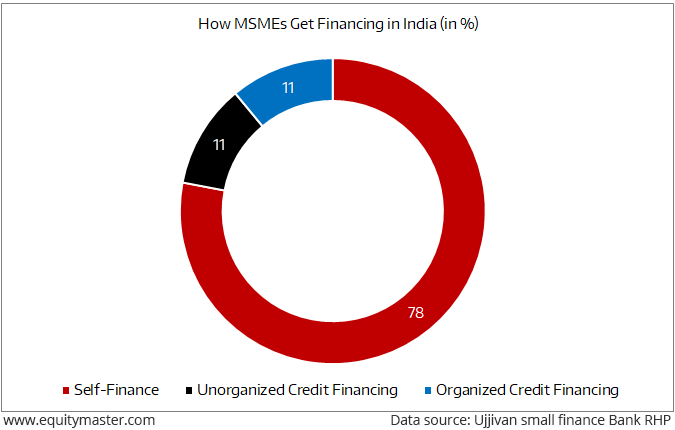
Of the 60 million MSMEs in India, only 11% had access to credit from organized lenders. Most of them are self-financed or get credit from unorganized sources.
Here's what Tanushree Banerjee wrote about this in a recent edition of The 5 Minute WrapUp...
- Self-financing limits the growth of these MSMEs. On the other hand, high-interest rates from unorganized sources makes it difficult for them to earn profits.
The Modi government is looking at various ways to correct this problem. Mudra loans, online loans facilities are being made available to MSMEs.
Slowly but surely, lenders are sensing the huge opportunity that lies ahead for this sector.
Banks and other financial firms with prudent lending practices and strong distribution networks will benefit from this megatrend.
Tanushree is counting on 7 top stocks from the Indian stock market that will benefit from this megatrend.



Comments
Log in or sign up to join the conversation.