

After opening the day higher, Indian share markets witnessed negative trading activity during closing hours and ended their trading session marginally higher.
Sectoral indices ended on a mixed note with stocks in the consumer durables sector, capital goods sector and healthcare sector witnessing buying interest, while automobile stocks and metal stocks witnessed selling pressure.
At the closing bell, the BSE Sensex stood higher by 52 points and the NSE Nifty closed up by 6 points. The BSE Mid Cap index ended up by 0.2% and the BSE Small-Cap index ended the day up by 0.5%.
Asian stock markets finished on a positive note. As of the most recent closing prices, the Hang Seng was up 2.2% and the Shanghai Composite stood higher by 2.1%. The Nikkei 225 was up 0.7%.
The rupee was trading at 71.29 to the US$ at the time of writing.
In news from the retail sector, Titan share price was in focus today. Stock of the company rose 1.5% after the company said it has purchased 9.45 lakh shares from one of the shareholders of Carat Lane Trading at Rs 328 per share.
Titan increased its stake in its subsidiary, Carat Lane Trading, from 69.5% to 72.3%. The acquisition has been completed by 16 August 2019 and has been done by means of cash consideration.
Carat Lane Trading is involved in the business of designing, manufacturing, trading and retailing of gems and jewelry in India, through its e-commerce portal as well as physical stores.
Earlier this month, Titan had reported a 10.8% rise in its consolidated net profit at Rs 3,637.4 million in the first quarter ended June 2019.
The Tata Group company said that its profit growth was subdued due to investment in one biennial overseas conference for its business associates, apart from a one-time wage settlement with some its unionized employees.
The jewelry division logged a moderate growth of 13% to Rs 40,470 million. Growth in the jewelry segment was adversely impacted due to high gold prices, especially during June, the company said.
To know more about the company, you can read Titan's latest result analysis on our website.
Here's an interesting data on Titan, every Rs 100 invested in the company in 2002 would have multiplied 330 times by 2019!
Every Rs 100 Invested in Titan in 2002 Multiplied 330 Times by 2019
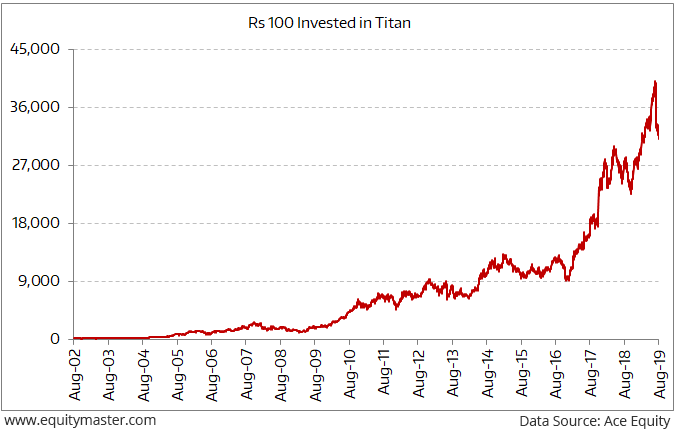
Co-head of Research, Tanushree Banerjee believes the opportunities in the Rebirth of India are not only more profitable than the ones in 2002 but the gains could come faster too.
Here's what she wrote in a recent edition of The 5 Minute WrapUp...
- Titan entered the branded jewelry market in 1996.
The retailer faced the challenge of breaching a well-entrenched network of family jewelers. The relationship between customer and family jewelers went back to a couple of generations.
The habit of buying from the family jeweller was strong and the trust was intrinsic. One also had the option of returning old jewellery to the family jeweler.
Through its jewelry brand, Tanishq, Titan broke down the early entry barriers in unorganized jewelry retailing. It consolidated its lead as very few national or branded players threw their hats in the ring.
She is on the hunt for the next set of Titan, HDFC Bank, Bajaj Finance, Asian Paints-like companies. These will be the companies that would catalyze the transformation she call the Rebirth of India.
Moving on to news from the finance sector, RBI Governor Shaktikanta Das ruled out ordering an asset quality review of non-banking finance companies (NBFCs) that are facing a credit squeeze since the collapse of IL&FS in August last year.
Addressing the press at the sidelines of the annual banking conclave organized by Federation of Indian Chambers of Commerce & Industry (FICCI), Das said "at the moment there is no such proposal to have an asset quality review. Let me also add that 50 odd NBFC's and HFC's are being closely monitored".
Das explained that bringing Housing finance companies (HFCs) under the regulatory ambit of the Reserve Bank is a significant move, given their asset-liability profiles.
Including HFCs, the size of the NBFC sector constitutes about 25% of combined balance sheet of scheduled commercial banks.
Bank credit to NBFCs fell by over Rs 60 billion between March to June highlighting the risk aversion towards the sector. Credit disbursals by NBFCs plunged by a third in the year to March raising worries over solvency issues.
Governor Das also said that it was the right time to formalize linking of fresh loans with external benchmarks like the repo rate.
The country's largest lender State Bank of India (SBI) recently introduced repo-linked lending rate for home loans from July only for new customers who are getting the direct benefit of lower policy rates.
How this all pans out remains to be seen. Meanwhile, we will keep you updated on the latest developments from this space.


Comments
Log in or sign up to join the conversation.