

After witnessing volatile trades during the day, Indian share markets ended their session marginally lower. Losses were largely seen in the realty sector, capital goods sector and IT sector, while metal stocks ended the day higher.
At the closing bell, the BSE Sensex stood lower by 73 points (down 0.2%) and the NSE Nifty closed lower by 38 points (down 0.4%). The BSE Mid Cap index ended the day down by 1.2%, while the BSE Small Cap index ended the day down by 0.8%.
Asian stock markets finished on a negative note as of the most recent closing prices. The Hang Seng was down 1.3% and the Nikkei stood lower by 0.2%.
The rupee was trading at 66.56 to the US$ at the time of writing.
In the news from pharma sector, Biocon share price witnessed selling pressure today on reports of US Food and Drug Administration (USFDA) observations of the company's Bangalore facility.
The company's Bangalore sterile drug product facility has got seven observations from USFDA and six observations from the European regulator.
Speaking of pharma stocks, did you know the BSE Healthcare Index is down 20% over the past three years? During the same period, the BSE Sensex is up 21%.Biocon share price ended the day down by 5.5% on the BSE.
And this was a sector they called 'evergreen'.
Have Investors boarded a plane that's about to crash? Or is it just turbulence on the way to a smooth and safe landing?
In other news, PC Jeweller share price was in focus today. At the closing hours, the stock of the company reversed its early losses and rose from the day's low after the management of the company termed reports of the arrest of MD and CEO Balram Garg by the CBI as factually incorrect.
PC Jeweller share price ended its trading session up by 9.7% on the BSE today.
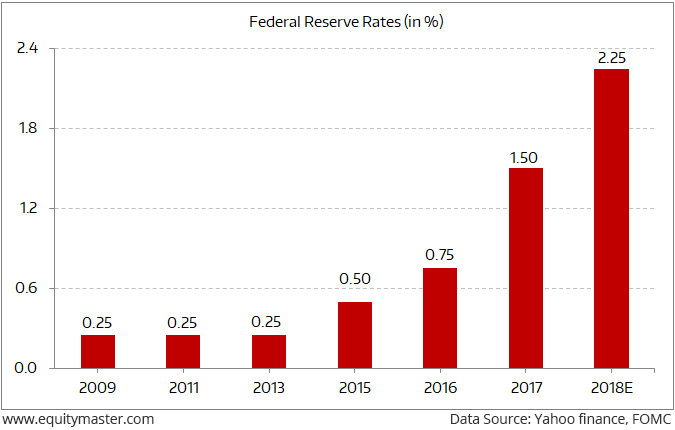
In the news from global financial markets, the US Federal Reserve left interest rates unchanged at 1.50-1.75% in its recently held monetary policy meet. While doing so, they also acknowledged that inflation is close to their target without indicating any intention to veer from their gradual path of interest-rate increases.
The central bank also signaled that the gradual path of rate hikes will stay.
Note that Fed officials have indicated that they expect a total of 3 to 4 hikes in 2018. This view was reaffirmed as the central bank said that economic conditions will warrant further gradual increases in the federal funds rate.
The Fed also mentioned that the labor market remains strengthened and economic activity is rising at a moderate rate. It also highlighted that the job gains have been strong in recent months, and the unemployment rate has stayed low.
Note that with the US economy chugging along for many months, the Fed is now gradually easing off the stimulus it provides to the economy by raising interest rates to more normal levels.
Federal Reserve Rate Hike in the Past 3 Years
How does a US interest rate hike affect Indian investors?
The instant effect is foreign money moving out of India's vaults. This means a slight correction in the share market in India, albeit temporarily.
While this might provide a good buying opportunity in long-term stocks, the main thing to look forward would be capex and earnings trends.
In the end, Indian investors are better off staying informed about the corporate earnings revival than Fed rate hikes.
It is also worthwhile to note that the Indian stock market has done relatively well during the last period of rate hikes by the US Fed.
Take 2003-2006 for example...
Between 2003 and 2006, the US Fed rate moved from 1% to 5.25%.
Despite this, the Sensex rose from 3,500 levels to more than 10,000 during the same period. This increase was supported by strong earnings growth.
So, in the long term, rate hikes (triggered by economic growth) have proved good for the Indian markets. In fact, earnings growth is at the heart of Tanushree's prediction of Sensex 100,000.
And here's a note from Profit Hunter:
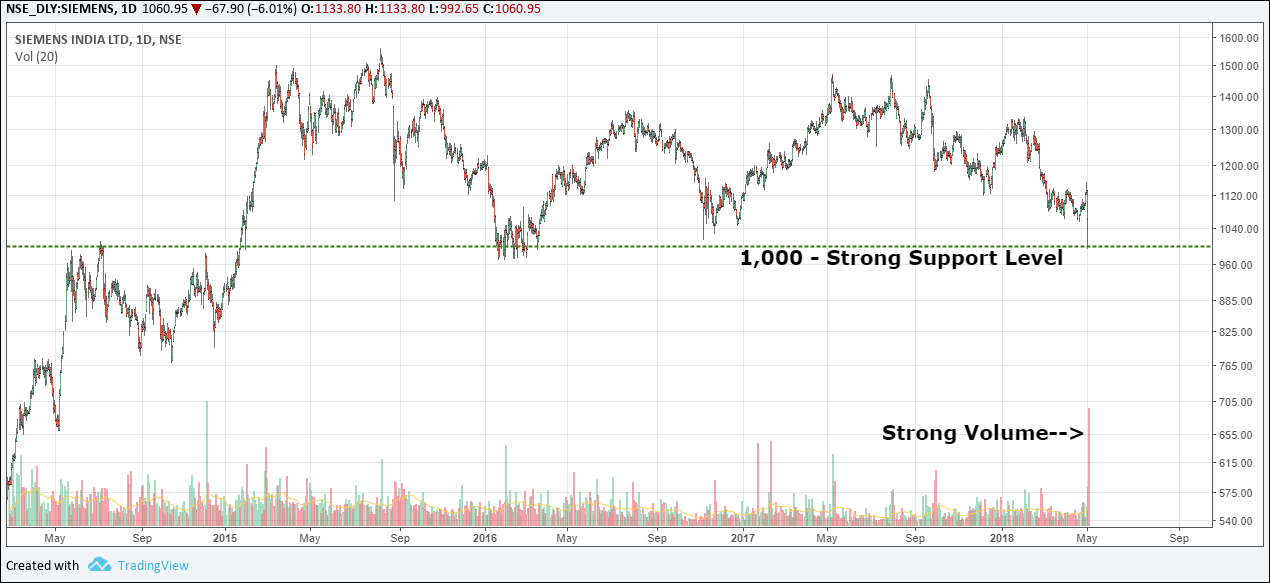
The Indian benchmark indices witnessed some selling pressure during the day. Siemens India is among the worst performing stock in the market today. Let's review its chart.
After the stock topped out at 1,560 in August 2015, it traded in a downtrend. The down move halted near 1,000 level in January 2016. It bounced up to 1,350, but couldn't hold up, slipping back to the 1,000 level in November 2016.
It again rallied to 1,470 in May 2017, but the bears continued to dominate and the stock fell to 1,000 level. As you can see from the chart, the 1,000 level has acted as a good support for stock multiple times.
Today, it slipped nearly 12% to hit an intra-day low of 993 and recovered half of its losses to close the session 6% down. The volumes for the day were quite strong.
So can the stock rally up again, after bouncing from the 1,000 support level, or will it show up different?
Siemens Bounced Up From 1,000 Level
(Click on image to enlarge)
Comments
Log in or sign up to join the conversation.