

After opening the day in the red share markets in India are trading on a negative note and are presently trading well below the dotted line. Sectoral indices are trading on a mixed note, with stocks in the oil & gas sector and stocks in the PSU sector witnessing maximum selling pressure.
The BSE Sensex is trading down by 421 points (down 1.2%) and the NSE Nifty is trading down by 162 points (down 1.5%). Meanwhile, the BSE Mid Cap index is trading down by 1.5%, while the BSE Small Cap index is trading down by 1.1%. The rupee is trading at 73.56 to the US$.
In news from stocks in the aviation sector. Jet Airways share price was in focus today after the cash-strapped carrier received US$ 35 million from Jet Privilege, its customer loyalty programme, for advance ticket sale.
The fresh funding comes as a lifeline to the full-service carrier, which has been in financial turbulence amid losses, caused by high jet fuel prices, rupee depreciation and inability to raise fares due to cut-throat competition. The cash crunch has forced the airline to delay salaries to its employees, while the management had taken a major cut in their remunerations.
Jet Privilege, which has got millions of members, is majority owned (50.1%) by its equity partner Etihad Airways, which also owns 24% in the carrier. The rest of the equity is held by the airline.
Jet Airways said that the customer loyalty programme regularly purchases these tickets to offer its members against redemption of miles hence this transaction is no different and is done under a normal course of business between Jet Airways and Jet Privilege.
At the time of writing, Jet Airways share price was trading down by 6%.
Indian Aviation Spreading its Wings
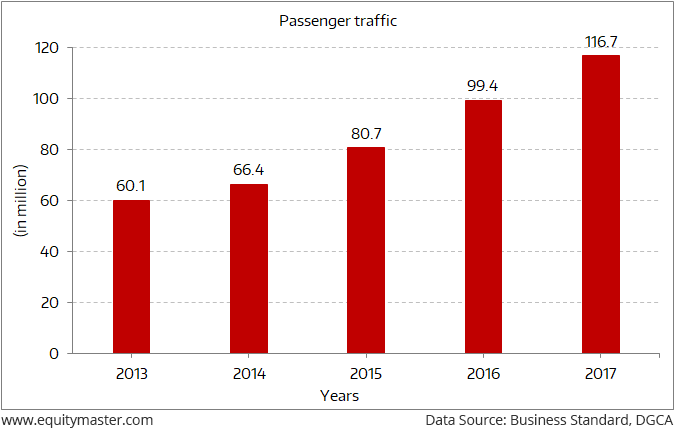
Talking about airlines, one must note that air travel has recorded double-digit growth for 45 consecutive months, thanks to low fares, the addition of new flights/destinations, and overall growth in the economy. What's foreseeable for India's aviation traffic in 2018 is some pressure on the back of the consistent rise in crude oil prices. Last month, Brent crude oil briefly breached US$80 per barrel and touched its highest level since December 2014.
Crude prices have been driven up by production curbs in OPEC nations and Russia, as well as by robust demand on the back of healthy global economic growth. Oil prices are closely monitored by the Indian air carriers, as aviation turbine fuel is their single largest input cost. A sharp rise in the cost of fuel puts pressure on margins, and consequently an increase in airfares.
Although air travel is becoming the new normal, investors need to understand the industry dynamics before buying up aviation stocks.
Moving on to news from stocks in the pharma sector. Cadila Healthcare share price is bucking the negative trend in the markets today as the company received an Establishment Inspection Report (EIR) from the US Food and Drug Administration (USFDA) for its Ahmedabad facility.
Notably, the facility received zero observations from the US drug regulator, signifying the successful closure of the audit.
The plant had completed the USFDA audit from August 14-24 2018 with zero form 483 observations.
At the time of writing, Cadila Healthcare share price was trading up by 0.5%.
Indian pharma companies catering to the US markets are breathing a sigh of relief. After being adversely affected by import bans and the suspension of new drug approvals from manufacturing facilities in the past three years, there has been a sharp pick-up in new drug approvals in FY17.
With an aim to lower the overall healthcare costs in the country, the US Food and Drug Administration (FDA) approved a record 763 generic drugs for the financial year ending 30th September. As per Mint Analysis, Indian pharma companies received 295 approvals accounting for 40% of the overall approvals during the year.
Even the total filings of abbreviated new drug applications (ANDAs) for generic drugs rose to 1,292 in FY17 from 852 in the previous year. While faster approvals expedite the commercialization of product pipelines of domestic pharma companies spurring growth. At the same time, however, it has raised the intensity of competition resulting in pricing pressures. The price erosion has been further compounded by a consolidation among US distributors and the decline in the number of products going off-patent over the past few years.
In other words, acceleration in generic drug approvals is like a double-edged sword. The growth boost can be quickly offset by the ensuing pricing pressures. Pharma companies that invest in creating a pipeline of complex generics or building competencies in alternative dosage forms are better equipped to tackle the changing dynamics in the US generics market.



Comments
Log in or sign up to join the conversation.