

After opening the day higher, stock markets in India have continued their momentum. Sectoral indices are trading on a positive note with stocks in the realty sector and telecom sector witnessing maximum buying interest.
The BSE Sensex is trading up 148 points (up 0.5%) and the NSE Nifty is trading up 37 points (up 0.4%). The BSE Mid Cap index is trading up by 0.7%, while the BSE Small Cap index is trading up by 1%. The rupee is trading at 64.12 to the US$.
As per an article in the Economic Times, BSE will be compulsorily delisting 200 companies with effect from today. It would also bar the promoters of these companies from accessing the securities market for 10 years.
The move comes as trading in these companies have remained suspended for over a decade.
The above companies belong to various sectors ranging from chemicals sector, pharma sector, finance sector, and textiles sectors.
As per the BSE notification, promoters of these delisted companies will be required to purchase the shares from the public shareholders as per the fair value determined by the independent valuer appointed by the exchange.
The above development also comes at a time when the market regulator is clamping down on shell companies for allegedly being used as channels for illicit fund flows.
Earlier this month, the market regulator had directed stock exchanges to initiate action against 331 suspected shell companies. Shell companies are entities generally used for laundering illegal funds.
Also, as per an article in Livemint, the government has already deregistered more than 1.75 lakh firms that have not been carrying out business activities for long.
The above developments are said to boost investor confidence as well as eliminate black money and laundering of illegal funds in capital markets.
In the news from the automobile sector, the Cabinet is likely to consider an ordinance to increase the cess on mid-size and large cars and sports utility vehicles to 25% from 15% earlier under the Goods and Services Tax (GST) regime.
The GST Council had earlier this month approved a proposal to change the GST compensation law to raise the ceiling of the cess that can be levied on motor vehicles.
The development will mean imposing a cess of less than 25% and should partially alleviate the fears of car makers about an increase in the cess forcing them to raise prices after having just dropped them following the rollout of the Goods and Services Tax (GST) on July 1.
Automobile manufacturers may face some hiccups on the back of above development. Also, executives from auto industry say they may re-evaluate their business plans owing to the above development. Meanwhile, we'll keep you posted on the recent developments from this space.
Speaking of automobile sector, there's a change of preference seen for first-time car buyers in India. As per the data, the new generation of first-time buyers is moving up the ladder to premium cars. This is evident from the chart below:
Changing Preference of First Time Car Buyers
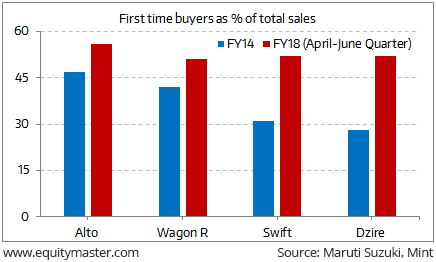
As can be seen, first-time car buyers are now buying costlier models such as the Swift or the Dzire. First-time car buyers accounted for 31% of Swift sales in FY14. That number jumped to 52% in the June quarter of FY18.
The above trend is similar to what has happened in other consumer segments such as mobile phones and consumer electronics. It indicates a shift towards premiumization in India's car market.
- The growing preference for these feature-rich and costlier models as first cars indicates growing premiumisation in India's car market. This trend indicates that first-time buyers are getting more aspirational. Interestingly, the age profile of first-time car buyers and higher disposable income are contributing to this phenomenon.
If this trend continues, going forward, one would see compact SUVs becoming the preferred choice for first-time buyers. The trend is already under way. The percentage of such buyers for Brezza, for instance, stood at 37% in the first quarter of FY18.
With the above shift, premiumization will be an important growth driver for the auto industry in coming years.



Comments
Log in or sign up to join the conversation.