

After opening the day in the red, Indian share markets witnessed further losses and are presently trading on a negative note. Sectoral indices are trading on a mixed note with stocks from the telecom sector and the healthcare sector witnessing maximum selling pressure. Consumer durables sector> is witnessing buying interest.
The BSE Sensex is trading down 146 points (down 0.5%) and the NSE Nifty is trading down 47 points (down 0.5%). Meanwhile, the BSE Mid Cap index is trading down by 1%, while the BSE Small Cap index is trading down 0.8%. The rupee is trading at 63.84 to the US$.
As per an article in the Economic Times, the government is unlikely to allow the total tax incidence on midsized cars, large cars and SUVs to exceed 50%.
The development will mean imposing a cess of less than 25% and should partially alleviate the fears of car makers about an increase in the cess forcing them to raise prices after having just dropped them following the rollout of the Goods and Services Tax (GST) on July 1.
As per the news, the finance ministry is likely to move a cabinet note over the next two days for amending the GST compensation act to raise the cess on such vehicles to 25% from 15%.
Automobile manufacturers may face some hiccups on back of the above development. Also, executives from auto industry say they may re-evaluate their business plans owing to the above development. Meanwhile, we'll keep you posted on the recent developments from this space.
Speaking of automobile sector, there's a change of preference seen for first time car buyers in India. As per the data, the new generation of first-time buyers is moving up the ladder to premium cars. This is evident from the chart below:
Changing Preference of First Time Car Buyers
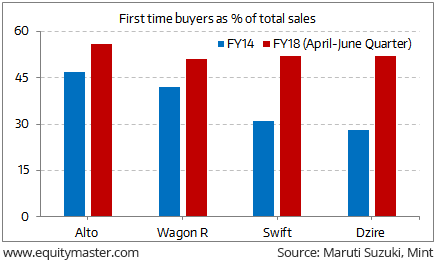
As can be seen, first-time car buyers are now buying costlier models such as the Swift or the Dzire. First-time car buyers accounted for 31% of Swift sales in FY14. That number jumped to 52% in the June quarter of FY18.
The above trend is similar to what has happened in other consumer segments such as mobile phones and consumer electronics. It indicates a shift towards premiumization in India's car market. As we wrote in a recent edition of The 5 Minute WrapUp...
- The growing preference for these feature-rich and costlier models as first cars indicates growing premiumization in India's car market. This trend indicates that first-time buyers are getting more aspirational. Interestingly, the age profile of first-time car buyers and higher disposable income are contributing to this phenomenon.
If this trend continues, going forward, one would see compact SUVs becoming the preferred choice for first-time buyers. The trend is already under way. The percentage of such buyers for Brezza for instance stood at 37% in the first quarter of FY18.
With the above shift, premiumization will be an important growth driver for the auto industry in coming years.
In the news from banking sector, the government of India is evaluating the possibility of consolidation across state-run banks. The main goal is to have fewer but stronger state-run banks. With fewer banks, the government expects sharper focus on the resolution of non-performing assets (NPA).
However, one shall note that consolidating two entities comes with its own set of problems. Integrating two different managements and cultures can be tedious. When merging a 'good' bank with a 'bad' bank, it's important that the consolidated NPA position doesn't deteriorate further. The government needs to decide if it will tackle the NPA issue before consolidation or use consolidation as a means of solving the NPA issue.


Comments
Log in or sign up to join the conversation.