

Indian share markets are presently trading on a negative note. Sectoral indices are trading on a mixed note with stocks from the capital goods sector and the banking sector witnessing maximum selling pressure. Realty stocks are trading in the green.
The BSE Sensex is trading down 125 points (down 0.4%) and the NSE Nifty is trading down 38 points (down 0.4%). Meanwhile, the BSE Mid Cap index is trading down by 0.2%, while the BSE Small Cap index is trading flat. The rupee is trading at 64.33 to the US$.
With two weeks to go for the goods and services tax (GST) roll-out, the GST Council has reduced the rates for 66 items and expanded the scope of the composition scheme for the benefit of small traders, manufacturers, and restaurateurs.
The composition scheme is a presumptive taxation scheme allowing small traders, manufacturers and restaurants to pay a 1-5% GST rate on sales without tax credits.
In our view, GST promises to transform India into a single common market and many sectors are subject to benefit immensely from the transition.
In other news, the Maharashtra government has announced a loan waiver for farmers. The state government has decided to form a committee to decide the criteria of debt relief.
Soon after the announcement, the farmer groups called off their protests which they have been agitating for the past ten days. The key demands made by agitating cultivators in Maharashtra included a minimum support price for all farm produce, 100% subsidy on drip irrigation equipment, better facilities for storage and transport of crops, etc. However, the key demand made by them was the loan waiver.
The above development is followed by Uttar Pradesh government's recent farm loan waiver of Rs 307 billion.
One shall note that the Uttar Pradesh government's farm loan waiver has also set a precedent of sorts with farmers from Tamil Nadu, Karnataka, Madhya Pradesh, and Rajasthan protesting for farm loan waivers from the government.
Our big-picture expert Vivek Kaul explains it in his Diary:
- The economist Alan Blinder in his book After the Music Stopped writes that the 'central idea behind moral hazard is that people who are well insured against some risk are less likely to take pains (and incur costs) to avoid it'.
This basically means that once the farmer sees a loan being waived off today, he will wait for elections in the future for the newer loans he takes on to be waived off as well. Essentially, he will see little incentive in repaying loans that he takes on in the future.
And the above situation is evident today. The recent farm loan waiver spoils credit discipline and sets the wrong precedent.
But there's more to it than just that.
As Vivek Kaul points out, if there is a moral hazard for the farmer, there is also one for corporates. And if the RBI governor wants to point out one, he should point out the other as well. Here's more from Vivek's piece, Dear Mr Urjit Patel, Have You Ever Heard of Wasim Barelvi?
- Corporate loan write-offs have led to the situation of diminishing bank capital. This has led to the central government having to recapitalise the PSBs over the years. This money is ultimately borrowed by the government and leads to crowding out, higher interest rates and a weaker national balance sheet. All these issues pointed out by Patel in case of farm loan waive-offs apply to corporate write-offs as well.
The point is that the practice of loan waivers could lead to more serious problems, exacerbate the ongoing moral hazards, and hurt economic growth in the long run.
Moving on to the news from the banking sector... As per the news, Finance Minister Arun Jaitley is going to meet heads of public sector banks to discuss the issue of non-performing assets (NPAs) and the steps being taken by them to expedite the recovery of bad loans that have crossed Rs 6 trillion.
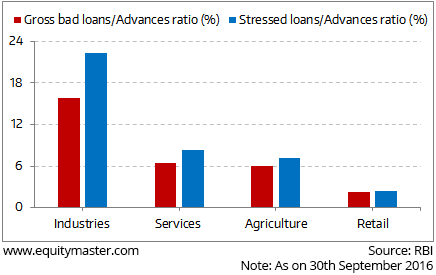
Please note that bad loans at state-run banks have grown more than Rs 1 lakh crore since April 2016 to Rs 6 lakh crore as of December 31, 2016. And Indian industries form a huge share of these bad accounts, as can be seen from the chart below:
India Inc in the Centre of the Bad Loan Storm
To tackle the above problem, the Reserve Bank of India is pondering over initiating tough measures against willful defaulters.
The RBI has done well to focus its attention on the willful defaulters. However, this seems to be a curative measure than a preventive one. For the bad loans problem to be solved, the root cause i.e. the initial lending process of banks needs to be put in order.



Comments
Log in or sign up to join the conversation.