

According to TechSci Research report, “India Warehouse Robotics Market Share– By Region, Competition, Forecast and Opportunities, 2021-2031F”, India Warehouse Robotics Market was valued at USD 413.42 Million in 2025 and is expected to reach USD 888.06 Million by 2031 with a CAGR of 13.59% during the forecast period.
The rapid evolution of e-commerce, organized retail, manufacturing, pharmaceuticals, food and beverages, and third-party logistics is creating strong demand for automated warehouse solutions. Businesses are under growing pressure to process larger order volumes, shorten fulfillment cycles, optimize warehouse space, and provide reliable delivery services. Warehouse robotics is emerging as an effective solution to these challenges.
Modern robotic systems are no longer limited to repetitive material-handling activities. Integration with artificial intelligence (AI), machine learning, sensors, robotics software, cloud platforms, and the Internet of Things (IoT) is enabling warehouses to become increasingly intelligent and interconnected. Robots can now navigate facilities autonomously, identify products, move inventory, support picking and sorting, and communicate with warehouse management systems.
India's expanding logistics infrastructure and increasing investment in smart warehouses are expected to further accelerate this transition. As businesses seek scalable automation solutions, warehouse robotics is becoming an increasingly important component of India's evolving supply chain ecosystem.
Request For Sample Copy of Report For More Detailed Market insight
Industry Key Highlights
The India Warehouse Robotics Market was valued at USD 413.42 Million in 2025.
The market is projected to reach USD 888.06 Million by 2031.
The market is expected to register a CAGR of 13.59% during the forecast period.
Increasing e-commerce activity and organized retail are creating strong demand for automated fulfillment.
AI, IoT, machine learning, advanced sensors, and autonomous navigation are improving robotic capabilities.
Food & Beverages is emerging as the fastest-growing vertical.
North India is the fastest-growing regional market, supported by industrialization and logistics infrastructure.
Automated storage, mobile robots, robotic arms, and intelligent warehouse software are gaining adoption.
Government initiatives supporting digital transformation, manufacturing, smart infrastructure, and Industry 4.0 are encouraging automation investments.
Growing pressure to improve warehouse productivity while reducing labor dependency is creating additional opportunities.
Main Drivers
Rapid Expansion of E-Commerce
The growth of India's e-commerce industry is one of the strongest forces behind warehouse robotics adoption. Online retailers and fulfillment providers must process thousands of orders within increasingly shorter timeframes.
Traditional warehouse processes can struggle to handle fluctuations in demand, especially during festive seasons and promotional events. Robotics allows businesses to automate picking, sorting, transportation, and inventory movement, enabling warehouses to respond more effectively to changing order volumes.
As consumers increasingly expect faster deliveries and accurate order fulfillment, businesses are investing in automated warehouse infrastructure to maintain competitiveness.
Rising Demand for Operational Efficiency
Warehouse operators are focusing heavily on improving productivity while minimizing operational expenses. Robots can perform repetitive tasks continuously and with consistent accuracy, reducing bottlenecks in warehouse operations.
Automated systems can also improve warehouse space utilization by coordinating inventory movement and supporting high-density storage configurations. These capabilities are particularly valuable as companies seek to increase throughput without continuously expanding their physical facilities.
Advances in AI and IoT
Technological innovation is making warehouse robots more intelligent and adaptable. AI-powered systems can analyze operational data, identify patterns, optimize routes, and support real-time decision-making.
IoT connectivity allows robots, sensors, warehouse management systems, and other equipment to exchange information continuously. This interconnected environment enables organizations to monitor operations more effectively and identify potential inefficiencies.
Predictive maintenance is another important benefit. By analyzing equipment performance data, companies can identify potential failures before they cause significant downtime.
Rising Labor Costs and Workforce Challenges
Warehouses frequently involve repetitive and physically demanding activities. Increasing labor costs and workforce availability challenges are encouraging businesses to automate selected processes.
Robotics does not necessarily eliminate the need for human workers; instead, it can shift employees toward higher-value activities such as supervision, quality control, exception handling, and system management.
Government Support for Industry 4.0
Government initiatives supporting manufacturing modernization, digital transformation, electronics, logistics infrastructure, and smart industrial development are helping create a favorable environment for warehouse automation.
Programs associated with Make in India, Digital India, and the National Policy on Electronics are contributing to broader technology adoption. Development of industrial corridors and smart logistics infrastructure is also encouraging companies to consider automated warehouse systems.
Emerging Trends
Rise of Autonomous Mobile Robots
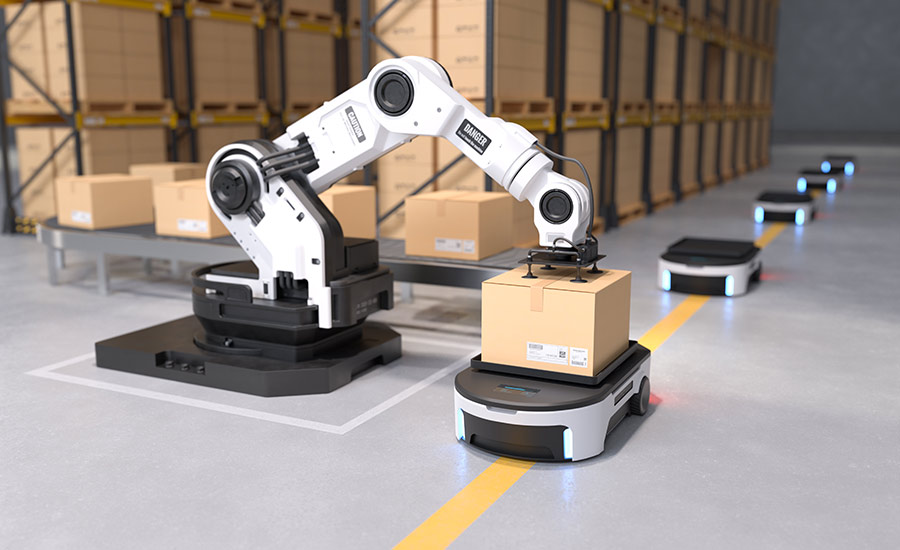
Autonomous mobile robots (AMRs) are becoming increasingly relevant in Indian warehouses. These robots can navigate warehouse environments without requiring fixed tracks and can dynamically adjust routes based on operational requirements.
Their flexibility makes them suitable for warehouses where layouts and inventory requirements change frequently.
Greater Adoption of Robotic Picking
Robotic arms equipped with advanced vision and sensing technologies are increasingly being used for picking and sorting applications. Improvements in computer vision and machine learning allow robots to identify objects with greater accuracy.
As the technology improves, robotic picking is expected to expand beyond standardized products toward more diverse product categories.
Smart Warehouse Software Integration
Robotics is increasingly being integrated with Warehouse Management Systems (WMS), Warehouse Control Systems (WCS), and Warehouse Execution Systems (WES).
This integration allows warehouse operators to coordinate robotic equipment, inventory, orders, and workforce activities through a unified technology ecosystem.
Human-Robot Collaboration
Collaborative warehouse environments are becoming more common. Instead of completely replacing workers, robots can work alongside human employees by transporting goods, bringing inventory to workstations, or handling repetitive movements.
This model can improve productivity while allowing employees to focus on tasks requiring judgment and problem-solving.
Growth of Data-Driven Warehousing
The combination of robotics, sensors, AI, and analytics is generating large volumes of operational data. Companies can use this information to evaluate warehouse performance, identify bottlenecks, optimize routes, and improve inventory planning.
Data-driven automation is therefore becoming an important part of modern warehouse strategy.
Real-World Use Cases
E-Commerce Fulfillment
E-commerce fulfillment centers use robotics for inventory movement, picking, sorting, packing support, and order consolidation. Automated systems help process large order volumes while maintaining accuracy and reducing fulfillment times.
Food & Beverage Warehousing
Food and beverage companies are increasingly adopting warehouse robotics to manage packaged foods, beverages, and temperature-sensitive products. Automation can improve inventory control, reduce handling time, and support hygienic operations.
Real-time monitoring and sensor integration can also strengthen cold-chain management by helping businesses monitor storage conditions and respond to deviations.
Automotive Warehouses
Automotive manufacturers and component suppliers manage thousands of parts and components. Robotics can assist with material transportation, component sorting, inventory handling, and production-line replenishment.
Automating these processes can reduce delays and improve coordination between warehouses and manufacturing facilities.
Pharmaceutical Logistics
Pharmaceutical warehouses require high levels of accuracy, traceability, and controlled handling. Robotics can support inventory movement, order preparation, and sorting while helping reduce manual handling.
Automation can also contribute to better tracking of sensitive products and improve operational consistency.
Electronics and Electricals
Electronics warehouses often manage large inventories of small and high-value products. Robotic systems can help improve product identification, sorting, storage, and retrieval while reducing the possibility of manual handling errors.
Third-Party Logistics
Third-party logistics providers are increasingly investing in robotics to serve multiple customers with different inventory and fulfillment requirements. Flexible robotic solutions allow logistics companies to scale warehouse capacity according to demand.
Competitive Analysis
Locus Robotics Corporation
ABB Ltd.
Fanuc Corporation
Yaskawa Electric Corporation
Clearpath Robotics, Inc.
Fetch Robotics, Inc.
Honeywell International Inc.
Mujin Inc.
Customers can also request 10% free customization on this report.
Market Segmentation
The India Warehouse Robotics Market is segmented based on software, type, vertical, and region.
By Software
The market includes:
Warehouse Management System
Warehouse Control System
Warehouse Execution Systems
These software platforms play a critical role in coordinating inventory, robotic equipment, orders, warehouse processes, and operational workflows.
By Type
Warehouse robotics can be categorized into:
Mobile Robots
Articulated Robots
Cylindrical Robots
SCARA Robots
Parallel Robots
Cartesian Robots
Each robot type is designed for different operational requirements, including picking, sorting, transportation, assembly, and material handling.
By Vertical
The market covers:
E-Commerce
Automotive
Electricals & Electronics
Chemical
Rubber & Plastics
Food & Beverages
Pharmaceutical
Others
Future Outlook
The India Warehouse Robotics Market is positioned for substantial growth as businesses increasingly prioritize automation, speed, accuracy, and supply chain resilience. The market's expected expansion from USD 413.42 Million in 2025 to USD 888.06 Million by 2031, at a 13.59% CAGR, highlights the growing importance of robotics within India's logistics ecosystem.
Future growth will likely be shaped by the convergence of AI, robotics, IoT, machine vision, cloud computing, and warehouse analytics. More flexible autonomous robots, intelligent picking systems, and software-driven warehouse operations are expected to become increasingly accessible to businesses of different sizes.
The continued development of e-commerce, food delivery, pharmaceuticals, automotive manufacturing, and organized retail will create additional demand for automated fulfillment. At the same time, government initiatives supporting digitalization, smart infrastructure, and Industry 4.0 are expected to strengthen the foundation for technology adoption.
As Indian supply chains become more sophisticated, warehouse robotics will increasingly shift from being an optional productivity tool to a strategic component of modern logistics. Businesses capable of integrating robotics with intelligent software and data-driven decision-making are likely to be better positioned to achieve faster fulfillment, improved accuracy, optimized warehouse utilization, and greater long-term operational efficiency.
Contact US:
Techsci Research LLC
420 Lexington Avenue, Suite 300,
New York, United States- 10170
Tel: +13322586602
Email: [email protected]
Comments
Log in or sign up to join the conversation.