

How Is India's Cotton Seed Market Performing?
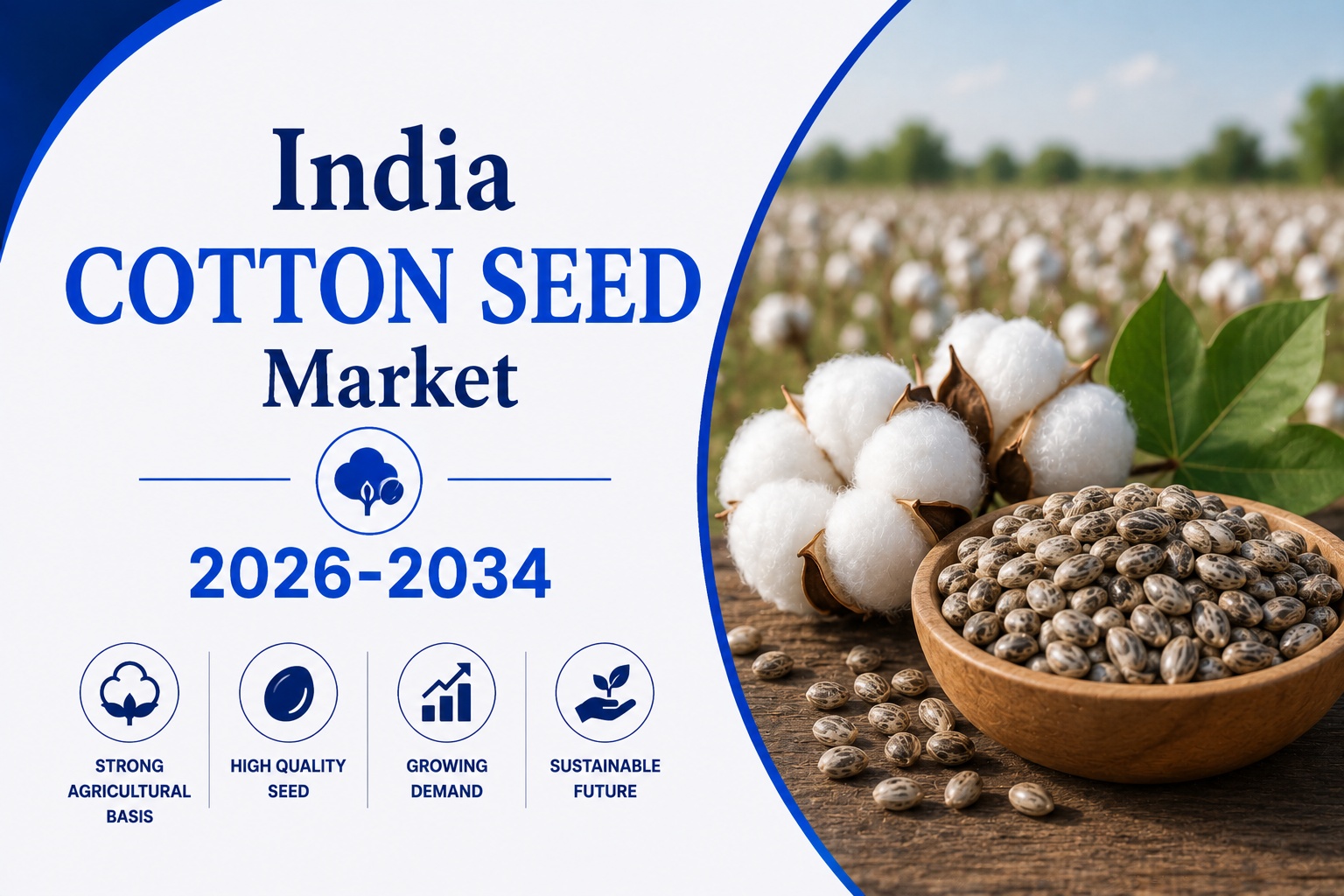
The India cotton seed market size was valued at USD 823.8 Million in 2025 and is projected to reach USD 1,347.6 Million by 2034, growing at a compound annual growth rate of 5.34% from 2026 to 2034. The market is driven by the widespread adoption of hybrid and transgenic seed varieties among farmers seeking higher yields and improved pest resistance.
Market-At-A-Glance
Leading Type: Upland Cotton — 72.4% share (2025)
Leading Application: Cotton Planting — 65.7% share (2025)
Leading Region: West India — 41.2% share (2025)
Key Drivers: Hybrid and Bt seed adoption, government policy support, textile industry demand, technological advancements in seed development
India Cotton Seed Market Dynamics
Driver: Government Support and Policy Initiatives:
The government's sustained commitment to agricultural development significantly propels the India cotton seed market through comprehensive policy frameworks and strategic initiatives. Minimum support price mechanisms provide price floor protection for cotton farmers, encouraging continued cultivation and investment in quality seeds. Schemes promoting certified seed usage, soil health management, and micro-irrigation adoption are improving on-farm productivity and reducing cultivation risks. Public sector research institutions and state agricultural universities play a key role in developing high-yielding, pest-resistant hybrids suited to diverse agro-climatic zones.
The government's announcement of the five-year Mission for Cotton Productivity in the 2025-26 Union Budget provides direct strategic support for enhancing productivity and promoting extra-long staple cotton varieties. Extension programmes, subsidy-backed input distribution, and digital advisory platforms further strengthen farmer confidence, accelerating the adoption of improved cotton seed varieties across major producing regions.
Opportunity: Development of Climate-Resilient and Indigenous Varieties:
With increasing concerns about pest resistance and the need for climate-smart agriculture, there is a growing opportunity for drought-tolerant, short-duration, and rainfed-adapted cotton seed varieties. Public sector institutions including ICAR-CICR are developing varieties suited to rainfed areas, which account for a significant proportion of India's cotton cultivation.
Private seed companies are simultaneously investing in stacked traits — combining insect resistance, herbicide tolerance, and moisture stress adaptation — to develop next-generation hybrids that address evolving farmer challenges. The government's emphasis on extra-long staple cotton varieties is also opening opportunities for value-added textile production commanding premium pricing in international markets.
Restraint: Regulatory Uncertainties and Delayed Approvals:
The complex regulatory framework governing genetically modified cotton seeds creates significant market uncertainties. Lengthy approval processes for new seed technologies through the Genetic Engineering Appraisal Committee (GEAC) extend commercialisation timelines, limiting the introduction of innovative varieties needed to address emerging pest resistance and environmental challenges.
Inconsistent policy implementation across states and ongoing debates regarding biotechnology approvals discourage research investments and restrict availability of advanced trait platforms. The emergence of pink bollworm resistance to existing Bt gene technologies also diminishes the value proposition of current transgenic hybrids, necessitating additional insecticide applications and eroding the economic benefits that initially drove widespread Bt cotton adoption.
Evaluate Market Opportunity with the Business Sample Report
How Is India's Cotton Seed Market Segmented?
By Type:
Upland Cotton — 72.4% share (2025) (dominant due to superior fibre quality, higher productivity, and widespread Bt hybrid adoption)
Tree Cotton
Extra-Long Staple Cotton
Levant Cotton
By Application:
Cotton Planting — 65.7% share (primary driver; six million cotton farmers across India; seasonal certified seed replacement cycle)
Cottonseed Oil Production
By Region:
West India — 41.2% (Maharashtra and Gujarat; favorable black soil conditions; established irrigation infrastructure)
South India
North India
East India
Government Initiatives Supporting the Market
Mission for Cotton Productivity: Five-year mission announced in Union Budget 2025-26 targeting enhanced productivity and promotion of extra-long staple cotton varieties across major growing states
Minimum Support Price (MSP): Cotton Corporation of India procurement at MSP provides price floor protection for farmers, encouraging continued cultivation and investment in premium certified seeds
ICAR-CICR Varietal Development: Public sector releases of drought-tolerant, pest-resistant, and high-fibre quality cotton seed varieties suited to diverse agro-climatic zones
Micro-Irrigation Subsidies: State-level programmes expanding drip and sprinkler irrigation coverage in cotton-growing regions, reducing climate vulnerability and improving returns on seed investments
Digital Extension Services: Government-supported mobile advisory platforms and farmer education programmes accelerating the transition from farm-saved seeds to certified hybrid varieties
Recent Developments
July 2025: The Indian government indicated intent to approve the contentious Herbicide-Tolerant (HtBt) Bt cotton, as part of a significant agricultural overhaul aimed at increasing national cotton output. The specialist committee on HtBt cotton seeds provided a favourable recommendation for its commercial farming to the primary biosafety regulatory authority, the Genetic Engineering Appraisal Committee (GEAC), after evaluating three years of biosafety data — marking a potentially transformative development for the India cotton seed market.
Request Customized Data Tailored to Your Interest
Competitive Landscape
The report offers an in-depth examination of the competitive landscape, including market structure, key player positioning, leading strategies for success, a competitive dashboard, and a company evaluation quadrant.
Conclusion
India's cotton seed market demonstrates promising and sustained growth prospects through 2034, underpinned by expanding cotton cultivation areas, the government's Mission for Cotton Productivity, continuous technological advancements in seed development, and the textile industry's robust demand for quality cotton fibre.
The potential approval of herbicide-tolerant Bt cotton, the growing adoption of digital agricultural platforms, and the development of climate-resilient varieties for rainfed areas represent the most significant near-term growth catalysts.
Companies that invest in trait innovation, region-specific hybrid development, digital farmer engagement, and distribution network expansion across Tier 2 cotton-growing markets will be best positioned to capture the USD 523.8 Million incremental market opportunity generated through 2034.
Source: IMARC Group
Comments
Log in or sign up to join the conversation.