

Industry Key Highlights
The India Collaborative Robot Market was valued at USD 148.82 Million in 2025.
The market is expected to reach USD 689.08 Million by 2031.
The market is projected to expand at a CAGR of 29.10% from 2025 to 2031.
Government initiatives such as Make in India and Production Linked Incentive (PLI) schemes are encouraging automation investments.
Metals & Machining emerged as the fastest-growing industry segment in 2025.
North India is emerging as the fastest-growing regional market.
Small and medium-sized enterprises are increasingly adopting cobots because of their flexibility and relatively accessible automation requirements.
Collaborative robots are increasingly being integrated with CNC machines, laser cutters, and other automated production equipment.
Automotive, electronics, metals and machining, plastics and polymers, and other industrial sectors are expected to contribute to market expansion.
Increasing demand for Industry 4.0 and smart manufacturing is creating long-term opportunities for cobot manufacturers and system integrators.
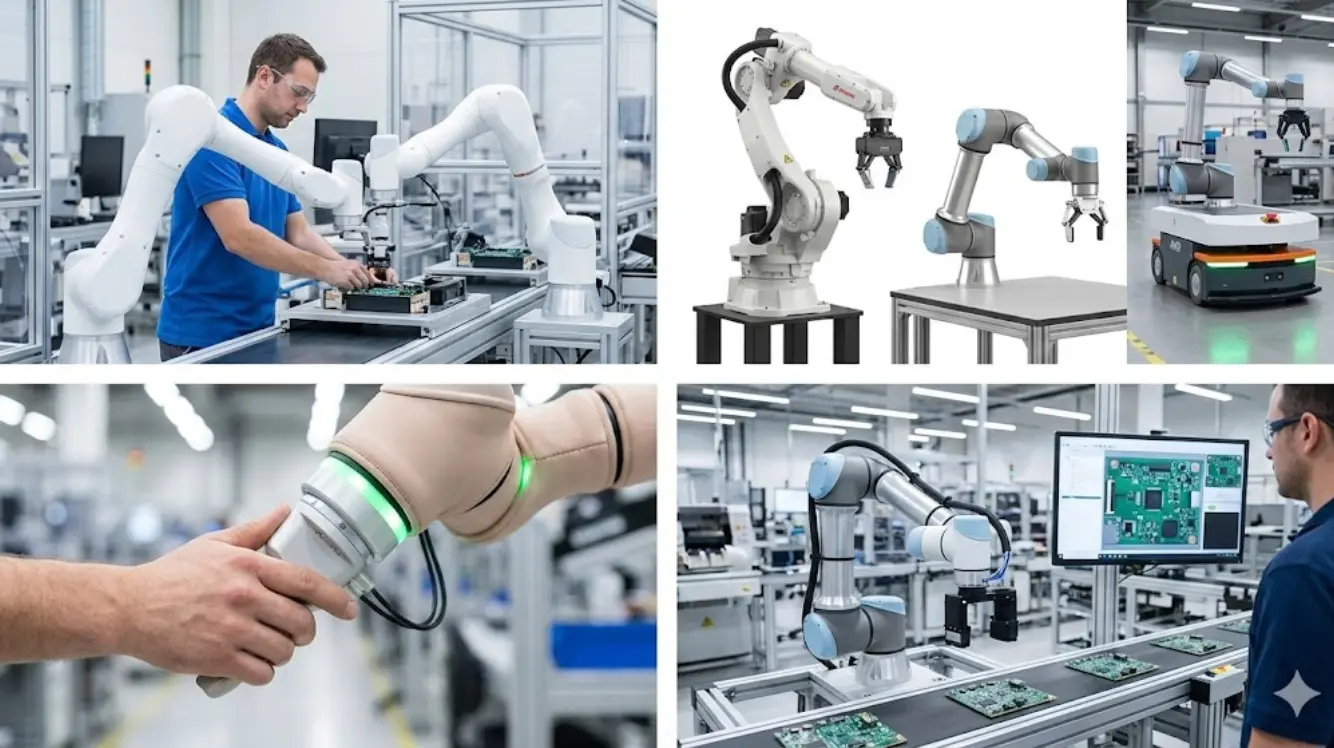
India Collaborative Robot Market: Growth, Drivers, Trends and Future Outlook
India’s manufacturing industry is undergoing a significant transformation as businesses increasingly adopt automation to improve productivity, product quality, operational safety, and production flexibility. Among the technologies gaining momentum, collaborative robots, commonly known as cobots, are emerging as an important solution for manufacturers seeking automation without completely replacing human workers.
Unlike conventional industrial robots that typically operate within isolated work cells, collaborative robots are designed to work alongside people in shared production environments. Their relatively compact footprint, flexible programming, ease of deployment, and ability to handle repetitive or precision-intensive tasks make them particularly attractive to small and medium-sized manufacturers.
According to the TechSci Research report, “India Collaborative Robot Market – By Region, Competition, Forecast and Opportunities, 2021-2031F,” the India Collaborative Robot Market was valued at USD 148.82 Million in 2025 and is projected to reach USD 689.08 Million by 2031, registering a strong CAGR of 29.10% during the forecast period.
The rapid expansion of Industry 4.0 practices, rising labor costs, increasing demand for consistent product quality, and government initiatives supporting advanced manufacturing are creating a favorable environment for cobot adoption. Industries ranging from automotive and electronics to metals, machining, plastics, pharmaceuticals, and logistics are exploring collaborative automation to improve production efficiency.
Main Drivers
Government Support for Advanced Manufacturing
Government initiatives aimed at strengthening India’s manufacturing capabilities are creating favorable conditions for robotics adoption. Programs such as Make in India and Production Linked Incentive schemes encourage manufacturers to increase domestic production, improve technological capabilities, and enhance competitiveness.
Financial incentives, technology-oriented programs, skill-development initiatives, and investment support can reduce some of the barriers associated with adopting advanced automation systems. As manufacturers seek to increase production while maintaining cost efficiency, collaborative robots are becoming an increasingly practical option.
State-level industrial policies in manufacturing-intensive regions such as Tamil Nadu, Gujarat, and Maharashtra are also supporting automation-related investments. Capital grants, financing assistance, clean-energy incentives, and other industrial benefits can make automation projects more commercially attractive.
Rising Demand for Manufacturing Efficiency
Indian manufacturers are under increasing pressure to produce higher volumes while maintaining consistent quality and controlling operating expenses. Manual production processes can become difficult to scale when businesses experience labor shortages or fluctuations in demand.
Cobots address these challenges by automating repetitive operations while allowing human employees to focus on activities requiring judgment, supervision, or specialized expertise. Their ability to operate for extended periods also makes them useful for improving production consistency.
Growth of Small and Medium Enterprises
Small and medium enterprises represent an important opportunity for the collaborative robot market. Traditional industrial automation can require significant infrastructure, programming expertise, and upfront investment, which may discourage smaller manufacturers.
Cobots offer a more flexible alternative because many models can be installed within relatively compact production areas and reprogrammed for different tasks. This flexibility allows SMEs to introduce automation incrementally instead of undertaking complete factory-wide transformation.
Increasing Labor Challenges
Manufacturers across several industrial sectors are facing challenges related to labor availability, skill gaps, repetitive manual work, and rising workforce costs. Collaborative robots can help address these issues by taking over monotonous, physically demanding, or potentially hazardous activities.
Rather than eliminating human involvement entirely, cobot-based systems can create hybrid production environments in which robots perform repetitive operations while workers manage more complex processes.
Request For Sample Copy of Report For More Detailed Market insight
Industry 4.0 Adoption
The transition toward smart manufacturing is encouraging businesses to connect machinery, sensors, software, analytics platforms, and automated systems. Collaborative robots fit naturally into this environment because they can be integrated into digitally managed production processes.
Their use can enable manufacturers to collect operational data, monitor production performance, improve workflow efficiency, and respond more quickly to changes in product demand.
Emerging Trends
Growing Adoption in Metalworking
Metals and machining operations are increasingly turning toward collaborative automation. Tasks such as machine tending, welding, grinding, component handling, and inspection often involve repetitive movements and demanding working conditions.
Cobots can improve consistency and reduce the amount of manual intervention required in such operations. Their growing compatibility with CNC equipment and other machinery is also making automation more accessible to machining workshops.
Flexible Automation for SMEs
A major trend is the development of automation solutions specifically suited to smaller production facilities. Manufacturers increasingly prefer systems that can be installed quickly, moved between workstations, and programmed for multiple applications.
This flexibility is helping cobots move beyond large factories and into smaller manufacturing units where production requirements can change frequently.
Human-Robot Collaboration
The future of industrial automation is increasingly focused on collaboration rather than complete workforce replacement. Cobots can perform repetitive handling, assembly, inspection, and machine-loading activities while workers remain responsible for decision-making and complex operations.
This collaborative approach can help companies improve productivity without requiring major changes to their workforce structure.
Expansion of Smart Factory Ecosystems
Cobots are increasingly being integrated with vision systems, sensors, programmable logic controllers, CNC machines, automated guided systems, and manufacturing software. These integrations allow robots to become part of broader smart-factory ecosystems.
As Indian manufacturers invest in connected production facilities, demand is expected to increase for cobot solutions capable of communicating with other factory systems.
Regional Expansion of Robotics Skills
The development of technical education and industrial training programs is helping create a workforce capable of programming, maintaining, and integrating robotic systems. Robotics-focused training centers and academic institutions can play an important role in reducing the skills gap that could otherwise slow automation adoption.
Real-World Use Cases
Automotive Manufacturing
Automotive manufacturers can deploy cobots for component assembly, machine tending, screwdriving, material handling, inspection, and other repetitive operations. Their ability to operate in shared workspaces makes them suitable for flexible production environments.
Electronics Production
Electronics manufacturing requires precision, repeatability, and careful handling of components. Cobots can support assembly, component placement, testing, packaging, and quality inspection while maintaining consistent production standards.
A notable example occurred in 2024, when four electronics companies near Bengaluru used a Production Linked Incentive scheme to deploy 22 cobots. The systems achieved an average utilization rate of 75% and helped reduce cycle times by 19%, demonstrating how targeted automation investments can contribute to higher production efficiency and export readiness.
Metals and Machining
The metals and machining industry emerged as the fastest-growing industry segment in 2025. Cobots are being used for welding, cutting, grinding, machine tending, material handling, and inspection.
These applications can be particularly valuable when workers need to handle heavy components, sharp tools, or repetitive operations. Cobots can also be integrated with CNC machines and other production equipment to create compact automation cells.
Plastics and Polymers
Plastic manufacturers can use collaborative robots for machine tending, material handling, packaging, component removal, and quality inspection. Their flexibility allows production facilities to adapt automation systems for different products and production cycles.
Logistics and Warehousing
Cobots can support picking, sorting, packing, palletizing, and material movement activities in warehouses and distribution centers. As e-commerce and organized logistics networks expand, collaborative automation can help businesses handle growing order volumes.
Market Segmentation
The India Collaborative Robot Market is segmented based on payload capacity, application, industry, and region.
By Payload Capacity
Up to 5 Kg: This category is suitable for lightweight assembly, electronics handling, inspection, packaging, and small-component operations.
Between 5 and 10 Kg: Mid-range cobots can support broader manufacturing applications, including machine tending, material handling, and assembly.
Above 10 Kg: Higher-payload collaborative robots are increasingly relevant for applications involving heavier components and demanding industrial operations.
By Application
The market includes:
Assembly
Pick & Place
Machine Tending
Others
Assembly and pick-and-place applications benefit from cobots because they involve repetitive movements that can be standardized and automated. Machine tending is also gaining importance as manufacturers connect collaborative robots with CNC and other automated equipment.
By Industry
The key industries include:
Automotive
Electronics
Metals & Machining
Plastics & Polymers
Others
Among these, Metals & Machining was the fastest-growing segment in 2025, supported by increasing automation across fabrication, machining, welding, grinding, and inspection processes.
By Region
The market is divided into North, South, East, and West India.
North India has emerged as the fastest-growing regional market. Industrial clusters in Haryana, Uttar Pradesh, and Punjab, along with manufacturing centers such as Noida, Manesar, and Baddi, are supporting increased automation adoption.
The region benefits from expanding industrial infrastructure, automotive and electronics manufacturing activity, special economic zones, industrial corridors, and growing availability of technical talent.
Government-supported industrial development and investments in smart manufacturing are further encouraging companies to introduce flexible robotic systems. As awareness of cobot technology improves, North India is expected to remain an important growth center.
Competitive Analysis
Universal Robots A/S
ABB Ltd.
KUKA AG
FANUC Corporation
YASKAWA Electric Corporation
Techman Robot Inc.
AUBO (Beijing) Robotics Technology Co., Ltd.
Doosan Robotics Inc.
Customers can also request 10% free customization on this report.
Future Outlook
India’s collaborative robot industry is positioned for substantial expansion as manufacturers move from isolated automation projects toward broader smart-factory strategies. The market is forecast to increase from USD 148.82 Million in 2025 to USD 689.08 Million by 2031, representing a strong 29.10% CAGR.
The combination of government manufacturing incentives, rising labor costs, growing demand for productivity improvements, Industry 4.0 adoption, and increasing awareness among SMEs is expected to accelerate deployment.
The future market will likely see greater integration of cobots with artificial intelligence, machine vision, connected machinery, and industrial software. Local manufacturing and application-specific automation solutions could further improve affordability and accessibility.
North India is expected to remain a major growth hub, while established industrial regions across western and southern India will continue to generate demand. As more businesses recognize the productivity and flexibility benefits of human-robot collaboration, cobots are likely to become an increasingly common component of India’s modern manufacturing ecosystem.
4 Frequently Asked Questions
1. What is the size of the India Collaborative Robot Market?
The India Collaborative Robot Market was valued at USD 148.82 Million in 2025 and is expected to reach USD 689.08 Million by 2031.
2. What is the CAGR of the India Collaborative Robot Market?
The market is projected to grow at a CAGR of 29.10% during the forecast period from 2025 to 2031.
3. Which industry is growing fastest in the India Collaborative Robot Market?
Metals & Machining emerged as the fastest-growing industry segment in 2025, driven by increasing automation in welding, cutting, grinding, machining, material handling, and inspection.
4. Which region is expected to grow fastest?
North India has emerged as the fastest-growing region, supported by industrial expansion, smart manufacturing investments, automotive and electronics production, industrial clusters, and government-backed infrastructure development.
Contact US:
Techsci Research LLC
420 Lexington Avenue, Suite 300,
New York, United States- 10170
Tel: +13322586602
Email: [email protected]
Comments
Log in or sign up to join the conversation.