


My wife and I went on a quick hike at the top of Mount Lemmon near Tucson. A few miles from the trailhead, we drove by this road.

I think TSLY's NAV is down Incinerator Ridge Road. I did a poor job explaining to my wife why this was so funny. It fits right in with our recent looks at various forms of NAV incineration versus products/strategies that might be aggressive without necessarily incinerating NAV.
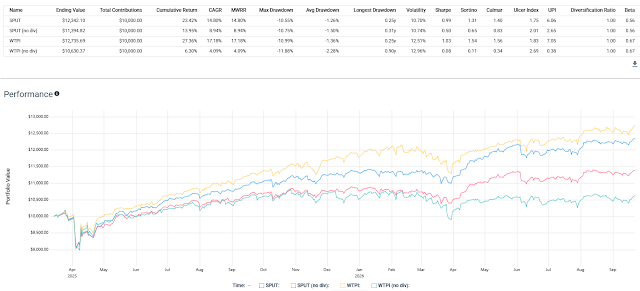
Here is a quick look at several new funds that have popped up on my radar. First, there is a new putwrite fund from Innovator, Innovator Equity Premium Income Daily Putwrite Fund (SPUT). It yields less than WTPI from WisdomTree with less volatility.
VistaShares has a diverse mix of ETFs with some thematic and derivative income funds, and now they are getting into the buffer part of the market with what I believe is a differentiated concept. VOOB references the S&P 500, and QQQB references the Nasdaq 100. The big idea is that the first 8% down should be completely insulated from market declines, and then the funds are only exposed to half of any decline beyond the first 8%. The upside does not have a hard cap, paraphrasing the literature, but the upside will be limited depending on the particulars of the option combo put on to effect the downside protection.
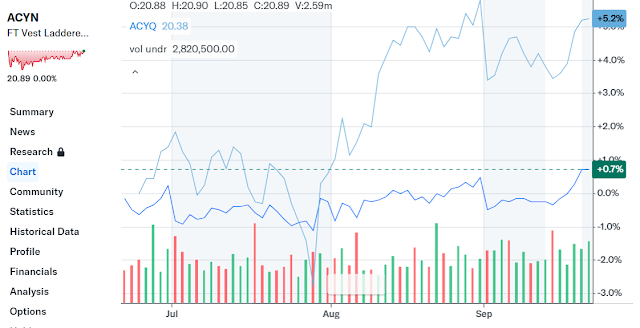
First Trust has thrown its hat in the autocallable ring with ACYQ that seeks a 21% and ACYN that seeks a 9-10% yield. ACYN listed in March, and ACYQ started trading in June. With the higher yield, ACYQ should be more volatile; the Q in the symbol tells you it references NASDAQ stocks, and it has been thus far.
This afternoon I went down a research rabbit hole on the Strive Series A Perpetual Preferred Stock (SATA). Strive (ASST) common stock is a bitcoin treasury stock that when I talk about some funds/stocks being like firecrackers, ASST is like holding on to molten lava or a McDonald's apple pie in the 1970's. ASST is much more volatile than Strategy (MSTR). Oddly, because of the corporate structure and how the preferred stocks are underwritten, it appears that SATA is less risky than the Strategy preferred issues, and it has been outperforming the Strategy preferreds.
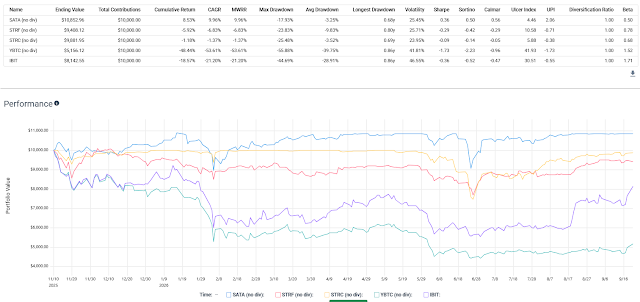
The chart has just two of what I believe are three different preferred issues from Strategy; YBTC is a covered call fund that references Bitcoin and "yields" about 25%.
In terms of attempting to understand and quantify the risks, the key word being attempt, the Strategy ecosystem runs into trouble at a couple of points. It's average cost is close to $75,000. It's cash buffer starts to deplete at Bitcoin $61,000. SATA is far more protected. ASST would be wiped out at Bitcoin $39,500 but SATA can function until Bitcoin drops to $30,000 and stays there for a year and half. At that point, everything else being equal, the company would run out of cash and be unable to make payments.
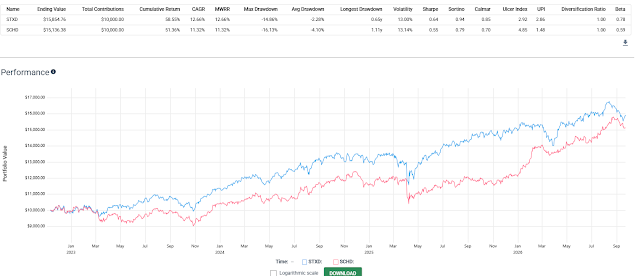
In addition to being a Bitcoin treasury firm, Strive is also an asset manager providing research, and there is a suite of mostly basic ETFs that has $2.9 billion in AUM, so there is a business there. Here's its dividend fund against SCHD. Nothing wrong there.
The ETF business is real, and it generates cash flow but only covers about 1/8 of the expense of servicing SATA. Servicing SATA is apparently not problematic as Bitcoin moves up or hovers at a not-low price for a while. Only for a while, though, as it buys more Bitcoin; eventually it would need Bitcoin to keep going up, but the current level is not trouble for now.
SATA will offer new shares whenever the price gets to the $100 par value, and then the proceeds will go toward buying more Bitcoin. In so doing, the $30,000 number I cited above can actually go up (not a good thing). At some point, maybe instead of being able to pay for 18 months at $30,000, maybe they can pay for 18 months at $35,000 or $40,000, or fewer months at the $30,000 level.
For all this complexity, SATA yields 13% and is not incinerating NAV like YBTC has done. SATA pays its distributions daily....five cents +/- every day and the distributions are ROC so no taxes until the cost basis goes to zero or the shares are sold. Both of these help shareholders.
I just found out about SATA today from a Tweet about a new ETF coming from Strive that will sell puts on Bitcoin treasury preferred stocks and will have symbol DCAP. Someone will figure out how to harvest Bitcoin volatility without incinerating NAV. Maybe SATA does that; maybe it doesn't I just found it today.
Whatever the risk of SATA is (I have some idea, I think), it differentiates from the risks of the lower-yielding autocallable ETFs, which both differentiate from catastrophe bonds. Something that yields 10-13% in a 4.5% world is risky; there's no changing that, which is a crucial point of understanding but putting something like 2% each into four or five of these that do truly differentiate the risk from each other creates a serious yield engine inside a portfolio and as we're seeing, quite a few of them have the tax advantage of ROC. No taxes for seven, eight, or nine years is worth exploring.
If this whole realm is more complexity than you'd ever want to take on, cool, leave it alone, but it is fun to dig in and learn.
All of these things we looked at today are evidence of how funds are evolving to create more tailored outcomes up to a point. It is easier to build a portfolio that has one very high-yield sleeve, a modest CPI plus maybe 3% sleeve that causes little to no stress, and then some plain, unconstrained equity beta.



Comments
Log in or sign up to join the conversation.