

It’s the Holiday (hiring) Season
The U.S. economy added 211,000 jobs in November. This was down from a prior revised 298,000 (up from 271,000), but lower than the Bond Squad forecast of 225,000, but above the Street consensus of 200,000. The private sector added 197,000 jobs, down from an upwardly revised 304,000 (up from 268,000), but above the Street consensus estimate of 190,000. The Unemployment Rate held steady at 5.0%. Average Weekly Hours declined to 34.5 from a prior revised 34.6 (up from 34.5). Average Hourly Earnings grew 0.2% MoM, half of October’s 0.4% monthly gain. Annually, wages grew 2.3%, down from a prior 2.5%. The U-6 Underemployment Rate rose to 9.9% from a prior 9.8%. The U-6 rate captures those who are underemployed (working part-time, but seeking full-time), unemployed workers and discouraged workers.
I would describe this data as “good.” I am not trying to kill the buzz. Why am I focusing on year-over-year comparisons of October/November payrolls data? Because it is in these two months which most holiday hiring occurs. In spite of seasonality formulas, the October/November period tends to be among the stronger periods for job additions. Thus, it is more honest to compare October/November 2015 with the same period from previous years. When we compare the October/November jobs data to the same period during the past two years, it does not indicate that the pace of hiring has picked up.
Something else which we must consider when analyzing today’s data is that construction hiring was unusually strong for this time of year, particularly in the post financial crisis environment. In the October/November 2014 period, the construction sector added a seasonally-adjusted total of 40,000 jobs. In the same period 2015, the construction sector added 77,000 jobs. The retailing sector also saw a downshift in jobs, year-over-year. The 2014 October/November total for retail sector hiring was 92,000 jobs. The total for the same period this year is 70,000 jobs.
I do not see this as the labor markets worsening. I see them as “settling in.” I remain of the opinion that the cyclical peak for the pace of U.S. economic growth occurred in 2014. Now the U.S. economy is probably in the process of settling in to whatever is trend growth, job creation, etc. in today’s version of the U.S. economy.
There was an uptick to both the Underemployment Rate (to 9.9% from 9.8%) and the Labor Force Participation (to 62.5% from 62.4%). When we take these numbers together it tells me that Ms. Yellen might be correct that there is more labor slack than many industry economists believe, as evidenced by the rise in the participation rate. It also tells me that the jobs which were added during the past month included a large number of part-time jobs. When taken together, the LFP Rate and U6 Rate point to holiday hiring and a ramp up in wages, to attract seasonal workers, being behind the improvements in the data.
A December Fed liftoff appears very likely, in my opinion.
Dash Away, Dash Away, Dash Away All!
Immediately following the data release, the yield of the benchmark 10-year UST note jumped to about 2.34% from about 2.30%, prior to the data. However, once market participants had time to dig through the numbers, the 10-year UST note yield fell back to 2.30%. The employment data were good, but did not change the U.S. economic narrative, in either direction. The Bond Squad view is that the U.S. economy remains on solid footing and is more structurally sound than its foreign contemporaries.
The yield of the 10-year UST note spiked on the news of solid job growth, but the rise of long-term rates were short-lived. Once the algorithms were done reacting to the headlines, market participants took a closer look at the data and the yield fell.
Kings of Orient Far
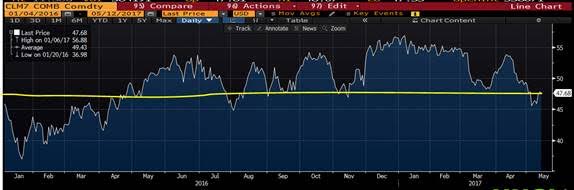
Then we had OPEC announce that, not only isn’t it cutting production, but it is acknowledging that its “nod and wink” 31.5 million barrels per day production level is the new official level versus the previous official production level of 30 million barrel per day. The question is: Does OPEC maintain areal production level of 31.5 million barrels per day, or does higher official production level provide room for some cash-strapped countries to produce more? We shall soon see. The next OPEC meeting is in June 2016.
OPEC’s decision not to cut production has put downward pressure on oil prices. The Bond Squad base case for 2016 is for a moderately flattening UST yield curve with short-term rates rising gradually and not much movement of rates on the long end of the yield curve.
Father Christmas, give us more accommodation
The ECB really rocked the markets last Thursday. I opined last month (and prior to that) that a Fed tightening could take some pressure off of the ECB to ramp up accommodation. ECB President, Mario Draghi disappointed the markets by not increasing the size of ECB QE and cutting the ECB (bank) Deposit Rate to -0.3% from a prior -0.2%. The ECB also extended its current QE bond buying program of 60 billion euros per month by six months, to March 2017.
Wait. The ECB lowered its Deposit Rate and extended QE? Why were the markets unhappy?
Because they believed that Mr. Draghi (after promising that the ECB would do “whatever it takes”) would do more to stimulate a sluggish EMU economy. Thus, traders and speculators sold short the euro and purchased EMU sovereign debt, expecting to benefit from both a weakening currency from more ECB accommodation and higher sovereign debt prices due to more QE bond buying. When the accommodation increase was less dramatic than what was priced into currencies and bonds, many speculators tried to leave the burning room at the same time. Some got burned.
The rout extended to U.S. bonds and stocks. However, once the algorithm folks and (unfortunate/ill-advised) frightened investors were finished selling, U.S. asset values rebounded last Friday.
A Market Story
There is a lesson for jittery investors and advisors who have jittery investors for clients. In my opinion, the lesson is:You mustn’t panic. If nothing has fundamentally changed, market panics, such as we experienced last Thursday, are non-events. For some investors (based on suitability and investment needs), such panics could represent investment opportunities.

Comments
Log in or sign up to join the conversation.