

IBM is back to its revenue declining, non-GAAP-EPS-beating-through-low-tax-gimmick ways.
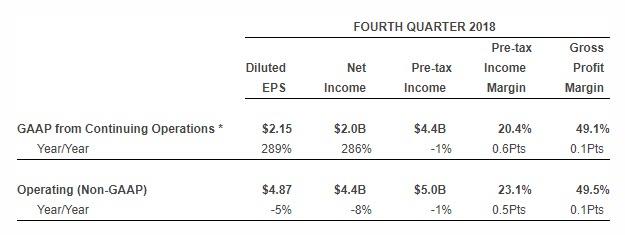
With Wall Street expecting IBM to report (non-GAAP) EPS of $4.82 in Q4, the company "beat" by the tiniest of margins, reporting non-GAAP, adjusted EPS of $4.87, a 5% drop from last year.
So far so good, but as usual, there was a gaping difference between GAAP and non-GAAP, and in this case, it was more than double, with the company reporting a paltry $2.15 in GAAP EPS, more than 50% below the Non-GAAP number. Unfortunately for IBM, unlike last quarter when non-GAAP pre-tax and net income both posted modest increases even as their GAAP equivalents dropped, this quarter, both non-GAAP and GAAP pre-tax net Income declined Y/Y by -1% while non-GAAP Net Income dropped by 8% (GAAP Net Income was not meaningful).
(Click on image to enlarge)
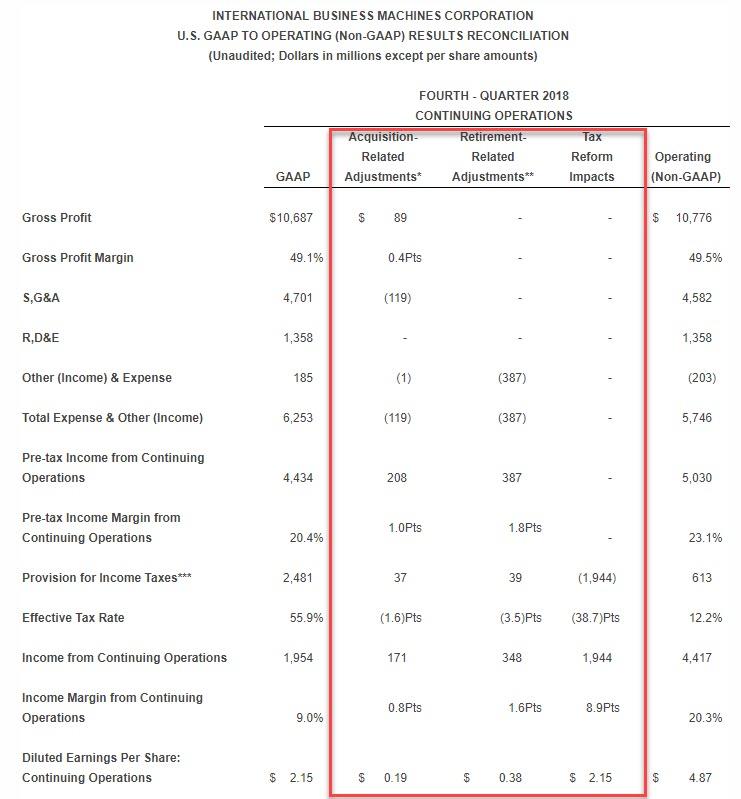
How did IBM bridge the traditionally lower GAAP EPS number to the higher non-GAAP? Simple: here is the full breakdown.
(Click on image to enlarge)
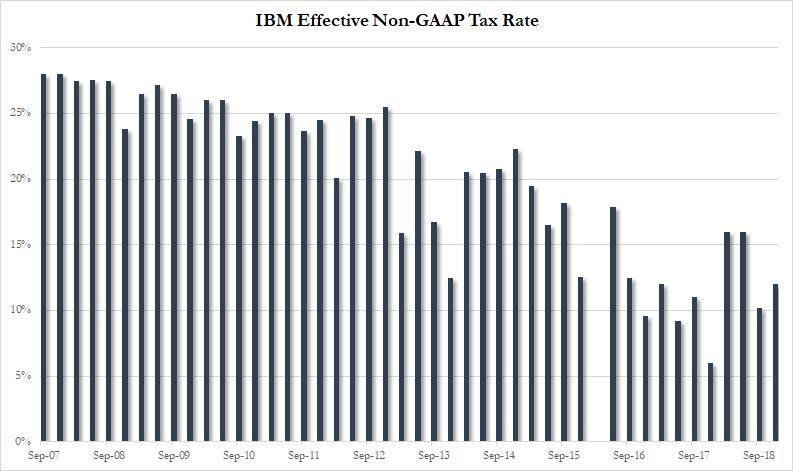
More importantly, the EPS only beat because the company reverted back to its tax gimmick ways, as IBM's effective GAAP tax rate was 56% yet its non-GAAP EPS once again managed to tumble to only 12%, which while laughable was double the 6% effective non-GAAP - and lowest ever - tax rate in Q4 2017.
(Click on image to enlarge)
Meanwhile, IBM reported Q4 revenue of $21.8 billion, which was just better than the $21.7 billion expected...
(Click on image to enlarge)
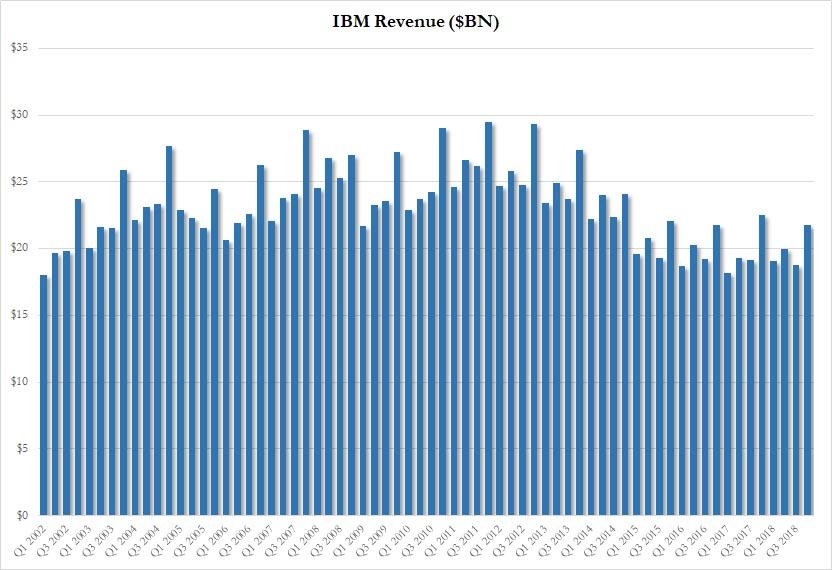
... however, after three-quarters of top-line growth - which followed 22 consecutive quarters of declines - IBM's Q4 revenue once again dropped after a similar decline in Q3, sliding by 3.3% Y/Y in Q4, and reminding investors that for all its non-GAAP and tax fudges, IBM remains a melting ice cube.
(Click on image to enlarge)
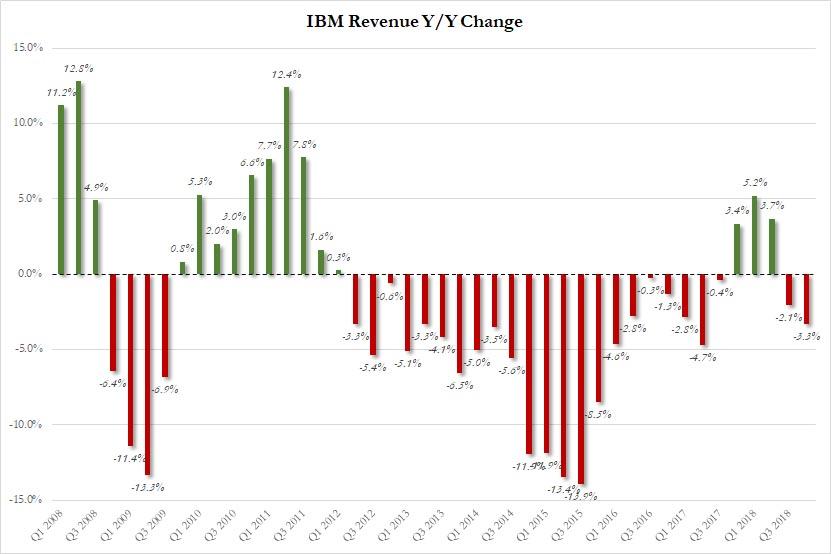
And yet despite this now traditionally accounting gimmickry and deteriorating top line, investors appeared to like the results for two simple reasons: the first, IBM's cloud revenue did not collapse:
- Technology services & cloud platforms revenue $8.93 billion down from $9.20 billion Y/Y
Of note, revenue from cloud-based offerings alone grew about 12% to $19.2 billion in 2018, half the growth rate of last year. Of course, in a bet to jump-start its efforts to catch up in the cloud, IBM famously agreed to buy software maker Red Hat Inc. for $33 billion in October, which CEO Rometty called "a game changer" for IBM.
The other closely watched segments also did relatively better:
- Cognitive solutions revenue $5.46 billion vs $5.43 billion Y/Y
- Global business services revenue $4.322 billion vs $4.152 billion Y/Y
- Systems revenue $2.62 billion vs $3.33 billion q/q
The second reason investors appeared impressed with IBM's numbers is that the company now sees 2019 operating EPS at least $13.90 vs estimate $13.80. We assume all the upside is from even greater non-GAAP addbacks. The company also expects GAAP diluted earnings per share of at least $12.45, as well as free cash flow of approximately $12 billion, same as last quarter.
Going back to the bad news, gross margins grew slightly in the fourth quarter, to 49.1%, but once again missed the average analyst estimate.
IBM also announced that it generated Q4 cash from operations of $4.1 billion. And as has been the case for the past several years, the company returned much all of its cash, or $3.5 billion, to shareholders through $1.4 billion in dividends and $2 billion in stock buybacks. At the end of 2018, IBM had $3.3 billion remaining in the current share repurchase authorization; for new readers, IBM has repurchased billions and billions of its stock in the past decade, which is the only reason non-GAAP EPS hasn't imploded.
IBM ended the fourth quarter with $12.2 billion of cash on hand, down from $14.7 billion at the end of Q3. And while cash declined by $2.5 billion, debt declined by far less, with IBM reporting $45.8 billion in debt, down from $46.9 billion a quarter prior. Of course, both of these numbers will change drastically once the Red Hat deal is completed.
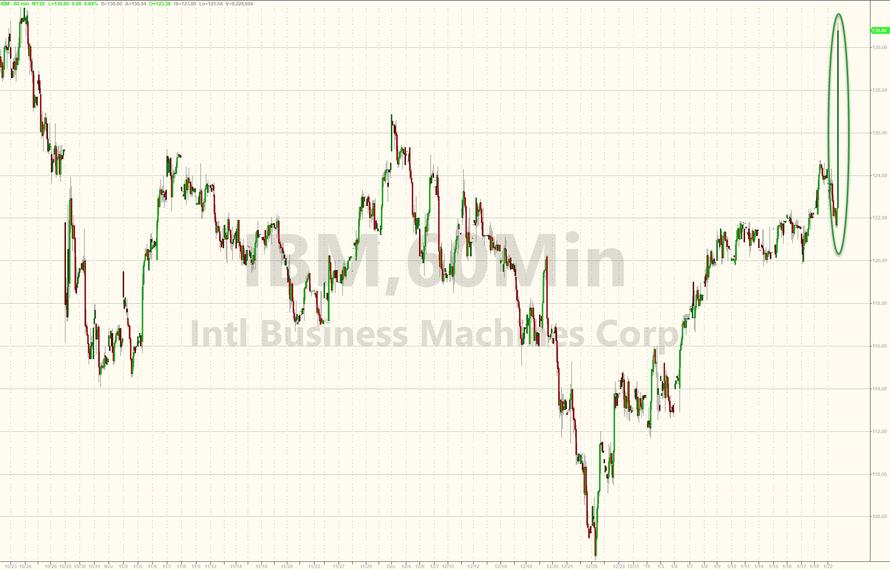
In short: after several strong quarters, IBM's Q3 and Q4 results - when in addition to everything IBM decided to purchase Red Hat and massively overpaying at that - saw the return of all that investors had grown to loathe about big blue. Even so, the stock is up after hours, as investors clung to the positive news of a modest improvement in the cloud and slightly stronger guidance, although like on prior quarters don't be surprised if IBM fades all of its after-hours upside.
(Click on image to enlarge)



Comments
Log in or sign up to join the conversation.