

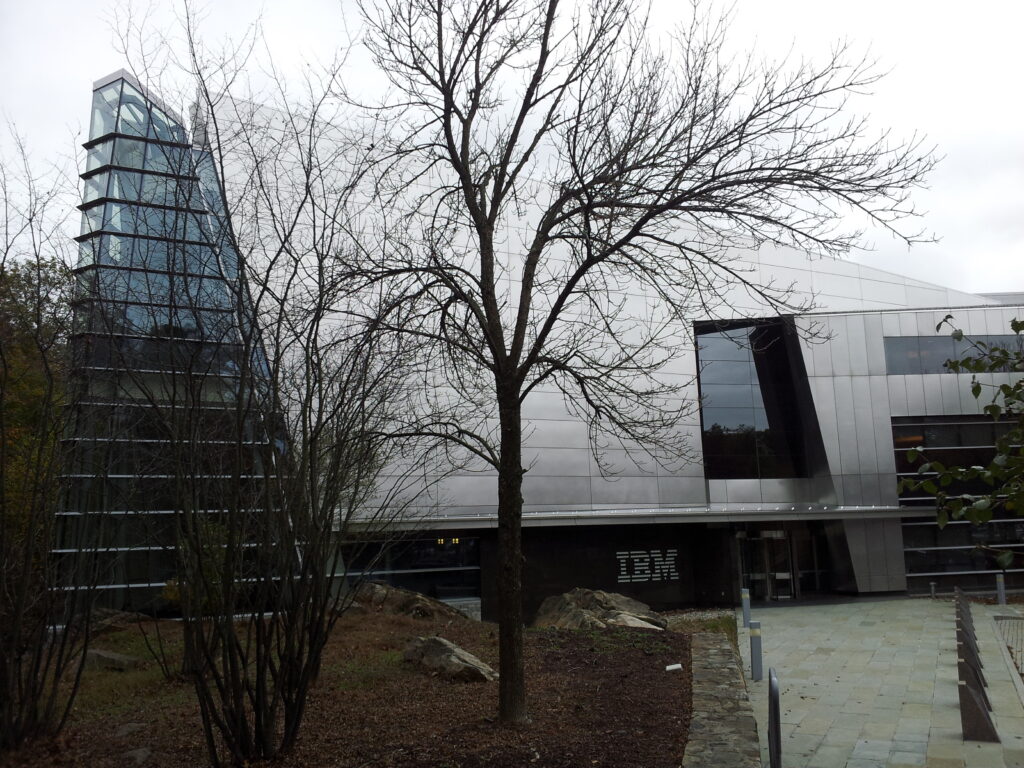
Earlier this week IBM (IBM) announced its quarterly results that outpaced market expectations. But a conservative guidance driven by uncertainty around AI sent the stock falling 6% in the after-hours trading session.
IBM’s Financials
For the first quarter of the year, IBM’s revenues grew 9% to $15.92 billion, ahead of the market’s expectations of $15.62 billion. Earnings came in at $1.91 per share and were also ahead of the expected $1.81 per share.
By segment, software revenue rose 11% to $7.05 billion, ahead of the consensus of $7.02 billion. Its consulting unit grew 3% to $5.27 billion, falling short of the $5.28 billion estimate. Its infrastructure division revenues grew 21% to $3.32 billion, ahead of the estimated $3.16 billion. Revenues from financing and other segments came in at $268 million.
For 2026, IBM maintained its revenue growth expectation of 5% over the year.
IBM’s AI Growth
Despite the strong results, the market was not too pleased on concerns that AI tools will displace cloud subscription models for tech companies. Earlier this year, Anthropic released details about Claude Code, an AI-tool that focused on modernizing COBOL, the programming language for IBM mainframes.
According to Anthropic, Claude Code helps address the discovery, analysis, and documentation phases that make legacy migration and upgrades expensive. Through a structured methodology, Claude Code reads the full COBOL codebase, maps dependencies, identifies entry points, traces execution paths, and identifies couplings through shared data structures and file operations. It then goes on to automated workflow documentation that includes generating diagrams of processing pipelines that exist only in the code itself. Further, it undertakes a risk assessment to identify high-coupling modules and isolated components ready for early migration.
Anthropic’s announcement of Claude Code had sent IBM’s stock falling 20%, registering the sharpest decline the stock ever saw in the last 25 years. Analysts were worried that Claude could automate the translation of COBOL into modern languages.
But IBM is not overly worried. IBM itself has been looking to address the legacy programming gap with Project Bob, an AI-native integrated development environment (IDE) and intelligent partner that has been designed for enterprise software development, modernization, and lifecycle management. Built on VS Code, Project Bob uses agentic workflows to understand codebases, generate code, automate testing, and refactor legacy applications, with reported productivity gains of 45%. IBM plans to replace watsonx Code Assistant with Project Bob to cover RPG, CL, SQL, Java, and Python besides COBOL on IBM.
Where Claude Code is known to be a high-productivity AI tool, IBM Project Bob is known for its AI-first IDE capabilities that are customized for enterprise software development. IBM also realizes that there is a bigger need among enterprises to modernize core systems to scale AI capabilities. The process involves making deliberate choices about where workloads should run and who controls the infrastructure for these workloads.
As part of AI adoption, enterprises will want to retain control of their proprietary data. AI will run everywhere across public cloud, private and sovereign clouds and on-premise, and the core challenge will remain of having to get all of this to work together. This would include the need to orchestrate across models, agents and workflows, govern enterprise data and secure these systems at scale. IBM believes that its solutions are able to provide customers with the right products needed for this transformation. It is building the platform that lets enterprises put AI to work while the enterprise retains control of its environment and data.
IBM’s recent results were also proof that its consulting business is not currently being impacted by AI. The consulting segment revenues grew 4% over the year. If some were worried that AI will reduce the demand for consulting services, at least in the near term, that does not seem to be the case. The growth in the segment was instead driven by demand for AI and modernization services.
IBM is counting on its earlier acquisition of Confluent to help drive growth. AI is only as good as the data it can access. Data, today, is not static and is generated continuously across transactions, applications, and interactions. To deliver real-term AI outcomes, IBM plans on leveraging Confluent (CFLT)’s abilities to stream live, governed data to models and agents across the hybrid environment. Additionally, IBM has also created AI solutions of software products like Db2, Cognos, and MQ. These embedded agentic AI capabilities can reason, act and automate at scale while preserving IBM grade security and trust.
IBM’s stock is trading at $251.86 with a market capitalization of $217 billion. It touched a 52-week high of $324.90 in February, just before it slid to a year low of $220.72 after Anthropic’s announcement.
IBM’s Layoffs
Like other tech players, IBM had announced layoffs last year. According to a recent report, IBM cut around 9,000 US workers, particularly in its Cloud Classic division. IBM did not attribute the layoffs to AI driven efficiencies. Instead, reports suggest that it has been moving some of its work offshore to countries like India.
As of April 2026, the global tech industry has recorded 78,557 layoffs, with 76.7% occurring in U.S. companies. While giants like Oracle (ORCL) (25,000+), Amazon (AMZN) (16,000), and Block (4,000) lead the charge, a disturbing pattern has emerged.
According to research by Alan Cohen (RationalFX), nearly half of these job losses are now explicitly tied to “AI Restructuring.” However, a deeper analysis suggests that AI is often being used as an “AI-as-an-excuse” narrative to justify aggressive cost-cutting and boost sagging stock prices. Companies like Oracle have automated the termination process itself, firing thousands via 6:00 AM emails—a cold-blooded approach that reflects a total deficit of empathy and human kindness.



Comments
Log in or sign up to join the conversation.