

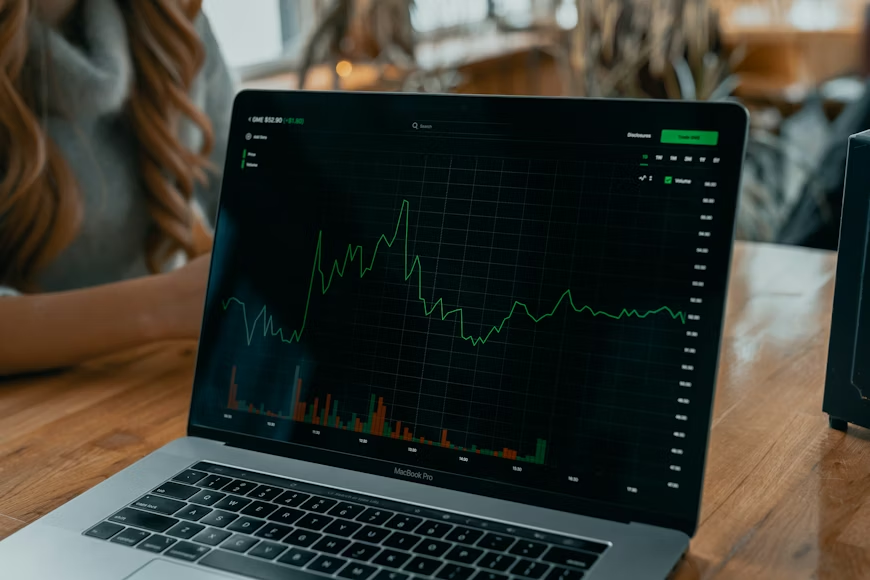
Image Source: Tech Daily on Unsplash
On Friday morning, Nasdaq futures sliced through Thursday's low like it wasn't even there. The price was falling, the tape was ugly, and I was sitting in a classroom teaching a masterclass. I even commented, "Believe me, I'm sitting here teaching a class and I'm looking out like, 'I'm missing so much.'"
The NQ was in free fall, with big displacement candles printing on the screen. That's the kind of move that makes traders abandon their plan and start firing off market orders just to be in something. I did nothing. And that decision to do nothing is the reason I walked out of Friday's futures session with 250 points on two trades before lunch.
The Trades That Came to Me
Friday morning opened with an ATR around 40. Bars were spitting out 40 points each on a two-minute chart. Conditions like that eat traders alive if they try to chase moves that have already happened. So I waited for the process to give me something.
The opening range established itself. The price broke above the pre-market high with a strong bullish displacement candle, and then it pulled back for a retest.
I bought the 46 mark on three micro contracts. The price ripped up to the 88 level, right to the top of the opening range. I exited there because, as any NQ trader knows, the 88 level can push price right back down. That trade delivered 40-plus points on three contracts. Over 120 points of total capture on one setup. "Solid little trade, right? So that's trade number one. Boom, done and done."
Most traders would have tried to buy it again. The level just worked. The momentum was there. But the chart told a different story. The price had made a lower low. A big bearish candle pushed back inside the opening range. The bullish tone was gone.
I said, "Now, we didn't do it again. Why didn't we do it again? Because it doesn't look so dang bullish anymore, does it?" So instead of forcing a second long, I waited for the short. I sold the 26, looking for the 88 below.
The first attempt got stopped at even on a retrace. I re-entered at the 18 mark, and the price fell right back to the 88 where I covered. Two winning trades. 255 total handles on micro contracts. The session was done before lunch. I stated, "It's just a nice little way to get a day done and not have to risk a ton of capital. That's the point of it."
What I Could Have Done Instead
Here is the version of Friday that would have destroyed most accounts.
Price was falling hard in the morning session. The Nasdaq was dropping below Thursday's low. The obvious play, to most people, would have been to short that breakdown and ride it. "We could have shorted, shorted, shorted, shorted and gotten exhausted through this whole process trying to pick that top, gotten blasted here for minus 50 points, 1,000 bucks out of our account, and then see it do this and go, 'Oh, man, I knew it was gonna do that. I was just early.'"
Being early is not a strategy. The traders who chased that selloff were caught in one of the most dangerous loops in day trading: entering on emotion, getting stopped, re-entering on frustration, and getting stopped again.
I missed the entire selloff because I was teaching. And that turned out to be the best thing that could have happened. By the time I sat down to trade, the opening range had formed, the levels had done their job, and the setups came to me on my terms. As I said, "It's gotta come back to us or we don't trade it. It has to follow our process or we don't trade it."
The 200-Day Was Watching
Something else worth noting about Friday: While the Nasdaq was selling off and traders in the room were watching the carnage, the price landed right on the 200-day simple moving average.
Earlier in the week, the Nasdaq bounced over a thousand points off that same average. On Friday, it was being tested again.
At the time I commented, "You don't have to pick the bottom. You don't have to pick the top. Let price show you." That context matters. Even though things looked terrible on a two-minute timeframe, the bigger structure was still intact. That perspective kept me from panicking when the tape felt like it was falling apart.
Why Friday Stays Green
After booking those 250 points, I told the room to stop trading: "Stop. It's Friday. Go do something else."
The Nasdaq futures space was still volatile. There was probably an afternoon setup forming somewhere. But capturing handles in the morning and then giving them back in the afternoon is one of the most demoralizing experiences in trading. "It's Friday. You don't wanna be green in the morning and go home red. Nothing more demoralizing than that."
The discipline to stop trading when you are ahead is the same discipline that kept me from chasing the selloff in the first place. Both require you to accept that there is money you will not make today.
The Levels Never Change
I pulled up a 15-year daily chart in Friday's session to make a point. When I started at TheoTrade 10 years ago, the Nasdaq was in the 4,000s and 5,000s. An entire day's range was 60 to 70 handles. A big day was maybe 130 handles.
Now, single two-minute bars print 40 handles. Daily ranges stretch over a thousand. I said, "I'm still using 88s. I'm still using 46s. I'm still using 26s. It's all the same stuff, but it's just expanded out."
The levels have not changed. The execution has adapted. On Friday, that adaptation meant using three micro contracts, targeting 50 handles of profit with 20 handles of risk, and walking away after two clean trades. "The risk/reward on this is insane. We're gonna take those trades. So even if we have one loser and two winners, we're still on the right side of it."
The traders who got hurt on Friday morning were the ones who chased a move they did not set up for. The traders who won were the ones who let the process do its job and kept their hands off the keyboard when the process said to wait.
I missed the selloff. I booked 250 points. Those two facts are connected. See you in the trading room on Monday.

Comments
Log in or sign up to join the conversation.