


The “baby boom” generation, made up of Americans born from after World War II up into the early 1960s, is sometimes called the “pig in the python” of US demographics. The pig started moving into retirement age around 2010, when the earliest of the boomers hit age 65. At present, the tail end of the boomers (like me) are hitting retirement age. This shift has some well-known implications, like the rising financial pressures on Social Security and Medicare. But here, I want to focus on a different implication: With large numbers of retirees, and lower birthrates after the baby boom generation, it seems as if the supply of labor in the US economy should be growing at a relatively slow pace for the next decade or two. In addition, basic economics suggest that a slowdown in supply should tend to raise the price–in this case, raise the wage for young workers entering the job market. How likely is this scenario?
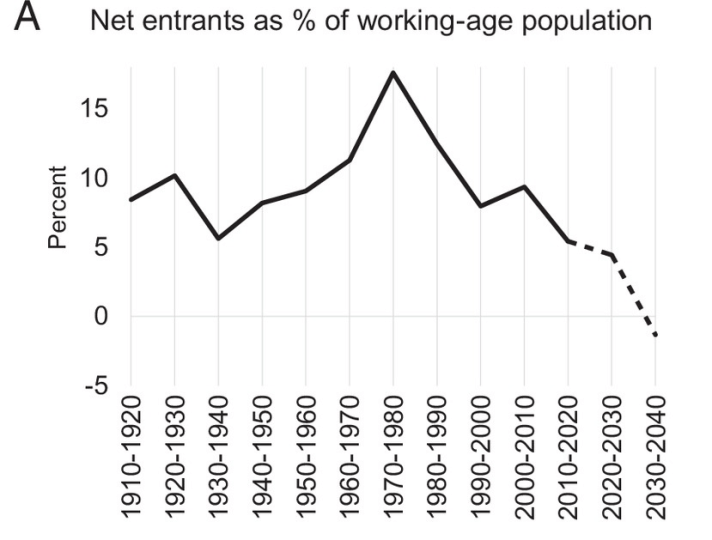
Steven Ruggles offers some calculations and insights in “The pig in the python: US decennial labor flows and economic opportunity, 1910–2040” (PNAS, May 15, 2026, vol. 123, #20, e2601716123). Here’s one illustrative figure. Let’s calculate the “net” entrants to the US labor force in each decade, and we will do the calculation as a share of the size of the pre-existing workforce in that decade.
During the high-immigration period at the start of the 20th century, net entrants to the labor force were in the range of 8-10% of the of the working-age population. After the clampdown on immigration in the 1920s and the miserable economic period of the 1930s, this dropped a bit, and the rises slightly again in the 1950. But then you see the big spike of new entrants into the US labor force in the 1960s, whihc is the boomers entering the labor force. After this boom, new entrants sag ove time. The level is currently down to below the Great Depression levels, and in the decades from 2030-2040, net entry into the labor force is projected to turn negative (with a combination of lower US birthrates and recent clampdowns in immigration to the US).
What are the implications for younger workers. Ruggles summarizes in this way:
We are on the verge of a fundamental transformation of the labor market. Baby boomers began retiring in large numbers during the 2010s, and immigration began declining in the same period. The number of births went down 17% between 2007 and 2024, which will contribute to a reduction in the number of new entrants to the labor force in the 2030s.
In the current moment of political turmoil, any economic predictions spanning the next 15 years are highly uncertain. We can predict with some confidence, however, the general demographic configuration of the 2040 working-age population: the births have already occurred, mortality change is ordinarily gradual, and a massive surge of immigration seems unlikely. Other factors may affect the prospects of new workers, including recessions, sudden shifts in federal policies, and long-running economic trends like globalization and mechanization. It is possible, as some prognosticators contend, that artificial intelligence will dramatically reduce the demand for workers. It is also possible—or even probable—that the magnitude of the coming demographic transformation may be great enough to swamp such economic changes.
Barring revolutionary changes in the economy, the drop in labor-market competition over the coming two decades will have profound consequences. There is likely to be an unprecedented shortfall of new workers, creating strong upward pressure on wages. … [W]e are already seeing signs of an uptick in the wages of young workers, and as the demographic shortage accelerates we may finally see real wages of the young exceed the levels of the early 1970s. Americans born in the 2020s might be the first cohort in a half century that earns significantly more than their parents did. Labor-force participation will probably increase as more workers are pulled into the market by higher wages, and some workers will postpone retirement. The decline in labor competition should be a boon for labor organizing. There will be increased incentives for automation of both manufacturing and services. We can expect reduced inequality, especially generational inequality. High demand for labor will create pressure to expand immigration. The unprecedented drop in employment competition may also have adverse consequences. Labor shortages may constrain economic growth, although there is some evidence to the contrary.
The movement of the boomer generation through education, the labor market, and now into retirement has been one of the dominant factors for the US economy for decades. But that period is, gradually, coming to an end.


Comments
Log in or sign up to join the conversation.