
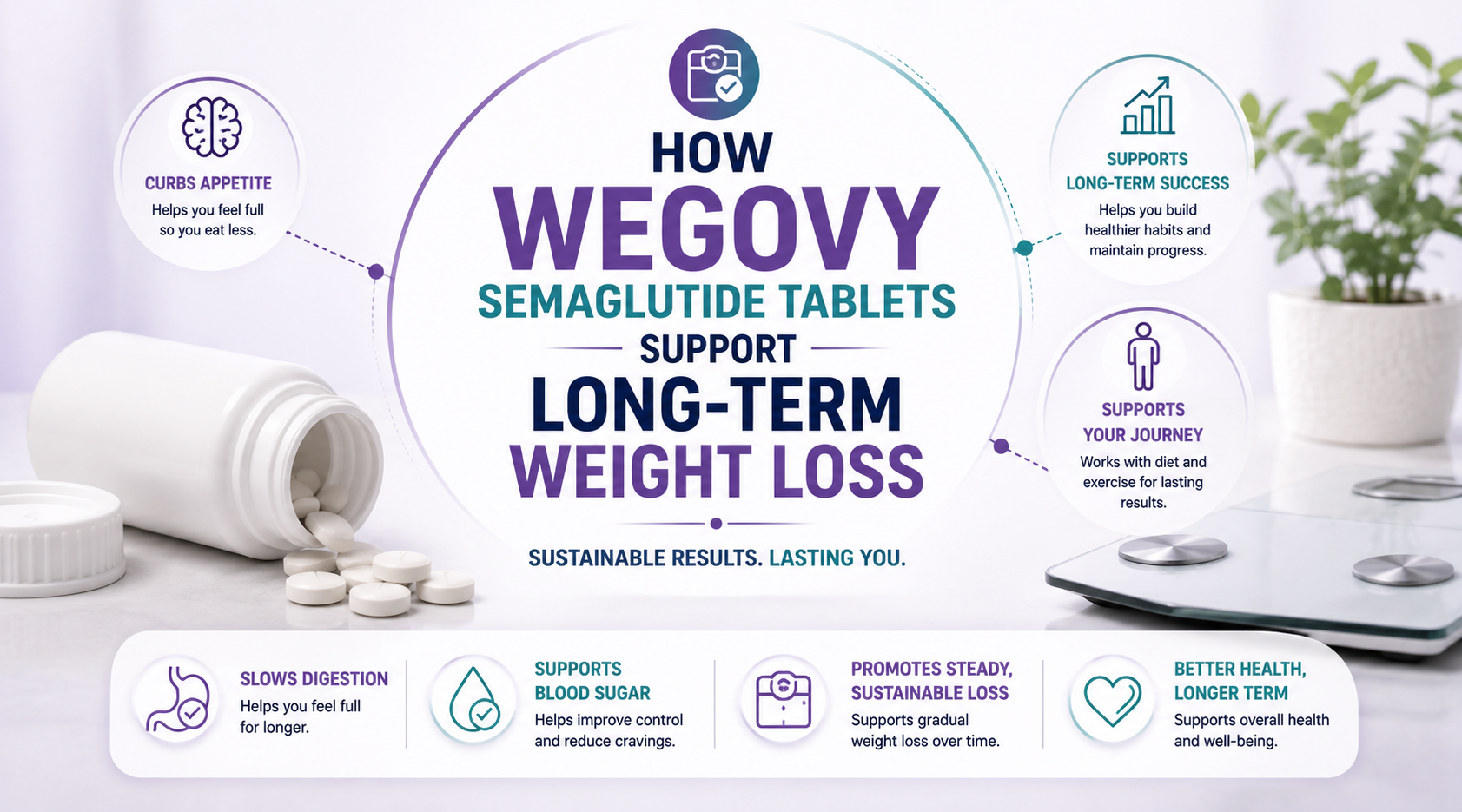
Most weight loss approaches fail for the same reason: they work while you're actively restricting, then unravel the moment life gets in the way. Willpower runs out. Hunger comes back stronger than before. The weight returns, often with a bit extra. This cycle is so common that it's practically expected, which is part of why semaglutide has generated so much attention. It doesn't rely on willpower alone. It changes the underlying signals driving hunger in the first place.
Here's a closer look at how Wegovy semaglutide tablets actually support weight loss that holds up over months and years, not just the first few motivated weeks.
Why Most Diets Fail Long-Term
Traditional dieting relies almost entirely on conscious restriction. You decide to eat less, and your body fights back. Hunger hormones increase, metabolism slows slightly to conserve energy, and the brain's reward system starts prioritising food more intensely the longer restriction continues. This isn't a personal failing. It's a well-documented biological response designed to protect against starvation, and it's precisely why so many people regain weight after a diet ends.
Semaglutide interrupts this pattern differently. Instead of asking you to override your hunger signals through sheer discipline, it works with your body's own appetite-regulating hormone system, GLP-1, to reduce hunger at the source. That's a meaningfully different mechanism, and it's a big part of why results tend to be more sustainable than with restriction-only approaches.
The Mechanism Behind Long-Term Results
Semaglutide is a GLP-1 receptor agonist, meaning it mimics a hormone your gut naturally releases after eating. This hormone signals fullness to the brain, slows how quickly food leaves the stomach, and reduces the intensity of hunger between meals. Wegovy Semaglutide Oral Tablets deliver this same active compound in a needle-free format, working through the identical biological pathway as the injectable version.
What makes this relevant to long-term weight management is that appetite reduction isn't a one-time event. As long as the medication is active in your system, those hunger signals remain suppressed, which means the discipline required to maintain a calorie deficit is considerably lower than with diet alone. Patients often describe simply feeling satisfied with smaller portions, rather than white-knuckling their way through hunger pangs.
Gradual Dosing Supports Sustainable Habits
One of the more overlooked aspects of semaglutide treatment is the dose titration process, where treatment starts at a low dose and increases gradually over several weeks under clinical supervision. This isn't just about minimising side effects, though that's part of it. It also gives your eating habits time to adjust in step with your changing appetite.
Rather than experiencing an abrupt drop in hunger that might lead to under-eating or an unsustainable pace of weight loss, gradual titration allows new habits, smaller portions, different food choices, more mindful eating, to form naturally over weeks rather than being forced overnight. Habits built this slowly tend to stick, which is exactly what long-term weight management actually requires.
Beyond Appetite: Why Behaviour Change Matters
Medication alone doesn't create lasting weight loss. What it does is create the conditions where behaviour change becomes achievable rather than exhausting. With hunger reduced and portion control feeling more natural, many patients find it far easier to build sustainable habits around meal planning, regular activity, and mindful eating, changes that are notoriously difficult to stick to when constantly fighting intense hunger.
This is why the most successful long-term outcomes tend to come from combining semaglutide with broader lifestyle adjustments rather than relying on the medication in isolation. The tablets create space for those habits to form. What you do with that space still matters.
Tablets vs Injections for Long-Term Adherence
Adherence, meaning how consistently someone actually takes their medication as prescribed, is one of the biggest predictors of long-term success with any treatment. This is where the tablet format offers a genuine advantage for certain patients.
Some people struggle with the idea of weekly self-injections long-term, even if they're not particularly painful. A daily tablet, while requiring more frequent dosing, avoids the psychological barrier some patients feel toward needles altogether. For these patients, sticking with treatment consistently over months or years becomes considerably easier with an oral format.
That said, injections have their own long-term adherence benefits too, mainly requiring action just once a week rather than daily. Anyone comparing Buy Best Wegovy & Mounjaro Weight Loss Injections options against the tablet format should think honestly about which routine they're more likely to maintain consistently over the months it takes to see full results, since consistency is what actually drives long-term outcomes, not the specific delivery method.
What Happens After Reaching Your Goal Weight
Long-term weight management doesn't end the moment you hit a target number. This is actually where many people run into trouble, discontinuing medication abruptly and finding their appetite returning to previous levels faster than expected.
Clinical guidance generally supports a gradual, supervised approach to reducing or discontinuing semaglutide once a goal weight is reached, alongside continued attention to the habits built during treatment. Patients who've used the treatment period to genuinely shift their relationship with food, portion sizes, and activity levels tend to maintain their results far better than those who viewed medication as a temporary fix disconnected from any lasting behaviour change.
Realistic Expectations for Long-Term Success
It's worth being honest that semaglutide isn't a guarantee of permanent weight loss regardless of what happens afterward. Genetics, activity levels, stress, sleep, and dozens of other factors all influence long-term weight maintenance. What semaglutide does provide is a genuinely powerful tool for reducing the biological resistance that makes sustained weight loss so difficult through diet alone.
Most people using semaglutide as part of a structured, medically supervised plan see gradual, steady weight loss over several months, rather than a rapid drop followed by a plateau. This slower, more consistent pattern tends to correlate with better long-term maintenance, since the body and habits both have time to adjust in tandem rather than the weight loss outpacing behavioural change.
When Semaglutide Isn't the Right Long-Term Fit
Not everyone responds the same way to GLP-1 medications, and some patients experience side effects that make long-term use impractical, or simply don't achieve the results they're hoping for. In these cases, alternative prescription options exist and shouldn't be overlooked.
Phentermine & Diethylpropion work through a different mechanism, appetite suppression via the central nervous system rather than GLP-1 receptor activity, and may suit patients who aren't good candidates for semaglutide or who need a shorter-term intervention alongside lifestyle changes. A proper reassessment with a prescriber can help determine whether switching medications, adjusting dosage, or adding additional support makes sense if initial results aren't matching expectations.
Why Medical Supervision Matters for Long-Term Success
Long-term weight management with prescription medication isn't something to manage without proper oversight. Regular check-ins allow a prescriber to monitor progress, adjust dosing as needed, watch for side effects, and help navigate the eventual transition toward maintenance once a goal weight is reached.
Weight Medics structures treatment around this kind of ongoing supervision, rather than a one-off prescription with no follow-up. This matters considerably for long-term outcomes, since the plan that gets you to your goal weight often needs to evolve into a different plan for maintaining it, and that transition works far better with proper clinical guidance throughout.
Final Thoughts
Long-term weight loss has always been less about a single decision and more about sustained, gradual change that your body and habits can actually adapt to. Wegovy semaglutide tablets support that process by reducing the biological resistance that makes lasting change so difficult, giving you the physical and mental space to build habits that hold up well beyond the treatment period itself.
Medication isn't a substitute for that behaviour change, but it removes one of the biggest barriers to achieving it. Paired with proper medical supervision and a realistic, patient approach to habit-building, semaglutide tablets offer a genuinely credible path toward weight loss that actually lasts, rather than the familiar cycle of loss and regain that traditional dieting so often produces.
Comments
Log in or sign up to join the conversation.