

Warehouse space is one of the most valuable assets in any industrial or logistics operation. As businesses grow, warehouses often become crowded with inventory, equipment, packing stations, maintenance areas, and employee workspaces. Expanding the building is not always practical, so companies need smarter ways to use the space they already have.
One effective solution is the use of warehouse partitions. These systems allow warehouses to divide large open spaces into organized sections without depending entirely on permanent construction.
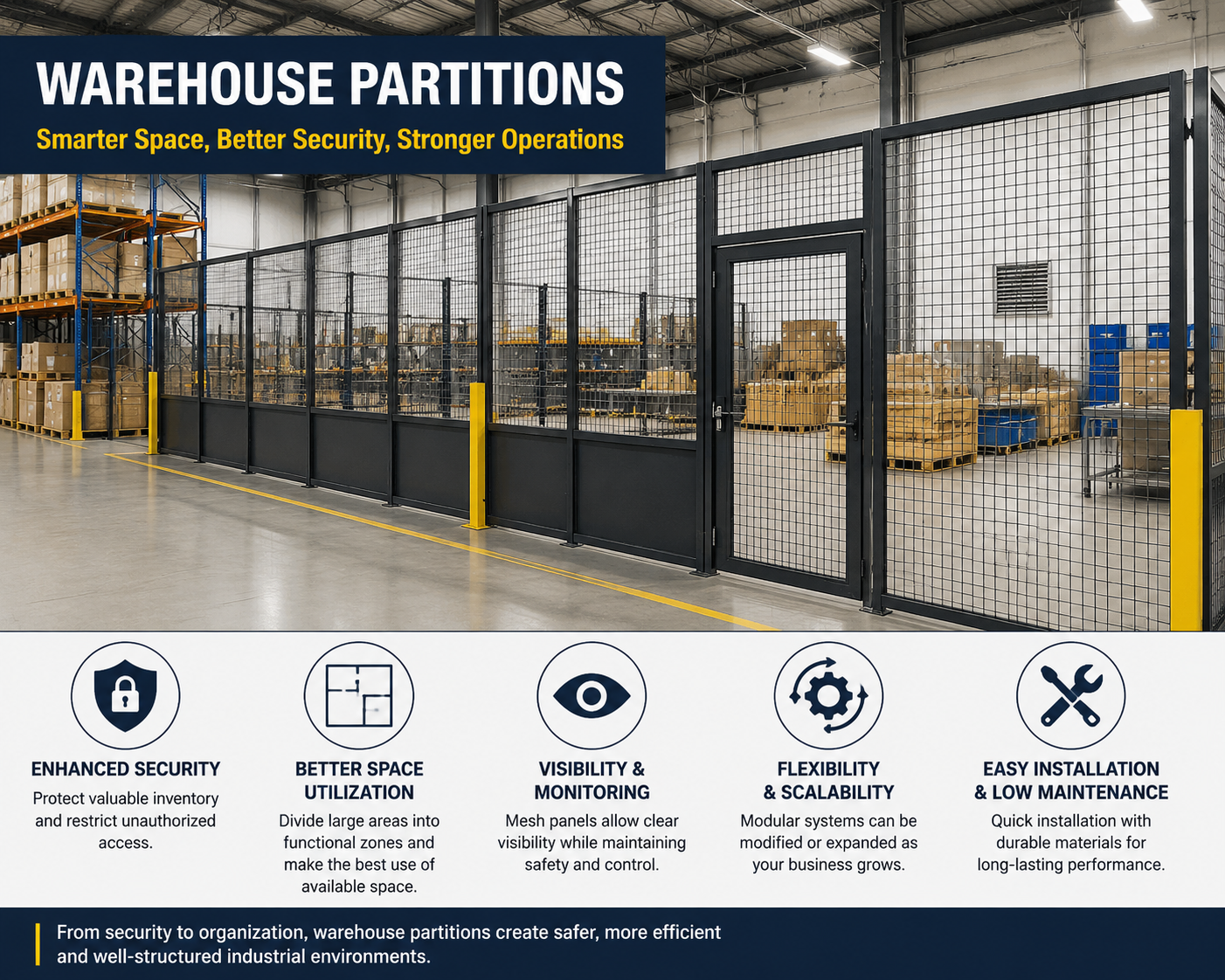
Why Warehouse Space Needs Proper Division
An open warehouse may initially seem convenient because there are fewer physical restrictions. However, as operations expand, a completely open layout can create problems.
Materials can be stored in the wrong locations, staff may enter restricted areas, and machinery can operate too close to general warehouse activities.
Using warehouse partition systems helps establish dedicated zones for different functions.
For example, a warehouse can separate:
Receiving areas
Finished goods storage
Packing sections
Equipment rooms
Maintenance areas
Secure inventory
Staff-only zones
Dispatch areas
Creating these sections makes warehouse operations more structured and easier to manage.
Protecting Important Inventory
Some materials require a higher level of protection than ordinary warehouse stock.
Expensive tools, spare parts, technical equipment, documents, and controlled inventory should not always remain accessible to every person working inside the facility.
Warehouse security partitions can help create restricted areas inside the warehouse while maintaining a practical industrial layout.
These partitions can include controlled entry points such as gates or doors, allowing businesses to decide who can access specific warehouse areas.
Wire mesh configurations can also provide visibility, allowing supervisors to monitor stored products without leaving the area completely open.
Making Better Use of Existing Floor Space
Warehouse expansion usually involves major costs, construction work, and disruption.
Partitioning provides another option.
Instead of increasing the total size of the building, companies can divide the available area more efficiently.
Warehouse storage partitions can transform unused sections of a building into organized storage zones.
For example, one warehouse area may be divided into separate sections for:
Raw materials
Finished goods
Returned items
Spare parts
High-value products
This can improve the overall usability of the warehouse without requiring major structural changes.
Modular Warehouse Partition Panels
Warehouse layouts frequently change over time.
A company may introduce new machinery, increase inventory, create new departments, or redesign its distribution process.
Permanent walls can make these changes difficult.
Modular warehouse partition panels offer greater flexibility because the system can often be extended or rearranged according to operational requirements.
This makes modular partitions particularly useful in growing warehouses where future layout changes are expected.
Warehouse Partition Walls for Defined Areas
Different warehouse environments require different levels of separation.
Warehouse partition walls can be used where businesses require more clearly enclosed sections.
Depending on the application, partition walls may be suitable for:
Equipment rooms
Staff areas
Packing sections
Technical spaces
Storage rooms
Controlled production areas
Solid panels can provide stronger visual separation, while mesh systems maintain visibility.
Choosing between the two depends on the purpose of the area.
Improving Daily Warehouse Management
A well-organized warehouse is easier to supervise.
When different departments and storage sections are clearly identified, workers can understand where products, tools, and equipment should be located.
Well-designed warehouse partitioning solutions can support this organization by establishing permanent or semi-permanent boundaries between operational areas.
Clear zoning can also make it easier to control inventory movement.
For example, incoming goods can remain in a receiving section before being transferred to storage, while outgoing products can remain in a separate dispatch zone.
Supporting Industrial Operations
Industrial warehouses are often connected with production, fabrication, assembly, or equipment maintenance.
This means storage areas may operate alongside machinery or technical equipment.
Industrial warehouse partitions can help separate machinery zones from storage and general working areas.
This separation can create a more controlled environment around industrial equipment and help prevent unauthorized access to specific work zones.
In factories, partitions may also be used to separate:
Production departments
Machine areas
Material preparation sections
Tool storage rooms
Inspection areas
Maintenance workshops
For this reason, factory and warehouse partitions are commonly considered when planning industrial facilities.
Commercial Warehouse Applications
Partitioning is not limited to large manufacturing facilities.
Commercial warehouse partitions can also be used in:
Distribution centers
Retail storage facilities
Workshops
Spare-parts warehouses
E-commerce fulfillment centers
Service facilities
Commercial stockrooms
Even smaller warehouses can benefit from dividing one open area into multiple functional sections.
Planning Warehouse Partition Installation
Before starting a warehouse partition installation, companies should carefully study how the warehouse currently operates.
The position of the partitions should not interfere with important warehouse activities.
Several factors should be considered, including:
Forklift routes
Pedestrian movement
Emergency exits
Storage racks
Loading and unloading areas
Door positions
Lighting
Ventilation
Equipment access
Future expansion requirements
Proper planning ensures that the partition system supports operations rather than creating unnecessary restrictions.
Choosing the Right Warehouse Partition System
The ideal partition system depends on the purpose of the area.
Mesh partitions may be suitable when visibility and airflow are important.
Solid partitions may be preferred when privacy or stronger separation is required.
Modular systems may be more practical when warehouses expect layout changes in the future.
Businesses should therefore evaluate both their current requirements and possible future needs before selecting a partition system.
Final Thoughts
Warehouse efficiency is not only about how much space a facility contains. It is also about how effectively that space is organized.
Warehouse partitions allow industrial and commercial facilities to create secure, organized, and clearly defined working areas within existing buildings.
Whether they are used for storage segregation, equipment protection, restricted-access areas, or operational zoning, partition systems provide a practical way to improve warehouse layouts.
By choosing the correct materials, layout, and installation method, businesses can create warehouse environments that are easier to manage and more adaptable to changing operational requirements.
#WarehousePartitions #WarehouseSecurityPartitions #IndustrialWarehousePartitions #WarehousePartitionSystems #WarehouseStorage #WarehousePartitionWalls
Comments
Log in or sign up to join the conversation.