
Spectators only ever see the finished product — players walking onto a court right on time, results updating within minutes of a match ending. What they don't see is everything that made that moment possible. Tournament operations management is the invisible machinery behind every well-run event, covering everything from the first player check-in to the final report emailed out days later. It's easy to overlook precisely because it's designed to be invisible — the better the operations team does its job, the less anyone in the stands notices it happening.
It Starts Long Before the First Serve
Operations work begins well before a ball is struck. Entries have to be validated, categories confirmed, and payments reconciled, all before a single court assignment can be made. A reliable player registration system is what keeps this stage from turning into a last-minute scramble, catching duplicate entries and missing documents while there is still time to fix them.
That same system carries into event morning, where check-in becomes the first real test of how well the operation has been planned. Staff need to know instantly who has arrived, who hasn't, and which court each player should head to, all without creating a queue that stretches out the door.
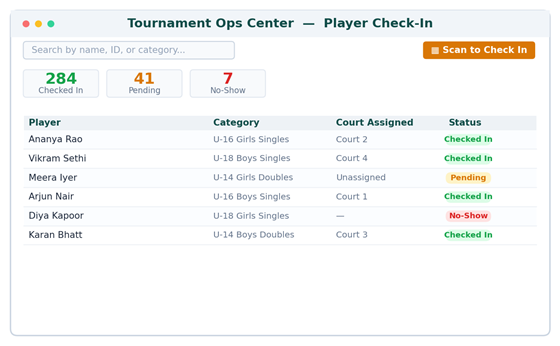
Screens like this one replace the clipboard-and-highlighter approach that used to define event mornings. Every arrival updates instantly, court assignments adjust automatically, and staff can see at a glance exactly where the gaps are instead of asking around the venue.
Coordinating People, Not Just Courts
Behind every smooth-running court sits a rotation of umpires, ball crew, medical staff, and volunteers who all need to be in the right place at the right time. Staff scheduling software handles this layer of coordination, matching shift availability against match schedules so no court is ever left waiting on a missing official. When a match runs long or a volunteer calls in sick, the same system can flag the gap immediately instead of leaving a supervisor to notice it by chance an hour later.
Read Also: “How Tournament Software Benefits Tennis Academies and Their Students”
Watching the Event as It Unfolds
Once play begins, the job shifts from planning to monitoring. Directors need a single place to see which matches are running long, which courts are idle, and where a weather delay is starting to ripple through the day. Real-time event monitoring turns what used to require walking the entire venue into something visible from one screen.
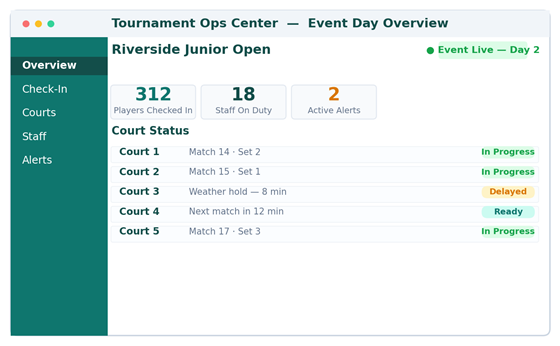
A dashboard like this is where the day's decisions actually get made. A delayed court, a staffing gap, or a spike in check-ins all show up the moment they happen, giving organizers time to react instead of finding out secondhand from a frustrated player.
Handling the Unexpected
No tournament runs exactly as planned. Rain delays, injury withdrawals, and last-minute schedule changes are the norm rather than the exception, and how quickly an operation adapts is what separates a smooth event from a chaotic one. Strong event day coordination means every disruption gets absorbed and communicated within minutes, not discovered by players standing at an empty court.
The Work That Continues After the Final Match
Operations don't end when the trophy is handed out. Match records, staffing hours, attendance figures, and incident notes all need to be compiled for review. Thorough post-event reporting turns a single tournament into a data point that improves the next one, revealing which courts saw the most delays or which time slots ran consistently over schedule. Organizers who skip this step tend to repeat the same scheduling mistakes season after season, simply because nobody wrote them down.
None of this happens in isolation either. Venue logistics — court maintenance, equipment counts, signage, parking flow — all sit alongside the scheduling and staffing work as part of the same operation. Good sports event logistics planning means these pieces are coordinated well in advance rather than handled reactively on the day.
Where Software Ties It All Together
Platforms built specifically for racquet sports increasingly bring these operational layers into one system instead of several disconnected tools. Tenniskhelo is one such tournament management app, built to connect registration, scheduling, staffing, and live monitoring so organizers aren't switching between five different systems to run one event.
What spectators experience as a smoothly run weekend is really the output of dozens of small operational decisions made correctly, hour after hour. Seamless tournament execution isn't luck — it's the result of registration, staffing, monitoring, and logistics all working together behind a screen that most players will never see, but would notice instantly if it stopped working.
Comments
Log in or sign up to join the conversation.