

Stopping tooth decay comes down to a routine you can actually repeat: brush twice daily with 1,450ppm fluoride toothpaste, treat the night-time brush as non-negotiable, spend two minutes covering every surface, clean between the teeth once a day, spit without rinsing, and reduce how often sugar reaches your teeth rather than how much. Two of those matter more than the rest. Night brushing, because your natural protection drops while you sleep, and not rinsing, because it leaves fluoride where it does the work. None of it is expensive, and none of it replaces regular examinations, which catch what a routine misses.
Most people already know roughly what they should be doing. The gap is usually in the details, and the details are where the evidence is more interesting than the standard advice suggests. If you want the reasoning behind why any of this is worth the effort, why prevention matters sets out the cost side.
The routine, in order
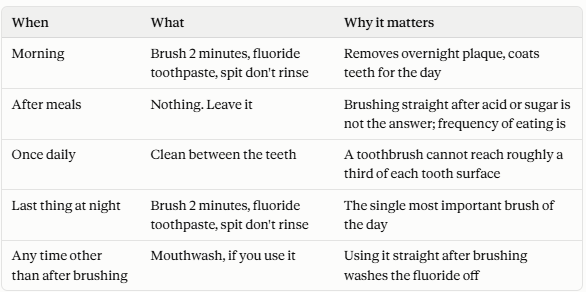
That is the whole routine. Anything beyond it is optional refinement.
Night brushing is the one that matters most
If you only manage one proper brush a day, make it the last one before bed. The reason is saliva.
Saliva is your mouth's own defence system. It neutralises acid, washes away food debris and carries the minerals that repair early damage to enamel. Salivary flow drops substantially during sleep, so anything left on your teeth at bedtime sits there for seven or eight hours with almost none of that protection running.
This is why a thorough brush at 11pm does more for your teeth than a rushed one at 7am. It is also why eating or drinking anything other than water after brushing at night undoes most of the benefit.
Brushing technique: what actually removes plaque
Two minutes is the target, and most people fall well short of it without realising. Time it once with your phone and you will probably be surprised.
The technique matters as much as the duration. Angle the bristles at roughly 45 degrees towards the gum line, where plaque accumulates, and use small circular or short back-and-forth movements rather than long horizontal scrubbing. Vigorous horizontal scrubbing is worth avoiding specifically, because over years it wears grooves into the necks of the teeth.
Cover every surface systematically: the outer faces, the inner faces, and the biting surfaces. Working in a fixed order stops you skipping the inside of the lower front teeth, which is the area most commonly missed.
Electric or manual? What the evidence says
Powered toothbrushes are better, but by less than the marketing suggests. A Cochrane review covering 56 studies and 5,068 participants found powered brushes reduced plaque by 11% at one to three months and 21% after three months, with gingivitis reductions of 6% and 11% respectively.
The strongest evidence was for rotation-oscillation brushes, where the head rotates one way and then the other. Sonic and other modes have less data behind them, not because they are worse but because fewer good trials exist.
An 11 to 21% improvement is real and worth having, particularly if you struggle with technique or dexterity. It is not a substitute for brushing properly. A well-used manual brush beats a badly used electric one, and the built-in two-minute timer is arguably the most useful feature on most powered brushes.
Cleaning between teeth: brushes, floss, and honest uncertainty
A toothbrush cannot reach the surfaces between your teeth, which is where a large share of decay and gum inflammation begins. Something has to clean there.
The Cochrane review of interdental devices found that interdental brushes may reduce gingivitis more than flossing at one and three months, and that both floss and interdental brushes plus toothbrushing may reduce gingivitis more than brushing alone. Interdental brushes also come out ahead on patient preference, being easier to handle than floss for most people.
Here is the part usually left out: the certainty of that evidence is low to very low. No study measured tooth decay, few measured severe gum disease, and most were short-term. So the honest position is that interdental brushes have the edge where the gaps are wide enough to fit them, floss is the option where they are not, and the device you will genuinely use every day beats the theoretically superior one you abandon after a fortnight.
Ask your dentist or hygienist which sizes fit your mouth. Interdental brushes come in colour-coded widths and using the wrong size is the most common reason people give up on them.
Where mouthwash fits, and where it does not
Fluoride mouthwash can be useful, but timing decides whether it helps or hurts.
Using mouthwash straight after brushing washes away the concentrated fluoride left by your toothpaste and replaces it with a much weaker solution. That makes your routine less effective, not more. If you use mouthwash, use it at a separate time of day, such as after lunch.
Mouthwash also does not clean between teeth. It cannot dislodge plaque, which is a sticky biofilm that has to be physically removed. Treating it as a substitute for interdental cleaning is the most common mistake people make with it.
The 30-minute rule after acidic food is not settled
You have probably been told to wait half an hour after acidic food or drink before brushing, on the basis that acid softens enamel and brushing then scrubs it away. It is repeated almost everywhere as established fact.
The evidence is more mixed than that. Reviews of the research have noted a lack of robust clinical studies, and have concluded that brushing with fluoride toothpaste immediately after an acidic challenge does not appear to increase the risk of erosive tooth wear, which sits alongside the general recommendation to brush twice daily with fluoride.
The practical takeaway is not to worry about the timing. Worry about the frequency of acidic drinks in the first place, since that is where the actual damage originates. If you drink something acidic, drinking it in one sitting rather than sipping over an hour matters far more than what you do half an hour later.
What is not worth your money
Whitening toothpaste does not prevent decay any better than ordinary fluoride toothpaste; whitening is a surface stain claim, not a protective one. Charcoal toothpastes are often abrasive and many contain no fluoride at all, which makes them worse than what you already own. Fluoride-free "natural" toothpaste removes the single ingredient with the strongest evidence behind it.
Check the fluoride content on the tube. Adults want 1,450ppm. If a product does not state a figure, that is your answer.
If you are unsure whether your routine is working, that question is answered at an examination rather than in a mirror. Regular reviews with a preventive dental care in St Albans practice, or wherever you are registered, are what pick up the areas your technique is consistently missing.
Frequently asked questions
What is the most important part of a daily dental routine?
Brushing last thing at night with fluoride toothpaste and not rinsing afterwards. Salivary flow drops during sleep, so anything left on the teeth at bedtime sits there without your mouth's natural protection for seven or eight hours.
Are electric toothbrushes better than manual ones?
Modestly, yes. Cochrane evidence from 56 studies found powered brushes reduced plaque by 11% at one to three months and 21% after three months. Rotation-oscillation brushes have the strongest evidence. Good technique with a manual brush still beats poor technique with an electric one.
Should I floss or use interdental brushes?
Interdental brushes appear to reduce gum inflammation more than floss where the gaps are wide enough to fit them, though the evidence is low certainty. Floss suits tighter contacts. Ask your dentist which sizes fit, since the wrong size is why most people give up.
Do I need to wait 30 minutes after eating before brushing?
The evidence for this is weaker than commonly stated. Reviews have found that brushing with fluoride toothpaste soon after acidic food does not clearly increase erosive wear. How often you consume acidic food and drink matters considerably more than when you brush afterwards.
When should I use mouthwash?
Not immediately after brushing. Doing so washes away the concentrated fluoride your toothpaste has just left on the teeth. Use it at a different time of day, such as after lunch, and treat it as an addition rather than a replacement for cleaning between the teeth.
Where to start
Change one thing tonight: time your bedtime brush for a full two minutes and do not rinse afterwards. Add interdental cleaning once you have made that automatic, rather than trying to overhaul everything at once. A routine you keep for years beats a perfect one you keep for a week. If your gums bleed when you start cleaning between the teeth, early warning signs in your gums explains what that does and does not mean.
About St Peter's Lodge Dental Practice
St Peter's Lodge Dental Practice is a private dental practice in St Albans, Hertfordshire, caring for patients of all ages for more than 35 years. The practice provides general dentistry, hygiene, children's dentistry, cosmetic treatments, dental implants, Invisalign and emergency care from one location on Adelaide Street.
All clinicians are registered with the General Dental Council and the practice is registered with the Care Quality Commission. Fees are published in full on the practice website, with costs for treatments that vary shown from a starting price and confirmed in a written treatment plan before any work begins.
St Peter's Lodge Dental Practice
48 Adelaide Street, St Albans, AL3 5BG
Telephone: 01727 853160
Email: [email protected]
Monday 08:00–19:30 | Tuesday 09:00–19:00 | Wednesday 08:00–16:30 | Thursday 08:00–19:00 | Friday 08:00–15:00 | Saturday 09:00–13:00 | Sunday closed
Comments
Log in or sign up to join the conversation.