

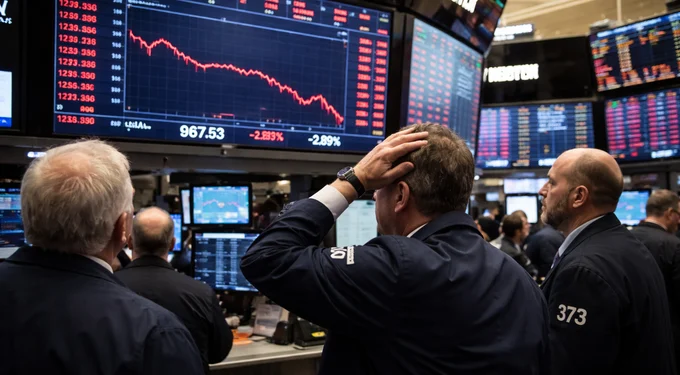
Home Depot (HD) has crashed.
It fell again on Thursday, along with FedEx (FDX). Lowe’s (LOW) printed another 52-week low on the same tape.
I call this the bottomless pit.
Money managers are dumping good companies no matter how cheap they get.
Over my 40 years in this business, I’ve seen selloffs like these make millionaires…or wipe you out entirely.
You see, sometimes “cheap stocks” are cheap for a reason.
For example, I think Peloton (PTON) and NIO (NIO) are going out of business.
Yet, on a chart, they can look just as inexpensive as a company worth owning.
The good news is you can separate them with just two checks, both of which I’ll share with you.
Because when I ran both a couple of days ago, it gave me the confidence to buy a little semiconductor exposure, even at these prices.
Cheap Stocks: Will The Business Survives
Cheap stocks come in two kinds. But, the chart can’t tell you which one you’re holding.
A business the market gave up on
A business that’s going away.
Look at what’s getting sold right now.
Home Depot, FedEx and Lowe’s keep falling, and I don’t think it’s about fundamentals.
Money managers are unloading everything to buy about 10 stocks. They won’t touch Starbucks (SBUX), Domino’s (DPZ) or Marsh & McLennan (MMC), no matter what the valuation is.
The economy is people. People buy things. They aren’t going to stop shopping at Home Depot, nor buying their morning coffee.
On the other hand, I think Peloton and NIO won’t be around in a few years. Peloton doesn’t have a sustainable business model. It was a fad that’s past its prime. Same with NIO.
The names I want have been around a long time, and so have their dividends.
A long dividend record shows a business that keeps producing cash. Blow one of those out 80% or 90%, and the dividend can yield 6% or 7%.
A dividend yield is the yearly payout divided by the share price. As the price falls, the yield climbs.
That setup produces the quantum leaps in gains.
A crashed stock only matters if the business survives the fall.
Cheap Stocks: Does The Price Makes Sense
Survival gets cheap stocks onto my list. However, it still has to earn my money on the numbers.
I use forward valuation for that. It compares today’s price with the earnings a company is expected to make.
A couple of days ago, I bought a little semiconductor exposure. Believe it or not, some of those names were down 80% to 90%.
But, the forward valuation made total sense. I think the upside’s there.
I still bought carefully.
You can’t buy just anything down that far. Buy anything, and you can get completely wiped out in this business.
Wells Fargo (WFC) is the one bank I have my eye on. I’m not committing to it yet.
If it drops all the way to $60, it trades around 9x earnings. At $60, it has my interest.
From there, I think the multiple could expand upward. That means investors start paying more for each dollar of earnings.
Why Half My Money Is Still Sitting In Cash
I want to make something clear: Passing both checks doesn’t mean I buy today.
Sellers have to finish first.
Wells Fargo still has a toilet flush coming. Everybody is selling it right now.
You can’t make money buying what everybody’s selling. You have to buy what the algorithms and people are buying.
McDonald’s (MCD) got the same treatment from me. It was always overpriced at $336, so I never bid.
I passed at $272 too, because the stock just sat there. Then the CEO warned of six months to a year of difficulty ahead.
He pointed to higher interest rates. He also said consumers are conserving and worried about their jobs.
Now the stock is getting down there.
I’d still like it lower.
I’m sitting on 50% cash until banks and tech get a total flush. With rates rising, I don’t think now is the time.
My shorts pay me while I wait. They let me hold my bruised longs until they come back.
Waiting like this takes the patience of a saint. I have it.
Cash lets you wait out the flush without buying into it.
How You Run This On Your Own Watchlist
Pull up any crashed stock you own or want. Run it through three steps, in this order:
Check the history. Look for a business and a dividend that have been around a long time.
Check the forward valuation. The price has to make sense against the earnings the company is expected to make.
Wait for the flush. Stay out while everybody is still selling, and keep cash ready for when they stop.
Step one saves you the most money. A cheap price can’t rescue a company that’s going away.
Right now, the bottomless pit is full of good businesses. You still have to know when the selling stops.
Your checks tell you which name deserves your money. They can’t tell you the day the buyers come back.


Comments
Log in or sign up to join the conversation.