

AI is moving from experimental technology into practical business applications across Saudi Arabia. Companies are exploring AI for customer service, predictive analytics, document processing, recommendation engines, fraud detection, automation, and decision support.
But choosing an AI partner isn't as simple as finding a company that lists artificial intelligence on its website. AI projects can involve data engineering, machine learning models, APIs, cloud infrastructure, application development, security, and continuous model improvement.
That's why the hiring decision matters early. The right development partner should understand what your business is trying to achieve and then determine where AI actually adds value.
If you're comparing an AI Development Company, this guide explains what to evaluate before signing a contract and how to avoid common mistakes during the selection process.
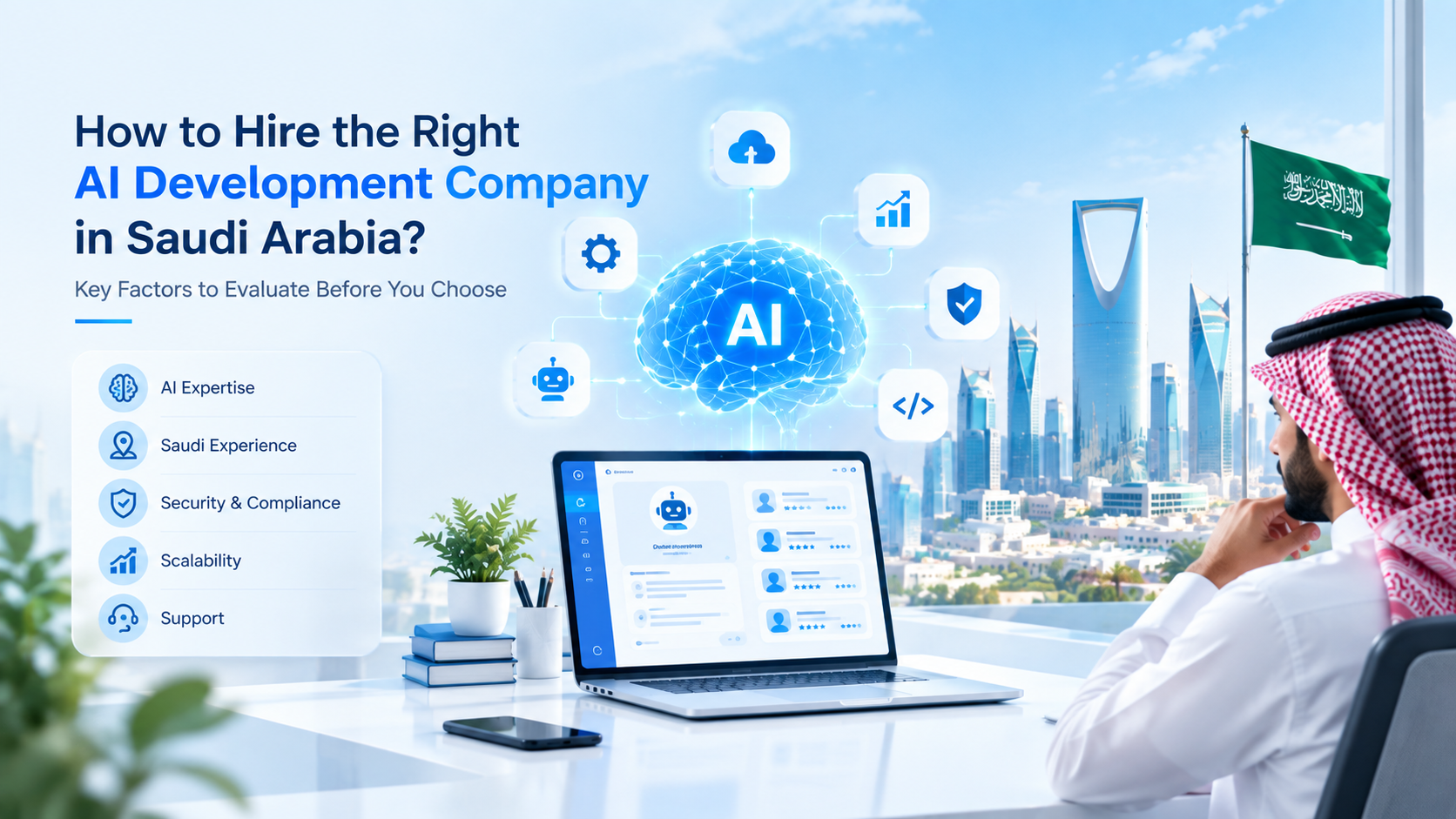
What Should You Look for in an AI Development Company?
The first thing to evaluate is whether the company understands your business problem—not just the technology.
For example, a retailer might want an AI recommendation engine to improve product discovery, while a healthcare organization may need intelligent appointment management or document analysis. Both involve AI, but their data, security, workflows, and success metrics are completely different.
Before reviewing technical proposals, ask potential vendors to explain:
What business problem will the AI solve?
What data will the system require?
Is machine learning actually necessary?
How will performance be measured?
What will the first version of the solution include?
How will the system be maintained after launch?
A good development partner should be comfortable challenging unnecessary requirements instead of recommending AI simply because it's popular.
Evaluate AI and Machine Learning Expertise
AI development covers a wide range of technologies. Depending on the project, your partner may need expertise in machine learning, natural language processing, computer vision, predictive analytics, generative AI, recommendation systems, or intelligent automation.
When evaluating an Ai and Ml Solution Company in Saudi Arabia, don't stop at the list of technologies on its website.
Ask for examples of how the team has handled real-world challenges such as:
Data Preparation
AI models are only as useful as the data supporting them. Your development partner should understand data collection, cleaning, labeling, storage, and preparation.
Model Development
The team should be able to explain how models will be selected, trained, tested, and evaluated according to the project's objectives.
Integration
An AI model rarely operates alone. It may need to connect with your CRM, ERP, mobile application, website, cloud infrastructure, databases, or existing enterprise software.
Model Monitoring
AI systems may need ongoing monitoring because data and user behavior change over time. Your development partner should explain how model performance will be reviewed and improved after deployment.
Check Their Understanding of Your Industry
AI solutions are highly dependent on context.
A banking application may require strict controls around financial data, while a manufacturing solution could focus more heavily on equipment data, predictive maintenance, and operational efficiency.
Healthcare, retail, logistics, real estate, and government applications also have different requirements.
This is why industry experience can be valuable when selecting an AI partner in Saudi Arabia. The development team should understand your workflows and the practical limitations of implementing AI inside an existing business.
For instance, if you're automating document processing, the team should first understand what documents employees currently handle, where delays occur, what information needs to be extracted, and what happens when the AI isn't confident about its result.
That level of discovery is often more valuable than simply choosing a vendor with the longest list of AI technologies.
Ask About Data Security and Governance
AI projects frequently involve large amounts of business or customer data, so security shouldn't be treated as a final-stage feature.
Before hiring a development company, ask how it handles:
Data access controls
Encryption
Secure APIs
User authentication
Data storage
Model access
Audit trails
Third-party AI services
Backup and recovery
Data retention
For businesses operating in Saudi Arabia, the applicable regulatory and data-protection requirements should also be considered based on the industry and type of information being processed.
If your AI application handles customer information, employee records, financial information, or healthcare data, ask the development partner to explain how those data flows will be managed before development begins.
Don't Ignore the Technology Architecture
An AI application is more than a machine learning model.
The complete architecture may include the mobile or web application, backend services, databases, AI models, APIs, cloud infrastructure, analytics, authentication, and monitoring tools.
A strong technical partner should be able to explain why a particular architecture is being recommended.
For example, if you're developing an AI customer-support assistant, the solution might need to connect with your knowledge base, CRM, customer account system, analytics platform, and communication channels.
The AI component is only one part of the product.
This is also where scalability becomes important. A prototype that works for a small internal team may require a different architecture when thousands of customers begin using it.
Define the AI Project Scope Before Discussing Cost
AI project pricing can vary significantly because development complexity varies significantly.
A simple AI-powered feature integrated into an existing application is very different from building a custom machine learning platform from scratch.
Your investment can be influenced by:
AI model complexity
Data availability and preparation
Number of integrations
Application platforms
Backend requirements
Cloud infrastructure
Security requirements
User volume
Custom model development
Testing and quality assurance
Post-launch monitoring
Instead of asking only for a total project price, request a breakdown covering discovery, design, development, AI implementation, testing, deployment, and ongoing support.
This makes it easier to compare proposals from different vendors.
Start With an MVP Rather Than Building Everything
One common mistake is trying to introduce AI across an entire organization at once.
A better approach is often to identify one high-value business problem and build a focused first version.
For example, a company dealing with hundreds of customer inquiries could begin with an AI support assistant. Once the system demonstrates value, the business could expand into automated ticket classification, customer sentiment analysis, recommendation systems, or predictive analytics.
This approach gives decision-makers actual usage data before making a larger investment.
The development roadmap can then evolve based on measurable results rather than assumptions.
How to Compare Potential AI Development Partners
Once you've shortlisted companies, compare them using practical criteria rather than choosing the lowest quote.
Look at:
Technical expertise: Can the team explain AI architecture and development decisions clearly?
Relevant experience: Have they built solutions similar to yours?
Data capabilities: Can they work with the type and volume of data your project requires?
Integration experience: Can the solution connect with your existing systems?
Security: Do they have a clear approach to protecting sensitive information?
Communication: Will you receive regular updates, documentation, demos, and access to the relevant team members?
Post-launch support: Who will monitor, maintain, and improve the AI system after deployment?
You should also ask to see a realistic project roadmap. Be cautious of vendors that promise sophisticated AI results without first understanding your data, users, and business objectives.
What Questions Should You Ask Before Hiring?
Before signing an agreement, ask your shortlisted vendors:
What AI approach would you recommend for our business problem?
Do we have enough suitable data for the proposed solution?
Would you build a custom model or use an existing AI service?
How will model accuracy and performance be measured?
How will the AI integrate with our current software?
How will sensitive business data be protected?
What happens when the AI produces an incorrect result?
How will the model be monitored after launch?
What is included in the initial development scope?
What ongoing maintenance will we need?
The answers should be specific to your project. Generic responses usually aren't enough when you're making a significant technology investment.
Final Thoughts
Hiring the right AI Development Company in Saudi Arabia requires looking beyond technical buzzwords. You need a partner that can connect AI capabilities with an actual business problem, work with your data, integrate the solution into your existing technology environment, and support the product after launch.
Whether you're exploring generative AI, predictive analytics, intelligent automation, computer vision, or machine learning, start with a clearly defined use case and measurable business objective.
Techugo can work with businesses to assess their AI requirements, define an appropriate development roadmap, and build AI and machine learning solutions around specific operational and customer needs.
If you're planning an AI initiative in Saudi Arabia, start by identifying the business problem you want to solve, then discuss your data, requirements, technology options, estimated investment, and roadmap with an experienced development team.
Comments
Log in or sign up to join the conversation.