

One of my most fatal flaws is my misplaced tendency to pattern-match. When I am around someone who has a British accent, I develop a slight British accent (and my actual accent is pretty confusing to begin with, a mix of Kentucky and Rhode Island with a minor speech impediment.) Or I’ll start mirroring people’s movements within a conversation or start matching their laugh or sometimes, much to the chagrin of my dear friends, I’ll start to try to finish their sentences for them.
Much of human nature is this, learning how we navigate environments that we don’t fully understand. We watch and listen to others to figure out how one should act. It seems as though that’s what people are doing as the economy changes. Trying to predict its next move, to always stay one step ahead of it, to try and make sense of the way it keeps changing and their role within it.
A big thing that has changed is payoff structures. You can get really, really rich if you own a lot of stuff—houses, stocks, etc. You can’t really get the same kind of rich if you’re just relying on labor income. This creates a disconnect (or seems to) between effort and outcome. Why work so hard if it doesn’t payoff? Why try? And if the economy organizes itself around asset holders, which it has, that leads to a culture of hostility and institutional illegibility. When people can no longer parse how their hard work might lead to a “normal life,” they pattern match the environment they are in.
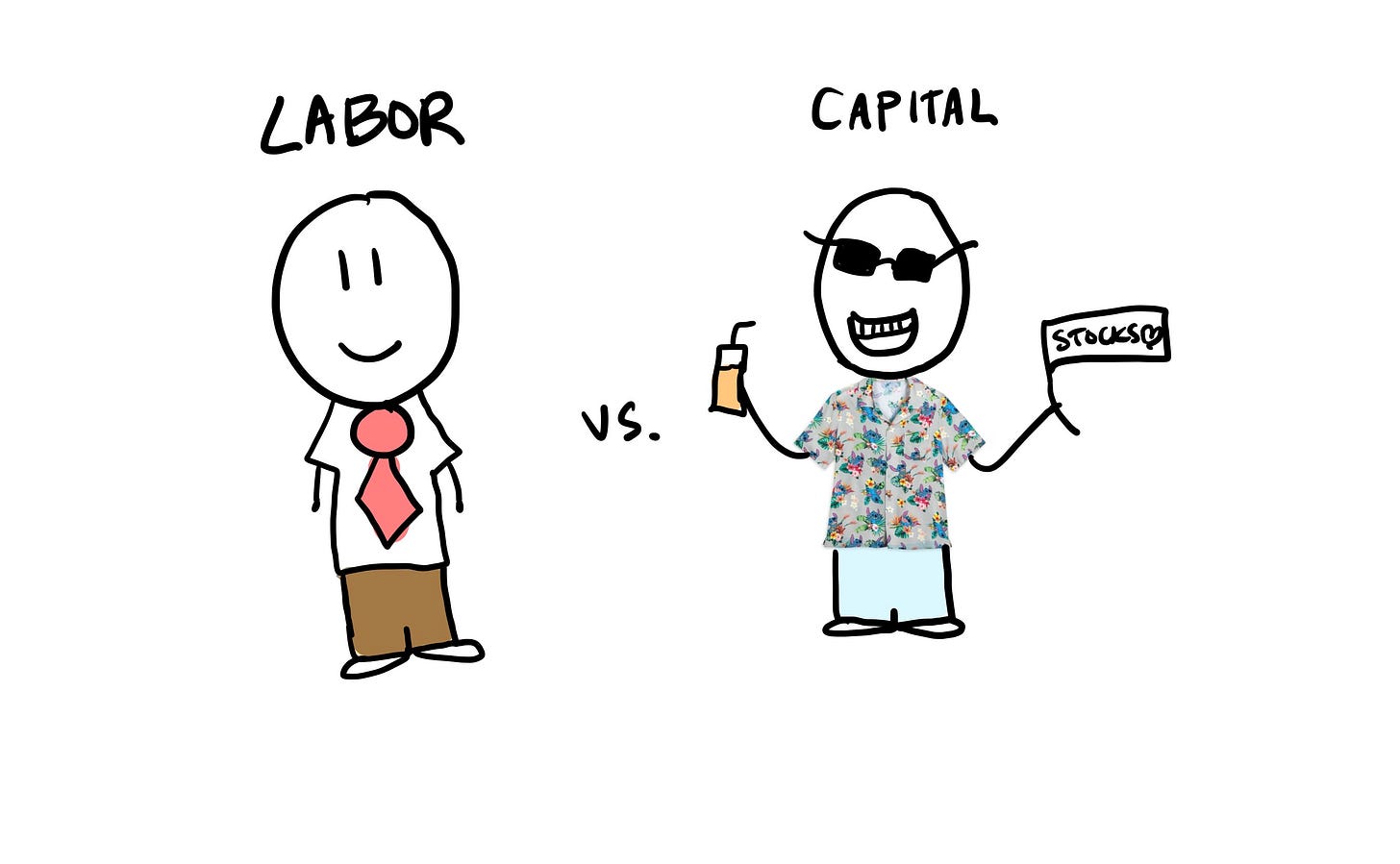
Part I. Labor vs Capital
The economy increasingly rewards ownership over effort, which has created some… problems.
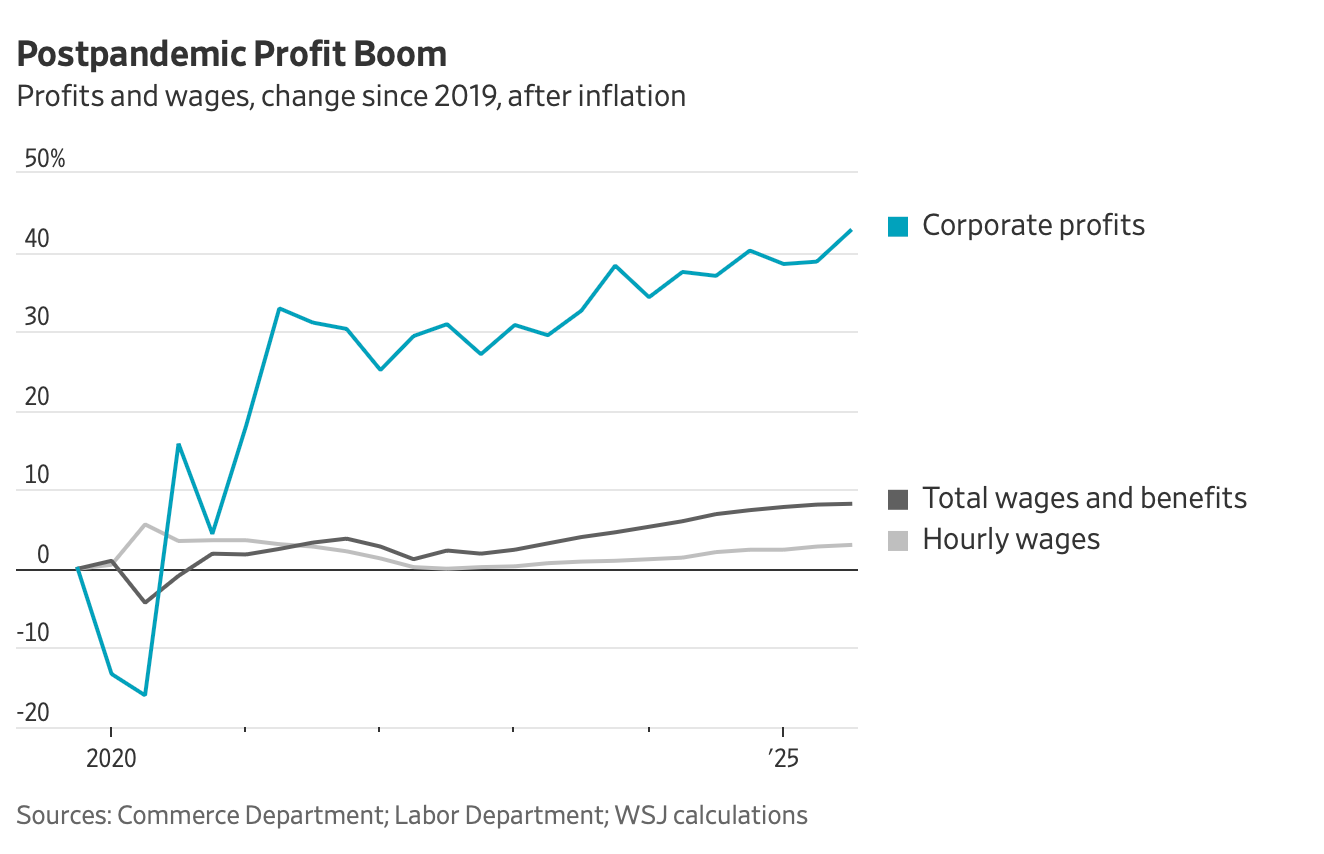
As Greg Ip wrote in the Wall Street Journal, labor received about 58% of total proceeds of economic output, as measured by gross domestic income, in 1980, a number that has since dropped to about 51% as of late last year. Over the same time frame, corporate profits’ share of the economy rose from 7% to 11.7%. Ip writes:
[The economy’s] rewards are going disproportionately toward capital instead of labor. Profits have soared since the pandemic, and the market value attached to those profits even more. The result: Capital, which includes businesses, shareholders and superstar employees, is triumphant, while the average worker ekes out marginal gains.
Ip points to the fall of unions and the rise in automation and fewer workers working at the superstar companies today as compared to decades past (he notes that IBM (IBM) was the most profitable company in 1985, with 400,000 workers. Nvidia (NVDA), 20x more valuable, inflation-adjusted, employs about a 10th of that) as the reason behind this seismic shift in the economy.
Paul Krugman points to the tax code. He has a series of explainers on how this works — we have (1) the payroll tax, which is tax on workers, and we have (2) a corporate income tax, which is a tax on capital. In the 1950s, over a fifth of federal revenue came from the corporate income tax, but today, it’s under a tenth due to the usual tax cuts and loophole shenanigans. But the payroll tax, the tax on work, went the other way. It grew from a sliver of federal revenue to the second largest source. So the government used to collect a lot more money from capital, and instead, collects it from paychecks. The tax code migrated in the same direction as everything else, toward favoring ownership over work.
You can think of the entire economy as one giant company with one pot of money to split between the (1) people who do the work and the (2) people who own the work. In 1980, workers got almost 60 cents of every dollar, but now it’s about 50 cents. Profits are up from 7 to 12 cents per dollar. The worker’s share fell about 10 cents, but the owners’ share rose by two-thirds.
Sure, whatever, right? But when you multiply it by a multi-trillion dollar economy, it’s a loss of somewhere between $8,000 - $12,000 a year for the worker, depending on the calculation used. And there are other pressure points bubbling around this too. The worker is taking a smaller and smaller share of the economy, but also, the money they make doesn’t… count as much.
How to Make Money
There are two ways to make money:
Wages, salaries, and benefits from an employer
Nonwage income, like Social Security payments, retirement account disbursements, capital gains, self employment income, alimony, gambling money, etc.
Most Americans make most of their money from wages. According to the Minneapolis Fed, the median American pulls in $3,000 from nonwage income per year, but about $37k in wages. Part of the problem with wages is that inflation gnaws away at them, and has wiped out all wage gains over the past four months.
But some people make a lot of money in the nonwage income category - the very rich and the older population.
Part of this is logical. As you age, you take in Social Security. As you grow rich, you mostly grow rich from stocks, as John Burn-Murdoch documented, noting that the median household’s net worth has roughly doubled in real terms since the mid-1990s, driven by the surge in stock prices and home prices over that same time frame, while incomes grew only around 50% (which is still pretty good.)
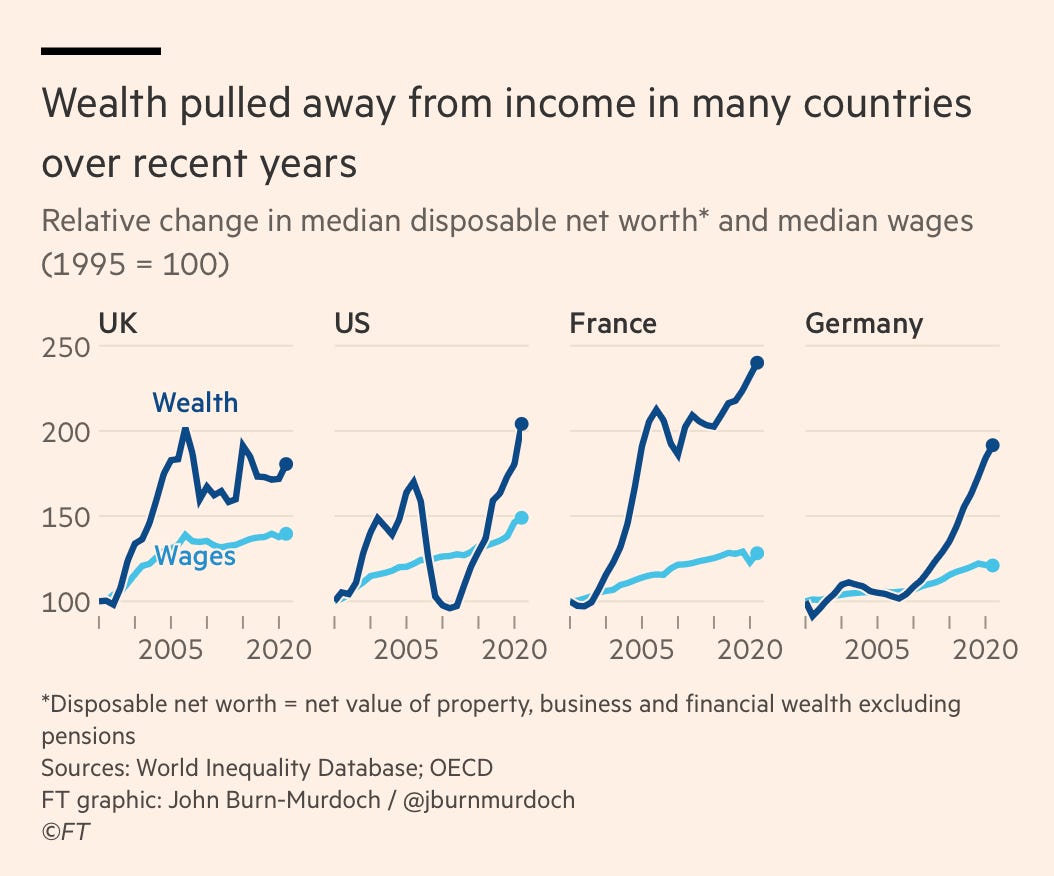
Chart plots median net worth and median wages, both indexed to 1995. US wages up 50% on this measure and the 20
As he points out, a generation ago (in the UK specifically) it took about 20 years of saving from an average salary to climb from the bottom quarter of the wealth distribution to the top quarter. Now it takes… 40 years. Almost a lifetime. Same theme in the States.
So how do you get rich?
Nonwage income.
42% of the nonwage income for the top 1% comes purely from capital gains, from stocks. The second biggest component is S-corp income, which as the Fed researchers note, is “labor in the economic sense.” It’s definitely a form of what we would consider “work.”
For older households, their nonwage income is a reflection of the work they’ve done through Social Security payments and the retirement accounts they spent careers filling.
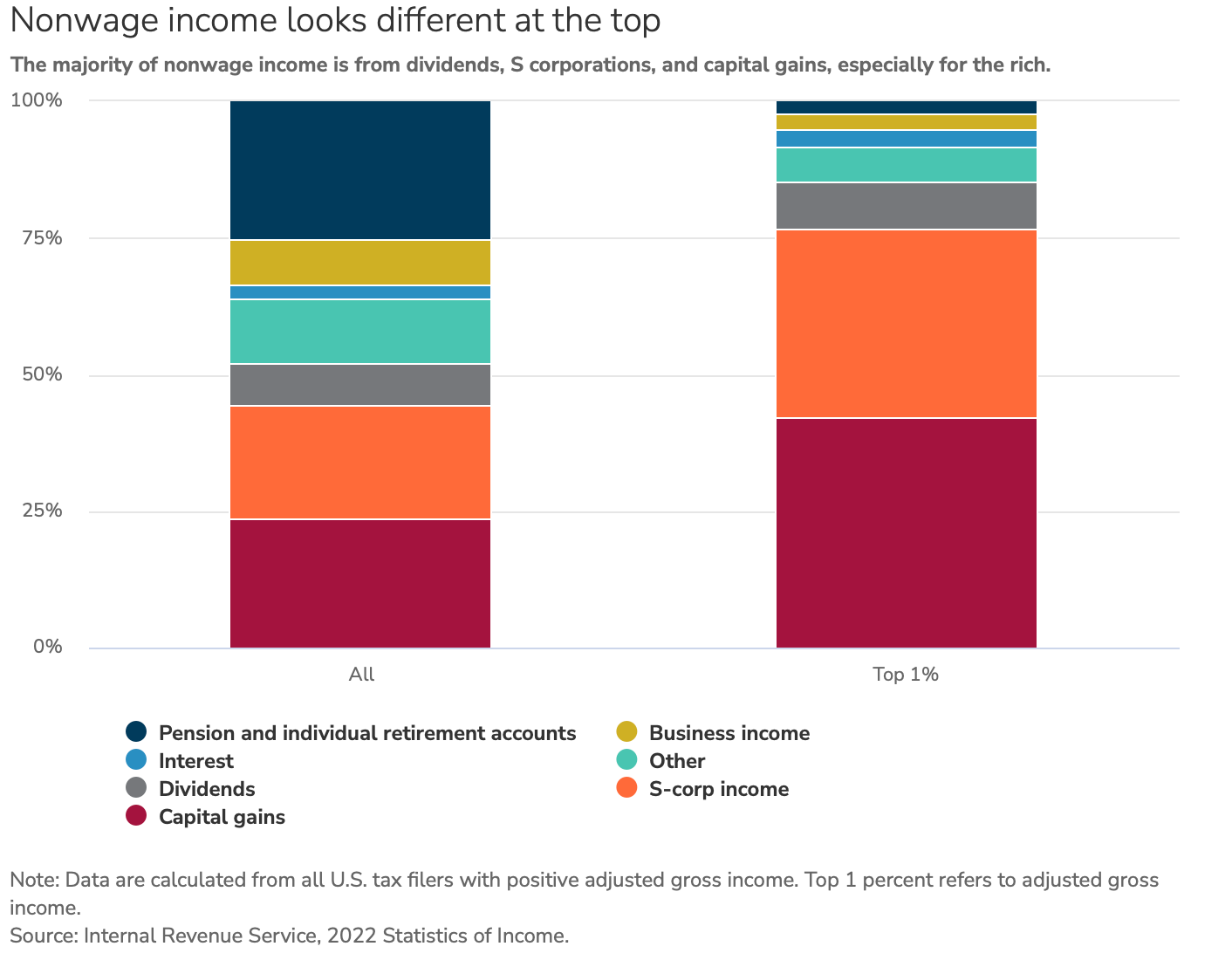
So… stocks. If you do the math here, at least (at least) a quarter of everything the richest filers report is pure gains, money made from money making money. That’s one of the most remarkable things about the present moment is that it’s never been more obvious that wealth begets wealth. Money can make more of itself if it sits inside the right investment account. Wealth—ownership—feels like it matters more than any sort of labor income, because wealth builds more wealth.
How to Make Money (Passively)
People see this. Over half of Americans, including 60% of Gen Z adults, say that a full-time job won’t let them meet their goals, according to reporting by the Wall Street Journal. 1 in 4 Americans have a side hustle, and everyone, everyone wants passive income. Google (GOOGL) search interest in “passive income” has increased by about 50% over the past five years or so. One person describes it as:
How little can I put in and make as much money as possible?
Much of this passive income world is filled with grifters, people who sell courses on how to make passive income to people who need passive income. The courses, of course, don’t really work.
Part of the desire for passive income is sheer dissatisfaction with work. According to the Wall Street Journal, 1 in 4 white collar workers have gone five years without a promotion or pay raise, with one worker, Sidi Traore, telling the Journal, “Job security, it’s a fallacy. We could get a six-figure job, but if you’re no longer an asset, they could fire you today or tomorrow.”
People are dropping out of the labor force entirely, especially those without a college degree. And this relationship to work, and the money we make or don’t make within it, is showing up in the media we consume, as Inkoo Kang wrote about in the New Yorker:
A fresh batch of shows has met the moment by focussing on the other side of the K-shaped economy: the downwardly mobile middle class. “DTF St. Louis,” “Beef,” and “The Comeback” feel tailor-made for an era marred by inflation anxiety, affordability crises, and fiscal doomerism […] these new programs capture the perspectives of those who fundamentally believe they should have more—and might in fact have more, in a fairer system.
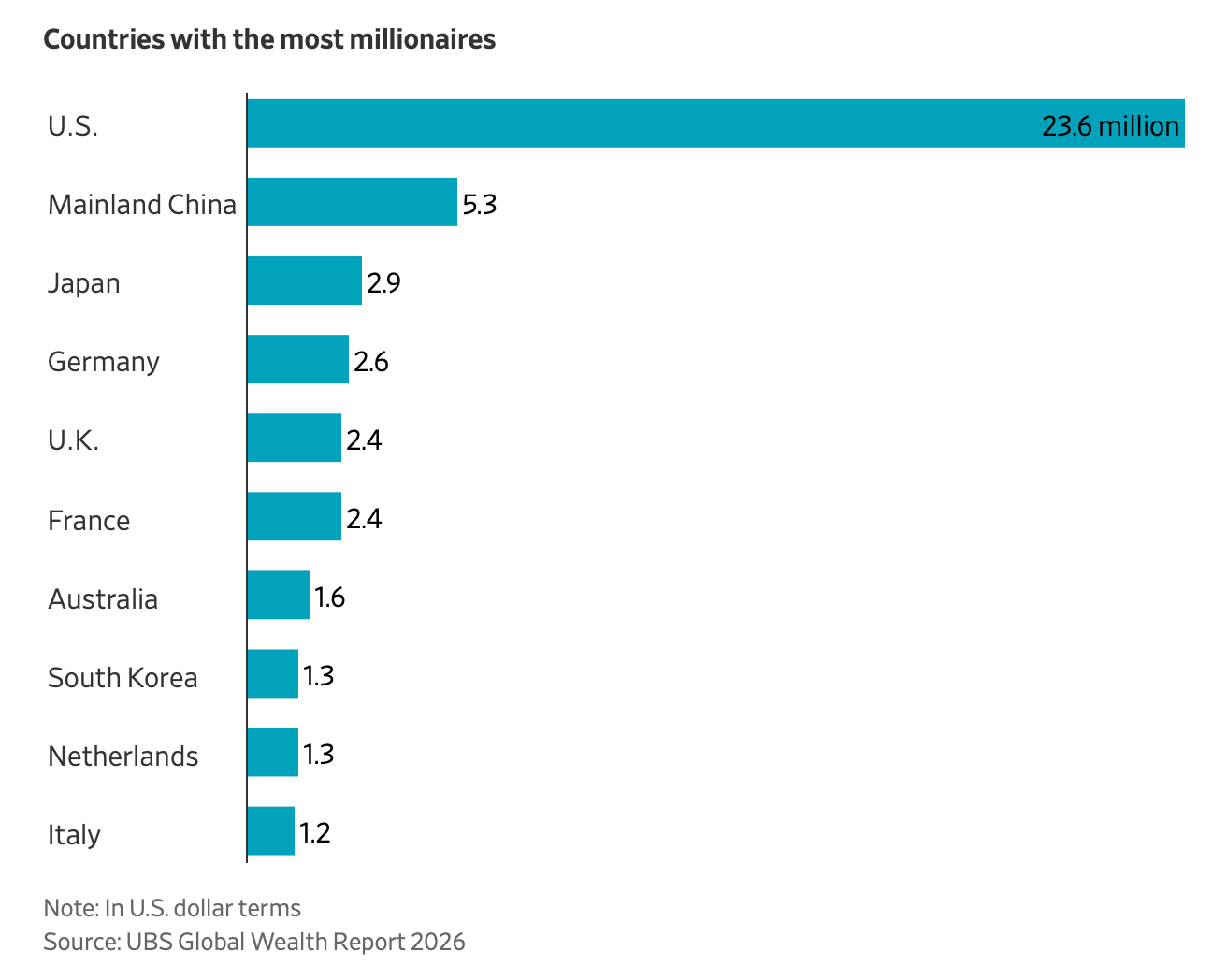
For a long time, the shows of the moment were things like White Lotus and Succession, but it seems like shows that document extensive and otherworldly wealth aren’t that… interesting anymore. Works of fiction became a little too real, and the real world became a little too fictitious. After all, the US added 1,200 new millionaires a day throughout 2025, mostly due to stock market gains. Financial assets, like stocks and bonds, account for almost 80% of gross wealth in the US.
Everything is the AI Trade Now
The AI boom is just the newest, most visible installment of this. Asset holders are getting very rich off a technology, that threatens to displace work and life as we know it (supposedly, although I would advocate to market it as “the next Internet” rather than “job killer 1000”) and it will also make everything in its wake more expensive, including computer prices and electricity costs.
The lesson that this era seems to have imparted is that all the hard work that you’ve put forth, is meaningless. What will bring you meaning? Money. Lots of money.
This creates a sense of malaise, as has been extensively documented, as the stock market rips and the economy surges forward, mostly powered by this AI boom. Neil Dutta points out in a recent piece for Bloomberg that Everything is the AI Trade Now™️, tying together (1) the people getting real rich off stock market wealth driving consumption to (2) state government revenue from the data centers (if they keep building them) to (3) companies like Caterpillar (CAT) and Cummins (CMI) essentially trading like tech stocks because everyone is within the AI capex order book.
The AI wealth effect, as it’s called, feels almost inescapable.
No wonder there is an enormous amount of data center backlash. Of course there is. Here is yet another thing, promising growth and opportunity (that it very well could deliver on) that’s being plopped down without much consideration and almost certainly going to make a select few people fabulously wealthy. So wealthy that all our money is going to it—in June, data center construction outlays hit almost $70 billion at annual rate, and outlays on everything else, including homes and hospitals, fell by $100 billion.
For Asterisk Magazine, Zilan Qian writes about China’s relationship to AI, which compared to Americans, seems optimistic:
Stanford University’s 2026 AI Index Report shows that more than 85% of Chinese respondents see AI as more beneficial than harmful, compared to less than 45% of respondents in the United States. A 2025 report published by the University of Queensland and KPMG Australia revealed that 73% of Chinese respondents are willing to trust AI system outputs and share relevant information with AI at work, and 88% intentionally use the technology, compared to 52% and 48% of Americans, respectively.
But Qian explains that this is not unbridled joy as much as it is China’s fear, given the enormous changes to their economy over the last fifty years or so. Qian describes it as “a possible coping mechanism is to rapidly accept and embrace it, because history has taught the Chinese that the only coping mechanism is to change oneself.”
But it does seem like Americans are changing themselves when it comes to this newest round of wealth generation opportunities. They are pattern-matching too. They are seeing the writing on the wall: that the job is perhaps not enough, that what really matters is Stock Market Money, and that’s it. And this is not just oh harrumph, people don’t want to work anymore, pull those bootstraps up to your earlobes—our relationship to work itself has changed.
AI (or at least, the CEOs of AI companies when they are on various stages) is actively threatening the labor market, so Americans, logically, are rethinking work. The World Economic Forum guesses that AI might displace 92 million jobs by 2030.
Employers are rethinking work too. 1 in 3 corporate employers are changing their hiring plans because of AI, and because older workers are working longer.
Researchers out of Stanford found that jobseekers would have to apply for 25 jobs in order to receive at least one chance to go to a second round interview.
Most of the job growth in the economy is in healthcare, which will likely continue into the future, driven by an aging economy and the wealth of the older population.
As Adrian Wooldridge wrote:
Economic revolutions produce grievances for three main reasons. They disrupt established ways of doing things, make a small number of people exceedingly rich, and deprive workers and citizens of a sense of agency
And this revolution is happening faster than all the others:
Four decades passed between Edison’s first public demonstration of electricity in 1879 and many regular Americans getting access to the new magic. ChatGPT reached 100 million users within months of its 2022 launch. Big Tech is betting on the change gathering pace: Spending on AI could reach $2.5 trillion by the end of 2026 and even cash-stuffed companies are borrowing heavily.1
Logically, in that sort of economy, where the established ladder is disrupted and agency is lost, the relationship to work evolves. Emi Nietfeld wrote a piece for the New York Times about America’s changing relationship with ambition, noting that:
[Younger people] no longer believe work in the traditional sense leads to any reliable payoff. The casino economy they’re entering doles out success in the form of windfalls, and makes those wins vanish just as suddenly. Ambition requires a belief that you have meaningful control over your future. With so much uncertainty today, it can feel pointless to prepare for tomorrow.
And to be clear, people still do prepare. As the Atlantic reported, “a 2024 Charles Schwab (SCHW) survey found that the average Zoomer started saving at age 19, younger than other generations had. (The typical Boomer, for comparison, began at 35.)”
But as I (along with many others) have talked about before, and to Nietfeld’s point, many people are just looking for windfalls. Northwestern Mutual noted in a study that “80% and 75% of Gen Zers and millennials” are “drawn to speculative investments because they feel financially behind.” This is prospect theory at a generational scale: when normal life pulls out of reach, lottery-like bets (crypto, meme stocks, options trading, Gary Vee NFTs) start looking pretty rational.
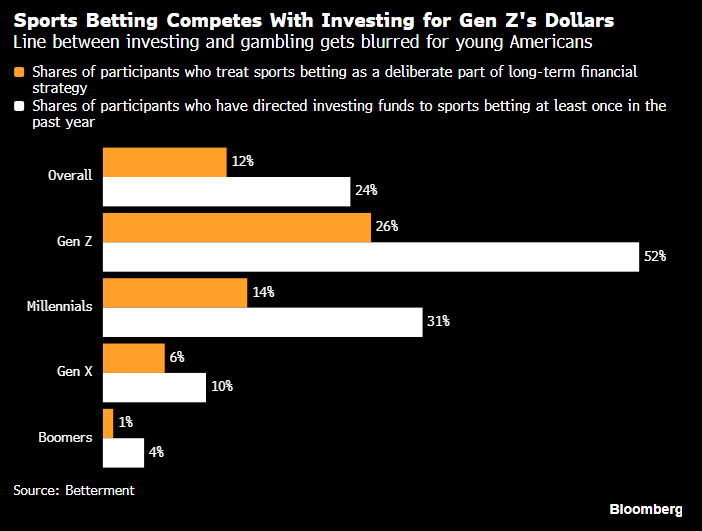
The graph above—sports betting as a (1) financial strategy and (2) investment vehicle among young traders—is not Gen Z being “irresponsible” or “stupid.” Eric Balchunas posted this on Twitter, and many of the comments were expressing concern about gambling and investing bleeding together, which is only growing more concerning because the two increasingly live within the same apps. Robinhood (HOOD) lets you do it all—everything from an IRA to betting on what Trump says next, all within the app. It’s completely a design of the apps, for the apps, by the apps. Incentives!
However, one person said this
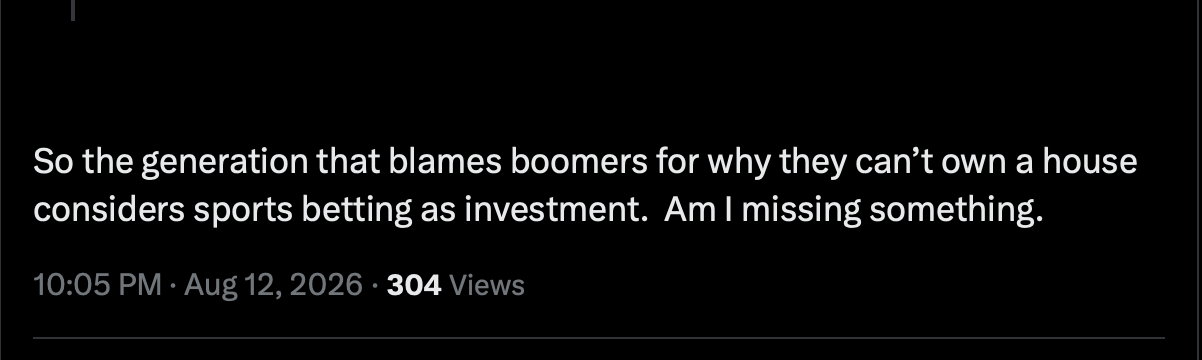
They aren’t missing anything, but these are incentive structures. The house is fundamentally out of reach. In order to get to the house, you have to get a windfall. If your job isn’t paying you enough, you might look to sports betting as a way to get that windfall.
All of this is incentive structures, all the way down. It’s pattern-matching, optimizing to the current environment, which rewards huge, enormous swings in a muddy, shallow pool where gambling and investing have totally blurred—the yolofolio world.
And this is not just the United States. In South Korea, “the number of active individual stock trading accounts in Korea has neared 110mn — the equivalent of about two for every citizen” with many choosing to invest because “home ownership has become out of reach for many young Koreans.”
It’s arguably more intense there than it is here, mostly because South Korean markets are hyper-concentrated in stocks like SK Hynix and Samsung. The Financial Services Commission is now requiring traders to go through trading exercises to get access to leveraged single-stock ETFs, funds that double one stock’s daily moves.
This sort of logic ends up entering into the relationship that many students seem to have with the new AI tools as well. School is ultimately means to an end, a chance to get into the perfect university to get the perfect job to have the perfect life. You’re going to tell some of the most anxious people in human history that they can’t use the magic homework machine?? No way. In this economy, the thinking goes, you have to put all your cards on the table, and using AI tools to complete assignments is the way to do that.
And that goes back to Nietfeld’s point about the deterioration between effort and outcome. AI also erodes the effort part. We have to rethink what it means to work hard when a machine, for better or worse, can just do many things for us. What is the proverbial “game” when the computer can (supposedly) beat you? For many, considering the state of the labor market and the technology winding through it, it doesn’t really make sense to keep playing the game at all. And you see that in the data.
Young people say that they want to be entrepreneurs (3 in 4) and influencers (1 in 2) and get away from the corporate rat race. They say that $600k a year is needed in order to feel financially successful.
That’s quite high.
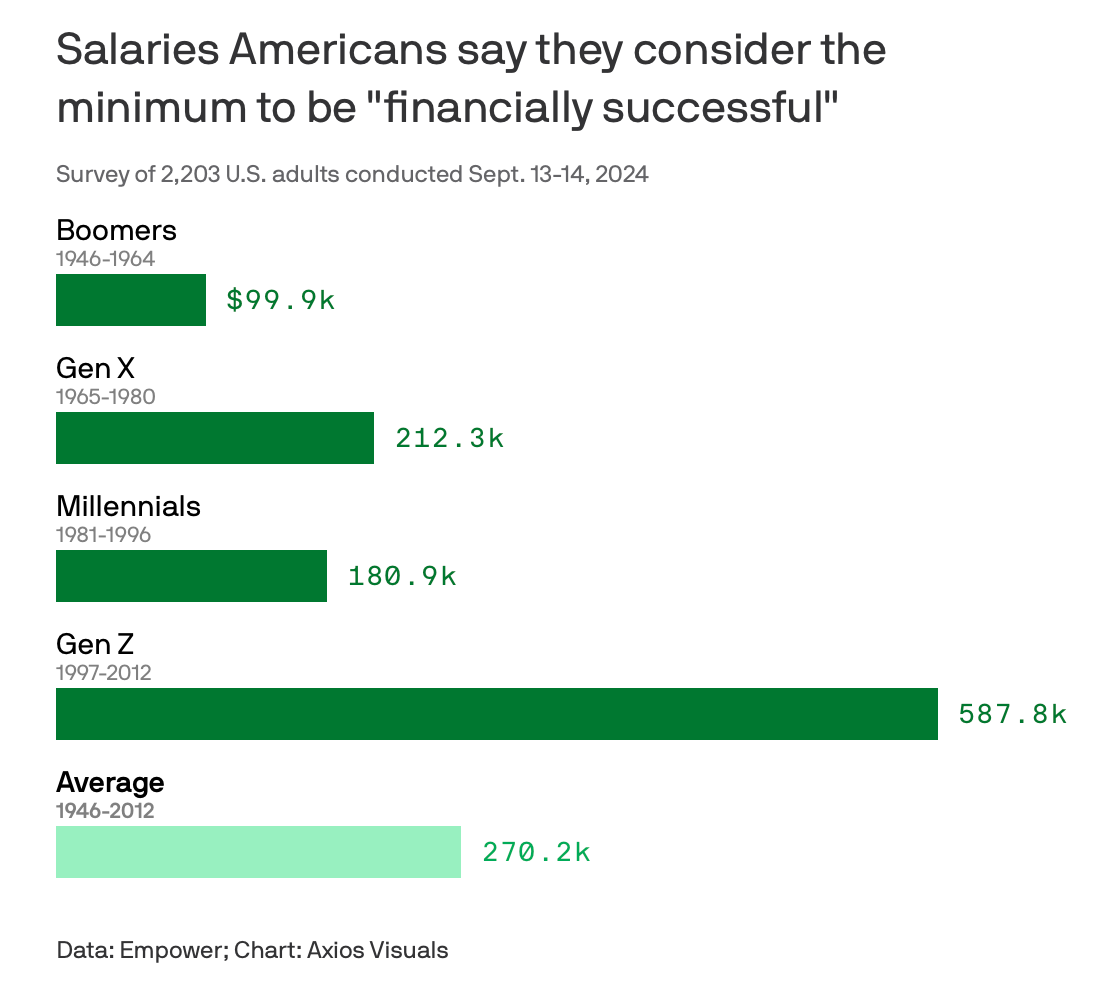
Axios notes that the reason younger people might feel this way is because:
Financial nihilism
High costs
Influencers
Mismatched expectations
Struggles with the career ladder
They do not believe they have a stake in the economy, or that the economy will work for them, as the economy gets rapidly more expensive, and as influencers make it all seem so… easy. I love Lauren Greenfield’s work on wealth. She has several important documentaries, including Generation Wealth and the Queen of Versailles, both of which walk through the excess (and sometimes excessive failure) of the ultra-wealthy and captured the rise of the proto-influencer.
She has been making the case for years that fame and fortune have become the new American dream. In a 2017 interview with NPR, she explained:
With the rise of reality TV and social media, everybody can be a celebrity and fame has currency. And so, in a lot of my interviews, when you ask kids what they want to be when they grow up they say: rich and famous [...] I think the backdrop of these 25 years is that we've never had more inequality and we've never had less social mobility," she says. “So, in a way, fictitious social mobility — bling and presentation — has replaced real social mobility ... because it's all you can get.”
Almost a decade later, and it’s more true than ever. The way you create social mobility if it is not available to you, is by creating a presentation of social mobility, a sense, that if someone were to scroll your Instagram, that you are Rich and Successful and Yes That Lambo is Rented and So is The Rolex, but Ignore That.
All that matters is the views. The views create the expectation. The views create the feeling of shame for the viewer if they are struggling with high costs. The views translate the shame into nihilism, distrust, and completely misaligned expectations.
But the views aren’t showing a real thing. They are showing the image of that thing, a simulation of sorts, a presentation that skews perception, all while being perfectly fake. But look at what it left behind: a viewer, completely distraught and ashamed.
So they try to do it too. Sometimes they pay the very person who made them feel behind for a course on how to catch up.
So it’s a circle. The more people that watch your videos about wealth, even if you are not yet wealthy, the higher the chance it is that you become so. Passive income courses that make passive income off course sales. A prophecy, for the ages.
The Presentation is Perception
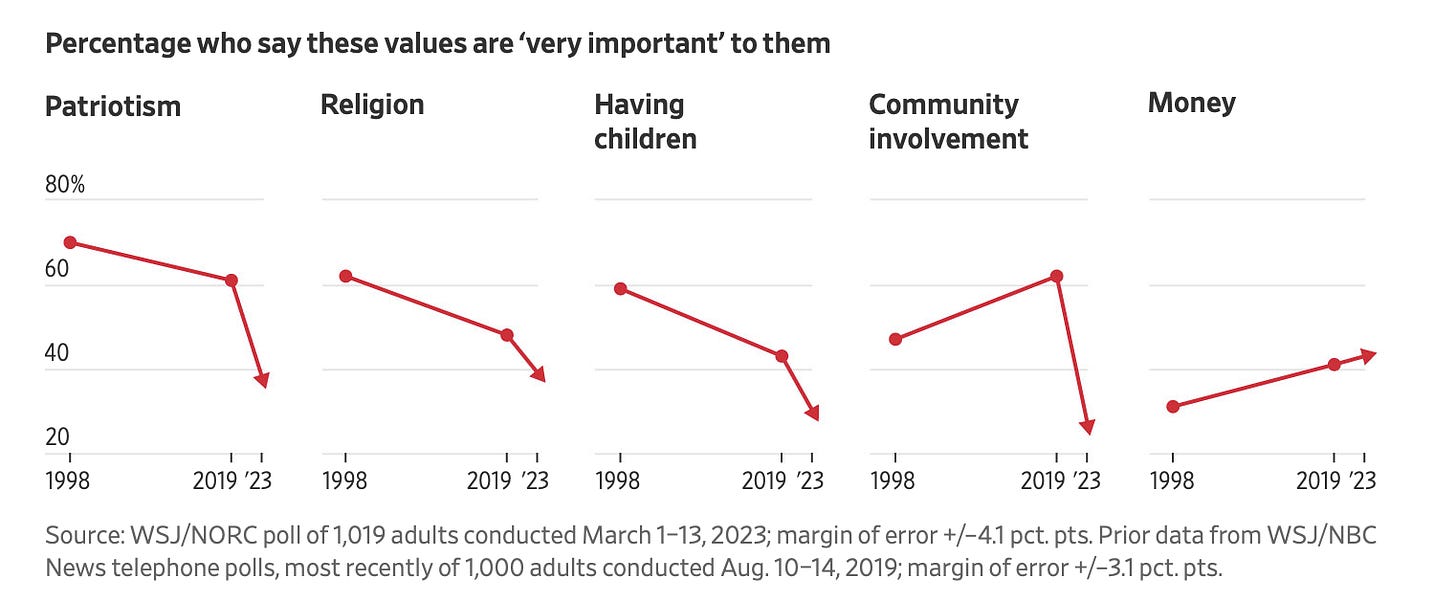
The presentation of wealth has infected the way we perceive wealth. And it’s haunting us. Money is the only value that has grown in importance over the past 25 years, according to a Wall Street Journal/NORC poll. It’s the only thing we seem to agree on — both Democrats and Republicans match here, with 45% of both groups agreeing that money is very important to them.
And of course, if money is the goal, especially the fictitious display of it via visual mediums, there will never, ever be enough of it. People will do crazier and crazier things for money, which MrBeast seems to be running the world’s most in-depth natural experiment on—17 of the 26 videos he has uploaded within the last year explicitly mention a dollar amount in the title.

A screenshot of MrBeast’s YouTube page
Money becomes an obsession. Financial independence is the most important thing for young people across the globe (likely because of social media). Being rich is not the most important thing, being stable is the most important thing. People are trying to buy security, because security, if it ever was a promise, certainly isn’t promised anymore.
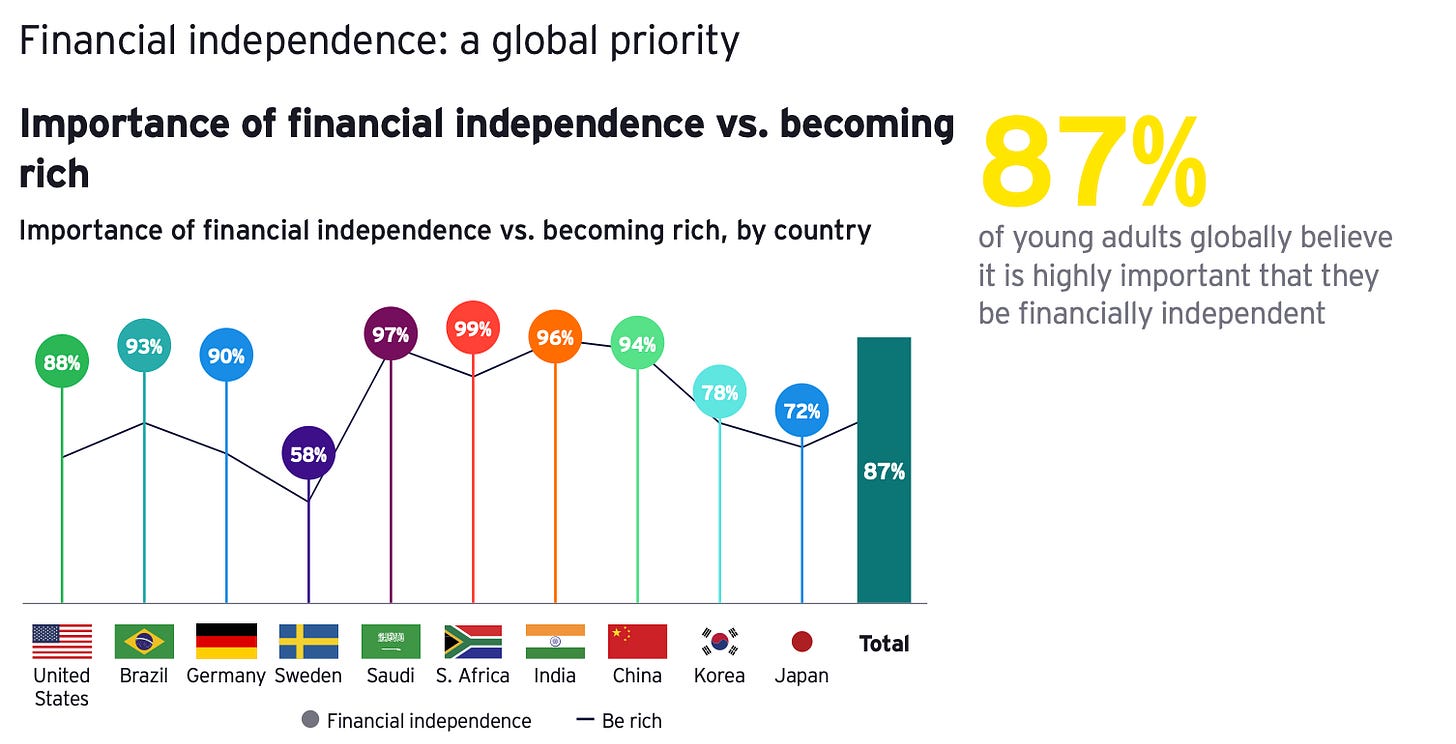
EY also notes that over 70% of young Americans still believe success is likely if one works hard, which is higher than Germany, Sweden, China, Korea, and Japan. But the US is low in trust, with almost 60% saying they distrust most people.
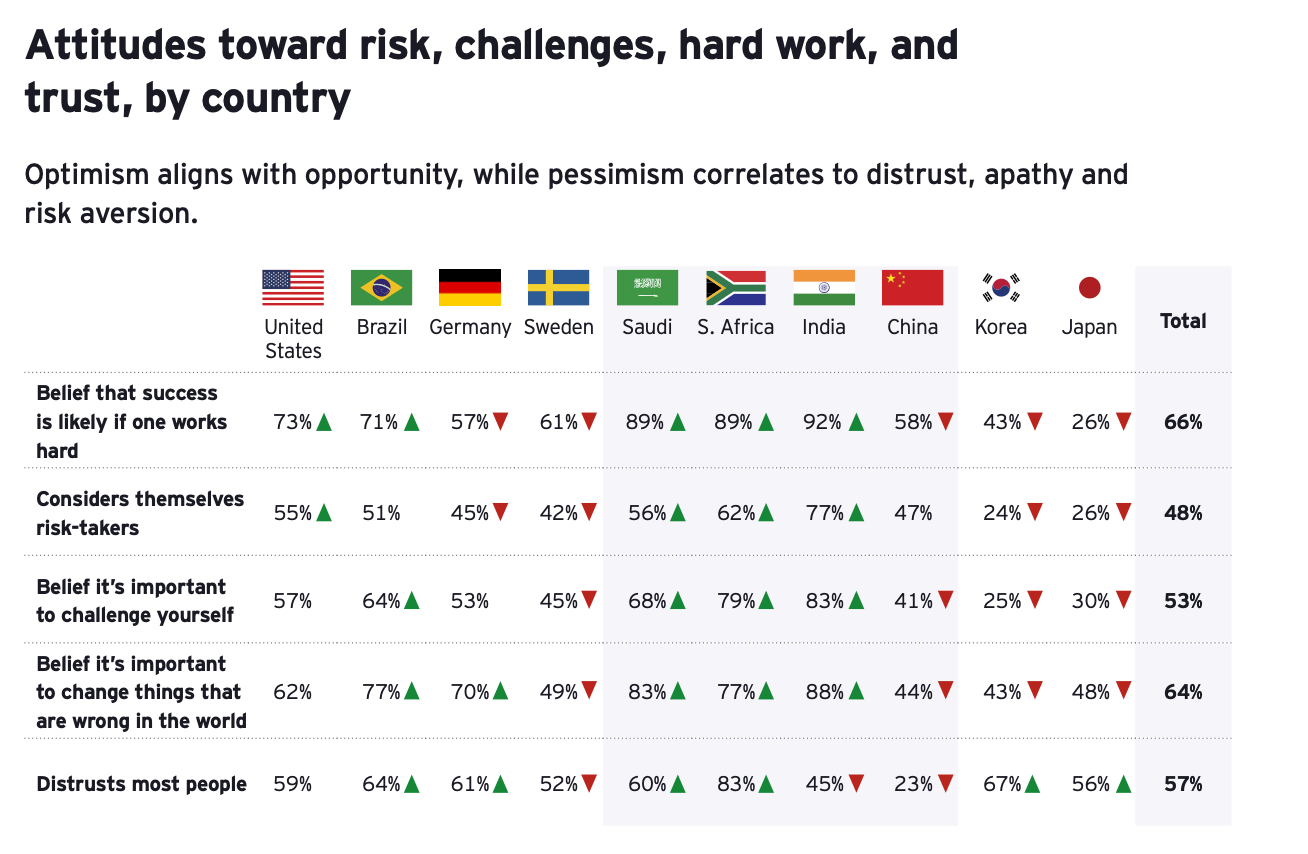
That lack of trust is corrosive to belief in the underlying system. According to another version of the WSJ/NORC poll, under half of Americans say capitalism works well and only 35% say “the nation offers people the ability to get good jobs and achieve the American dream.”
A young Chinese worker told the Financial Times that in China:
“Some people will say our generation is not so hard working but our environment has changed from the last generation. I think the last generation enjoyed the best time of China, with rapid development. But nowadays, sometimes people work hard, very hard, and what they get does not match their effort.”
It’s the same worry as what you hear from people in the United States. The last generation had it better. Everyone feels like they are on an infinite hamster wheel, spinning endlessly and listlessly. Because work no longer pays the way ownership does and because assets are increasingly concentrated in one demographic, the comparison does become generational.
Part II: Demographics
So who are they comparing themselves to?
I wrote a piece for NYT Opinion on the housing/retirement crisis, arguing that the two are one and the same—high home prices ensure retirement, which means that home prices, functionally, can never go down.
In the comments (and in the Letters to the Editor about the piece), many people took my analysis to mean that I personally was going to come and take their house away from them and that I was threatening to steal what they had (undoubtedly!) worked so hard for. This is a very prevalent fear in a lot of older, richer circles: that their wealth, buoyed by a record-breaking stock market and a housing shortage, will be taken from them. One person said
Here’s my response to Kyla Scanlon’s essay about the housing crisis in America: Although my home has increased quite a bit in value, I am not holding on to it for its potential further appreciation value. Why should I sell and move somewhere else when I currently have a 2.875 percent fixed rate on a 30-year mortgage? My age is irrelevant. Buy a new home with a 7 percent mortgage rate? No thank you.
This answer was interesting, because here, this person argues that they aren’t holding onto the home for appreciation purposes, but they are holding onto it for a lower interest rate, which is two sides of the same coin. Many of the other commenters pointed out that (1) their homes were expensive too (2) that the value of their home is not shutting other people out and (3) that everyone (including me) is blaming older people for the housing crisis.
I do not believe that most people who bought homes and have watched them skyrocket over the past several decades are responsible for the housing crisis. As Idrees Kahloon explains in the Atlantic, much of it was circumstance:
The typical home today costs five times the median annual income, up from 3.5 times the median annual income in 1984. Boomers got lucky: When they were young, they could afford to buy houses that then appreciated fantastically in value. But that luck was arguably manufactured by Washington, which engineered the rise of 30-year, fixed-rate mortgages and created tax deductions for mortgage interest and property taxes.
But it is imperative that we be honest about where the United States is at demographically. Honesty is not the same thing as casting blame.
By 2030, 1 in 5 Americans will be over the age of 65. In 1920, it was 1 in 20.
Almost half of Americans live in a county where those over 64 outnumber those under 15. This number was 5% in 1990, according to the Economist.
And that’s showing up in how the economy operates:
In 1989, Americans 55+ held a little over half of all wealth in the United States, now they hold 74%.
At the same time, wealth held by those under 40 fell from 11% to 6.6%.
People aged 70 and older are 12% of the population, which has grown from 7.5% in 1981.
They now hold 32% of all household net worth, up from 20% two decades ago.
Their share of household equities has nearly doubled since 2007, as has their share of real estate.
Part of this is pure demographics! There are a lot of baby boomers. They have been around a long time, and have had a lot of chances to accumulate wealth. The American experiment worked. We should be so happy that this worked for some (not all, to be clear).
But is it still working?
As Greg Ip wrote in his aptly titled piece, Over 65? Congratulations, You Own the Economy, there are a few things to consider here, including the fact that you can have a lot of money but not feel really rich. Many 65 + year olds are struggling to make ends meet.
But on the whole, this is an economy that worked for some, and now, has to keep working for them. But in order for the economy to keep working for these retirees, who drive over a quarter of consumer spending and counting, the economy has to change.
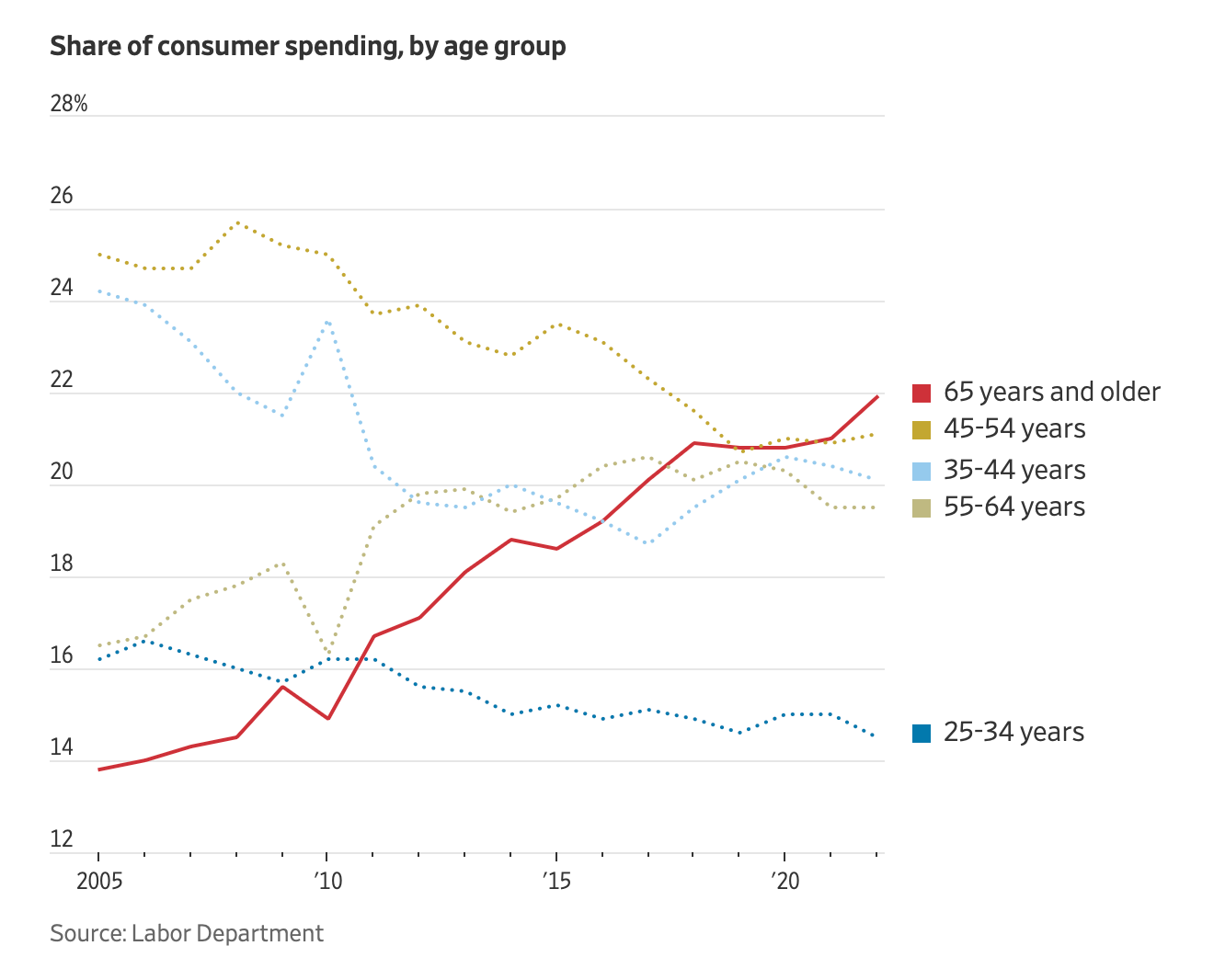
How will it change? Healthcare demands rise. More pressure is put on Social Security, and the dwindling number of workers that fund it. And the Boomers spend because they usually have no mortgage and not a lot of debt, so the economy ends up bending around them, in a way.
As you can see in the graph below, which uses data from the Federal Reserve’s Survey of Household Economics and Decisionmaking, most (not all) people who are over the age of 60 are doing pretty well. Over 80% of them say they are doing okay economically, which is tremendous.
And this a politically powerful cohort. They are entirely reshaping politics.
According to the Atlantic, the typical general-election voter is 52 and half of all money donated to political campaigns comes from someone over the age of 66.
According to the Penn-Wharton budget model, retirees get about $43k per person from the government each year, whereas children and young adults receive about $4,300 per person. This is only expected to increase, with federal spending on elderly programs expected to hit over 11% of GDP in the next decade, a big spike from 6.9% in 2007.
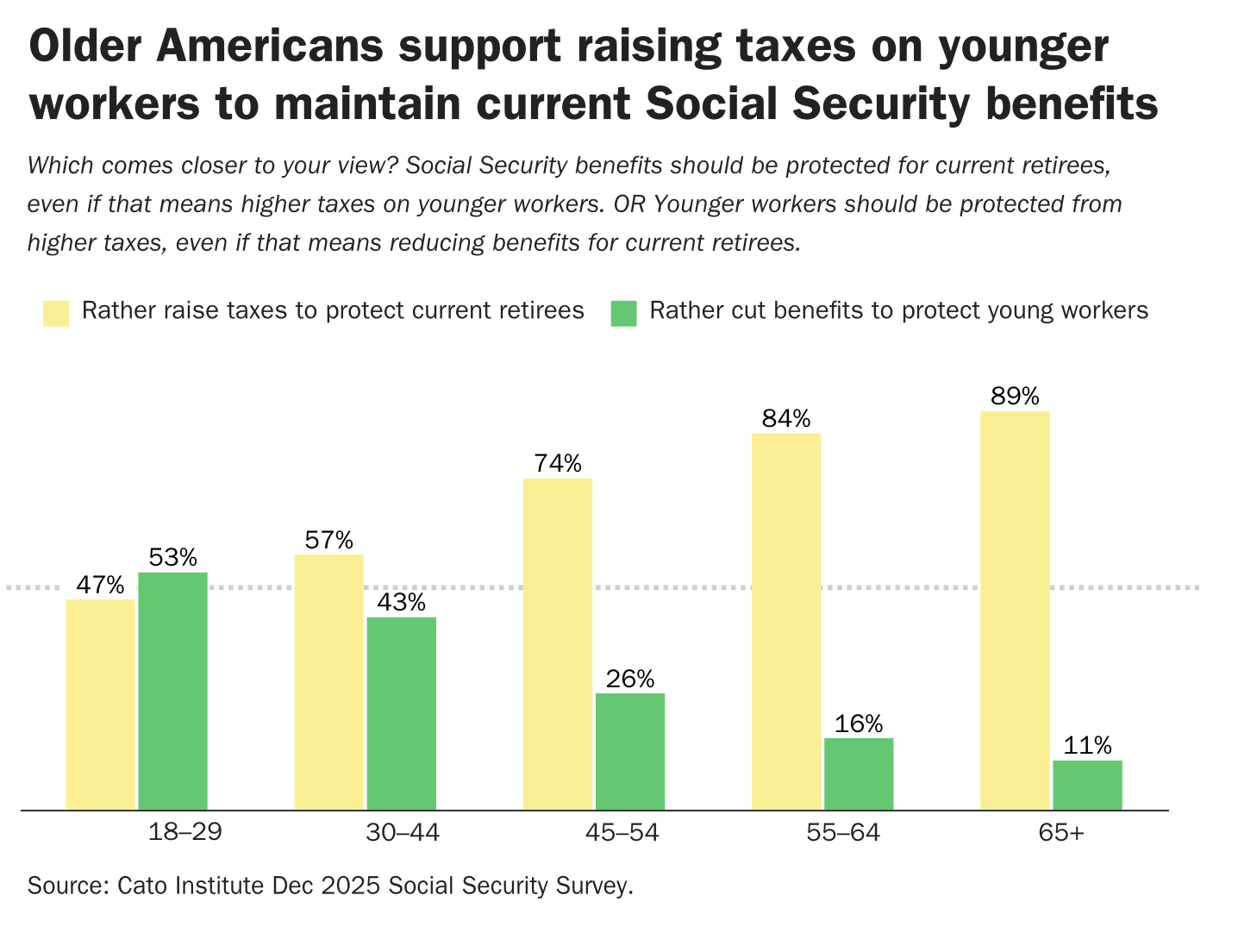
Older Americans also support raising taxes on their younger counterparts to ensure that their benefits are protected (which I think is more so a statement on wanting benefits to be protected, rather than advocacy for increased taxation)
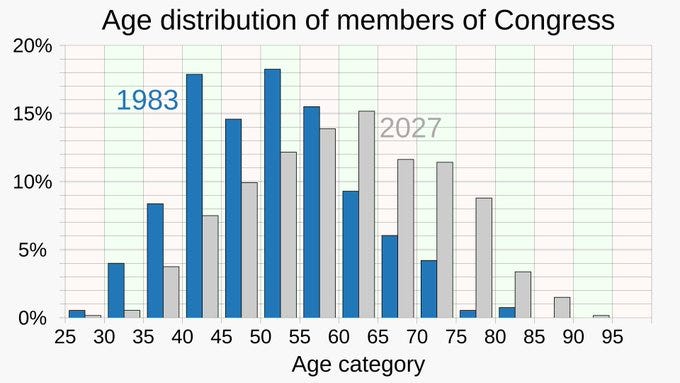
They are also a growing component of actual politicians making decisions, so it’s a one-two punch. The group that votes, the Boomers, are also largely the group that is creating legislation. I am sure you can guess the outcome of that.
As economist Jesús Fernández-Villaverde duly noted, the first-order problem of an aging society is redistributing income from workers to retirees. There are only two pipes for that transfer: taxes (Social Security) or capital income (retirement accounts). The first pipe is pretty visible because it shows up on a paystub, but the second is invisible because in a 401(k) economy, retirees collect their share of the nation’s output as corporate profits—through big ol stock market returns. Fernández-Villaverde’s point is that much of America’s anger at corporate profits is also a worker-retiree conflict in disguise.
Ed Yardeni recently made four points about what he calls the Boomer Spending Machine. Two we’ve covered: they are (1) wealthy and (2) have a lot of financial assets. But he adds that (3) the Boomers are pretty insulated from monetary policy, and in fact, even benefit from higher rates. As Yardeni writes:
For a large segment of the population, rates are not simply a cost of borrowing. They are also a source of income and the reason that home prices are rising!
Yardeni also points out (4) that the Boomers are pretty detached from the labor market, and that stock prices, home prices, and interest income drive their spending more than labor market conditions. More succinctly, “consumer spending is increasingly being supported by the spending from accumulated retirement wealth, rather than labor income.”
Part III: I’m Okay, They’re Not
So given an economy reorganized around people who already own things, it’s logical that over half of Americans say the American dream is out of reach, citing the cost of living and housing costs as the main hurdle.
Right?
But, according to CNBC, over 40% of respondents said they’ve already achieved the American Dream, and over half of those “who hadn’t said they were confident that they will eventually.” So it’s out of reach for others, but it’s still doable for me.
The article cites Elizabeth Suhay, who notes, “People tend to be more optimistic when talking about themselves or their futures than they are about the American public as a whole.”
This broad discontentment is potentially one of the main reasons for the gap that shows up in the Federal Reserve’s Survey of Household Economics and Decisionmaking, which asks people to (1) rate their own finances and then (2) rate the national economy. The difference is wide enough to drive a truck through. 73% of respondents say that they are “doing okay or living comfortably” but only 26% (!) rate the national economy as good or excellent.
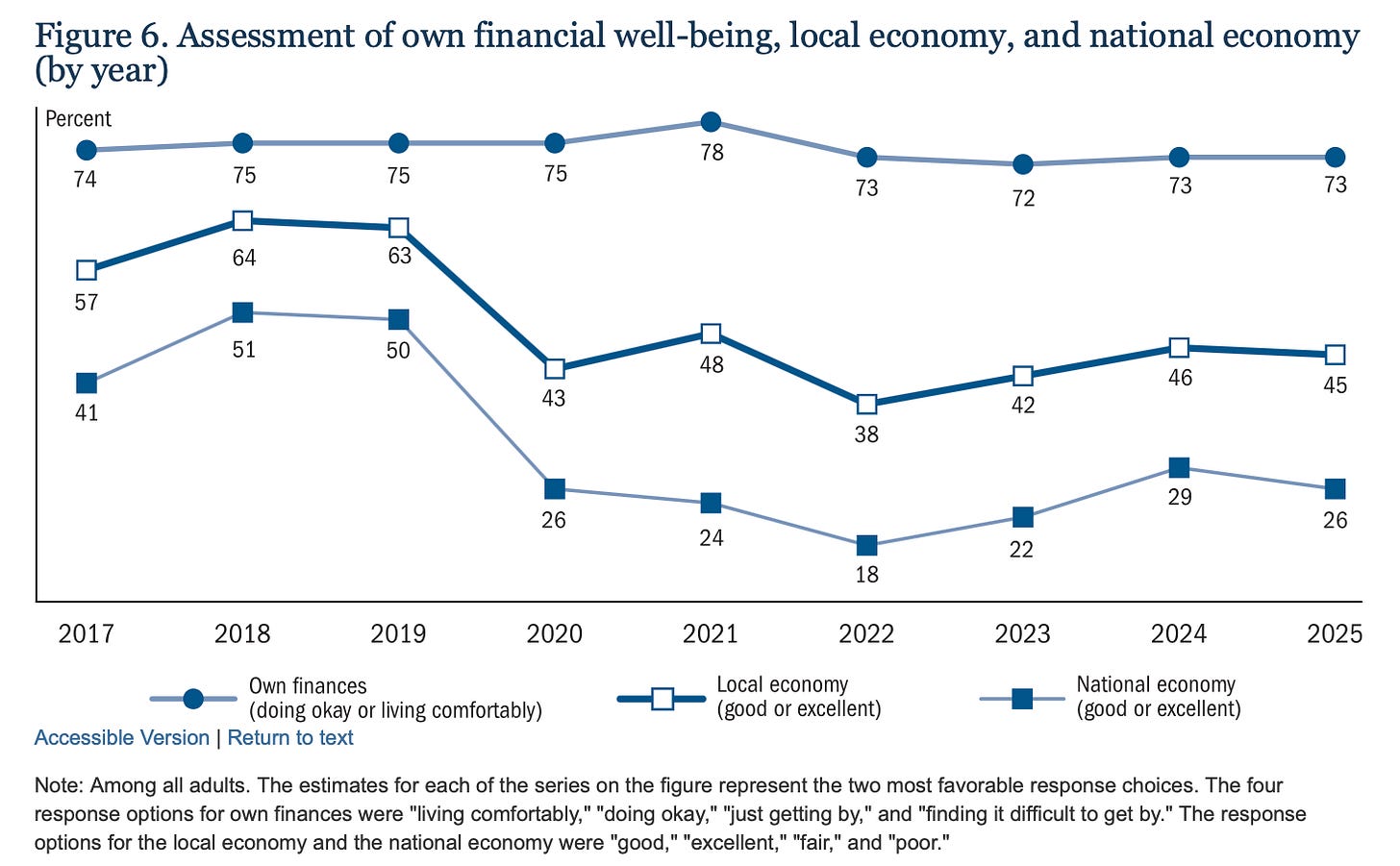
In this survey, people say they are worse off due to high prices, high expenses, and more debt. People say they are better off because the value of their assets increased. The downside of American life is quite literally priced in prices, whereas the upside is priced in through asset appreciation. Things are fine, as long as stocks go up.
The price of what we might consider a “normal life” like a house or a college degree or increasingly, a kid’s baseball game, has ballooned. It creates what David French describes as a “Group 1 economy for a Group 9 nation,” referring to boarding groups on airplanes. He points out that “affordability” is how expensive things are, sure, but it’s also the price of entry in what we might consider this “normal American life.”
That isn’t cynical indifference. People are hopeful about their own chances. David Whitman wrote about this in his 1998 book, The Optimism Gap: The I’m OK—They’re Not Syndrome and the Myth of American Decline, pointing out that people tend to describe their own lives as perfectly pleasant, while rating the nation as a collapsing heap of rot. Kinder and Kiewiet document this through sociotropic vs pocketbook evaluations, noting that people really do judge the “nation’s economy” and “my finances” as two separate objects.
Elsewhere, the economy is doomed, but at home, it’s mostly okay. The share of people saying they’re doing okay has actually risen over the past decade, in every age group except the youngest, which is flat. They were once moving in tandem with everyone else.
And that’s the concern. And the other concern is that the systems governing all of this—monetary policy, fiscal policy, the off balance sheet loans—have gotten incredibly confusing.
Part IV: Illegibility and Kludgeocracy
One of the things that most boggles me about this era is that we quite literally have never had more information, about anything, ever in the history of humanity, but we don’t know what to do with it. We don’t know how to use it, we don’t know how to implement it, and we certainly don’t know how to make decisions with it. So people exist in this sort of swampy water of reality, where you can sense that you are indeed in water, but have no idea which way is up, around, or out.
Political scientist Steven Teles calls the design pattern of these swampy systems a “kludgeocracy” where complexity gets slapped on bit by bit until no one understands how anything works. Annie Lowrey calls its human cost the “time tax” in her (upcoming!!) book, the hours that the state and private corporations extract in paperwork and administrative friction.
A version of it exists in the healthcare system. Rana Foroohar calls it “shadow work,” the cost of the time spent looking for things like “lost claims, incorrect payments and cheques sent to the wrong payee.” She also notes that 25% of American healthcare spending goes towards things like this.
I, for one, have healthcare that has denied me every single appointment I have tried to go to because it’s not “covered.” I am not sure what I pay for, to be honest. I also was double-billed for months, and it took me quite a long time to get a human to fix it, because I couldn’t escape their cursed customer support bot, who kept telling me to update my credit card.
Everyone is hitting some type of communication wall these days. The Federal Reserve has forward guidance (or used to?), which is a tool central banks use to signal the course of monetary policy. There are two types:
Delphic: The Fed forecasts their own behavior and says things like “ we expect rates to stay low”
Odyssean: The Fed fully commits to a decision and says “we will hold rates until unemployment hits x%”
Fed Chair Kevin Warsh doesn’t seem to like either version2. He has dropped forward guidance from Fed statements entirely, declining even to say what would make him raise rates. The stated logic is that “markets should play ball, not the referee.” Watch the economy, not the Fed. But as economist Claudia Sahm points out, dropping this means that nobody knows what the Fed is watching or what its contingency plans are. The most powerful economic institution in the country looked at the legibility problem, and chose more opacity.
There’s a certain poetry to the timing. “Odyssean” guidance is named for Odysseus lashing himself to the mast to not hear the sirens, commitment in advance. One of the things driving the economy forward right now is The Odyssey, Christopher Nolan’s version. One of the most long-lasting stories in human history, a story that is about nostos, a desire to go home, a desire for “normalcy” whatever that might mean.
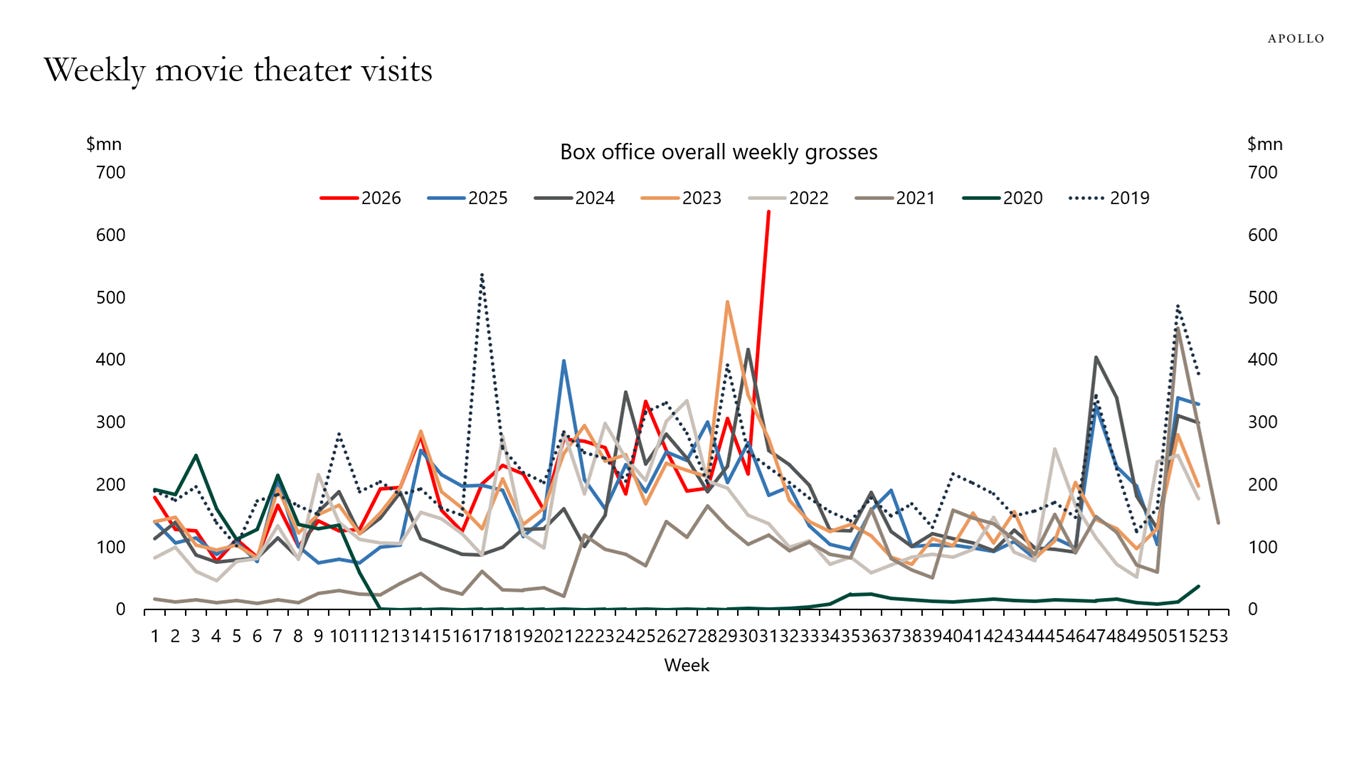
When “normalcy” feels out of reach and when systems become opaque and confusing to navigate or simply plopped in without much guidance, trust evaporates. And when trust evaporates, people change how they engage with democracy.
The onus falls on the individual. As systems become unmanageable, control migrates inward, as we talked about a few months ago. You can’t make the housing market affordable, but you certainly can optimize your portfolio! You can’t force the hospital billing bot to route you to the care you pay for, but you can track macros! The trading account, the supplement stack, the personal brand, are all domains where input and output still correlate, which is why so much energy and time goes into them.
Part V: Voice, Resignation, and Exit
But one cannot be solely an individual within a society! And how people feel as an individual within an economy, can influence how they think about democracy.
In 1952, the American National Election Studies started asking people if they agreed with the following sentence: “People like me don’t have any say about what the government does.3” They also asked whether you voted. The cross section of those two questions sorts people into one of four boxes:
Believing voters (have a say, voted)
Angry4 voters (no say, voted anyway)
Standby citizens5 (have a say, didn't vote)
The resigned (no say, didn't vote, also known as the exit box).
The four-box structure is inspired by economist Albert Hirschman’s work in Exit, Voice, and Loyalty, where he argued that people respond to a declining organization in basically two ways: leave it (exit) or stay and complain (voice), with loyalty determining how long they’ll stay. Hirschman’s central claim was that voice keeps institutions alive and the exit drains the voice that might have saved them. As long as people keep showing up, the institution can survive, but what kills them is when people stop caring at all.
In 1952, over half of respondents were believing voters. The angry voters, the one who think they have no say but vote anyway, were only 19% of the country. The two lines converged for decades, with the angry voters tying the believing voters in 1996, but separated again, seemingly for good.
At least, until 20206.
In 2020, the typical American respondent became someone who votes while believing their vote changes nothing. (The 2020 survey was fielded online). These are angry voters. 50.6% of all respondents that year, holding at 49.3% in 2024, a roughly 18-point gap over the believing voters. But still, the exit box, the resigned group, didn’t grow. Seventy years of collapsing efficacy didn’t make people withdraw, but it did make them very angry.
However, like many things in the US, this is an age split. Among Americans 55 and over, the resigned voter is only 7.5% of respondents in 2024 and has never really grown. These are are our angriest voters and the ones who still vote, seemingly no matter what. Just over 55% still vote while reporting they have no say in democracy, the highest of any age group.
The under-35s look different:
In 1960, over 60% of under-35s felt they had a say and voted, and their belief in what they were voting for, democracy, was higher than their elders. That’s not the case anymore. In 2024, the youth resigned voter hit over 23%, up six points in one cycle, with over 60% saying that they had no say in democracy. Reported voting fell 8 points.
They withdrew.
That’s not a surprise, right? It’s all anyone talks about, the young being anesthetized. But what’s remarkable is that if you dig into the data just a little bit, young people really are not indifferent as much as they are… lost.
Per Gallup and Kettering’s democracy study, they pay far less attention to politics than their elders, and yet, per the Reuters Institute, they are the most news-trusting cohort in the country, with 33% (still abysmally low) agreeing you can trust the news most of the time.
Per Gallup and Kettering again, young people are more than twice as likely as their elders to report four or more barriers to civic participation. The barriers question asks which of nine things prevent you from getting involved in causes you care about. Eight are external — time, money, know-how, invitation, health, overload, feeling unwelcome, fearing judgment. One is internal, the answer that, “you have no desire to get involved.”
Young adults have a lot of desire. Per the report, they are “the subgroup most inclined to say they haven’t volunteered but wanted to.” Some of this might be survey noise, but this seems like a state of internal conflict where they desperately want to contribute, but find no visible, legible path forward.
The survey also asks “if I had a concern, I know how to share it with my elected officials.” Barely half of Americans agree, sitting at 40% agreement among the youngest adults to 63% among the oldest. Among people who got a civic education, almost 70% know the route, and among those who didn’t, only 40% do. Education is always a key for navigating a map that doesn’t make sense.
The shape of this moment, both within the economy and democracy, seems to be one of an attempt to understand. Pattern matching wealth accumulation techniques onto an economy that rewards it and attempting to pattern match civic participation techniques onto a system that doesn’t make it too clear on what to do (at least, that’s what people think.)
Hirschman says voice is what keeps institutions alive. By that standard, American democracy is running on its loudest, angriest voice in its history, sustained by people who don’t think it’s listening. For the young, their desire to participate (again, if we believe what people say) is the highest of any age group and their verdict on the system that they are inheriting is the worst of any age group. It’s a map problem.
Pattern-matching is how species navigate environments that they don’t totally understand (a baby orangutan learning how to eat and me learning how to exist inside a room designed for “networking” are functionally the same thing.) When I pick up a stranger’s accent, some ancient part of my brain has concluded that mirroring the room is how you survive the room. Americans have been doing exactly this within the economy, and have been doing it well.
When the economy rewards ownership over effort, when essential systems become uninspectable, and when traditional work no longer buys entry into a “normal life,” people do not stop caring. They simply optimize to the world as it exists. They gamble on speculative windfalls to survive the ever-changing economy, and retreat into exit to survive politics (I’ve been informed this is also known as “gray rock.”)
This is a well-calibrated read of incentives, performed by the best pattern-matching species that has ever lived, which is hopeful. Mood is downstream of the environment, and the environment can be changed.


Comments
Log in or sign up to join the conversation.