

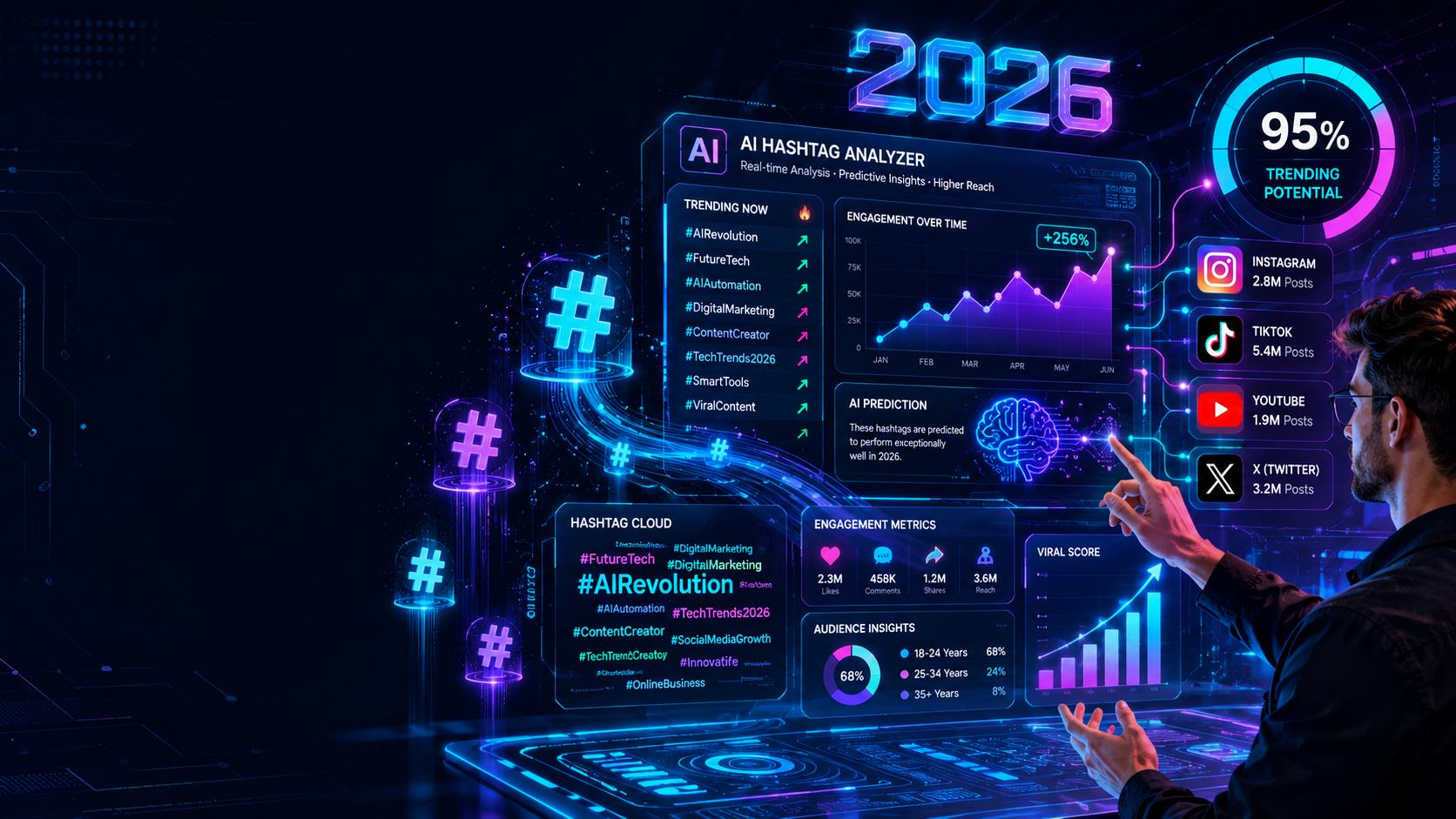
In today's competitive digital landscape, hashtags remain one of the simplest yet most effective ways to increase content visibility on social media. Whether you're a content creator, small business owner, influencer, or marketer, the right hashtags can help your posts reach new audiences and generate meaningful engagement.
However, choosing hashtags is no longer about adding the most popular terms and hoping for the best. Social media algorithms have evolved, user behavior has changed, and competition continues to grow. In 2026, the best hashtag generator artificial intelligence (AI) has become an essential tool for discovering hashtags that align with your content goals.
This guide explains how to find high-performing hashtags using AI and incorporate them effectively into your social media strategy.
Why Hashtags Still Matter in 2026
Many people assume hashtags have lost their importance, but they continue to play a valuable role across platforms such as Instagram, TikTok, LinkedIn, and X.
Hashtags help platforms understand the context of your content. They categorize posts, connect users with topics they care about, and improve discoverability beyond your existing followers.
Benefits of using relevant hashtags include:
Increased reach and impressions
Better audience targeting
Higher engagement rates
Improved content organization
Greater visibility within niche communities
The key difference today is that relevance matters more than volume. A well-targeted hashtag strategy often outperforms a collection of broad, trending tags.
What Makes a Hashtag High-Performing?
Not every popular hashtag delivers results. High-performing hashtags share several characteristics.
Relevance
The hashtag should accurately describe your content and align with audience interests.
Audience Intent
It should reflect what users are actively searching for or engaging with.
Balanced Competition
Extremely popular hashtags can bury your posts quickly. Moderately competitive hashtags often provide better opportunities for visibility.
Niche Alignment
Industry-specific hashtags help attract users who are genuinely interested in your content.
Trend Potential
Some hashtags gain momentum due to emerging conversations, seasonal topics, or current events.
AI tools analyze these factors simultaneously, making the research process faster and more accurate.
How AI Helps Identify Effective Hashtags
Artificial intelligence processes large amounts of social media data that would take humans hours to analyze manually.
Modern AI systems can evaluate:
Engagement trends
Search popularity
Content relevance
Audience behavior
Competitor hashtag usage
Industry-specific conversations
Seasonal patterns
Predicted hashtag performance
Start With Your Content Topic
Before using any AI tool, identify the primary focus of your post.
Ask yourself:
What is this content about?
Who is the intended audience?
What problem does it solve?
Which industry does it belong to?
For example, a post about healthy meal preparation may generate different hashtag recommendations depending on whether the target audience includes busy professionals, fitness enthusiasts, or parents.
Providing clear context allows AI to produce more relevant suggestions.
Use AI to Generate Keyword-Based Hashtags
Most AI hashtag generators begin by analyzing keywords.
Enter your primary topic, product, or campaign phrase. The system then creates hashtag recommendations based on semantic relationships and audience behavior.
For instance, a content creator discussing remote work productivity may receive suggestions related to:
productivity tips
remote work
work-life balance
digital workspace
professional growth
The advantage of AI is its ability to uncover related opportunities that users may overlook.
Analyze Hashtag Performance Metrics
Generating hashtags is only the first step.
Review available performance indicators, including:
Engagement Potential
Some hashtags consistently produce higher interaction rates.
Popularity Scores
These estimates show how frequently users engage with a hashtag.
Competition Levels
Understanding competition helps you avoid overcrowded spaces.
Audience Match
AI can identify whether users interacting with a hashtag align with your target demographic.
Balancing these metrics creates a stronger hashtag strategy.
Combine Different Types of Hashtags
Relying exclusively on trending hashtags often limits effectiveness.
A balanced approach typically includes:
Broad Hashtags
These attract larger audiences but involve greater competition.
Niche Hashtags
They connect with highly interested users.
Community Hashtags
These foster engagement among specific groups.
Branded Hashtags
Businesses use these to strengthen recognition and encourage user-generated content.
Campaign Hashtags
Designed for promotions, events, or product launches.
AI tools often recommend combinations that improve overall reach.
Monitor Competitor Strategies
Competitor analysis remains valuable in 2026.
Review creators and brands within your industry to understand:
Which hashtags appear frequently
Which posts generate significant engagement
Emerging trends within your niche
Audience responses to specific topics
AI platforms can automate this process by identifying patterns across multiple accounts.
This approach reveals opportunities while helping you avoid ineffective tactics.
Adapt Hashtags for Each Platform
Different platforms reward different hashtag behaviors.
A mix of niche and moderately competitive hashtags often performs well.
TikTok
Trending conversations and culturally relevant hashtags tend to generate visibility.
Professional and industry-focused hashtags are generally more effective.
X
Fewer, highly relevant hashtags often deliver stronger engagement.
YouTube Shorts
Hashtags should support discoverability without overwhelming the content description.
AI tools frequently tailor recommendations based on platform-specific trends.
Track Results and Refine Your Strategy
Hashtag optimization is an ongoing process.
After publishing content, monitor key metrics such as:
Reach
Impressions
Likes
Shares
Comments
Saves
Click-through rates
Follower growth
Identify which combinations consistently perform well.
AI-powered analytics can detect patterns over time and suggest adjustments based on historical data.
Continuous refinement leads to better outcomes.
Common Mistakes to Avoid
Even with AI assistance, certain practices can reduce effectiveness.
Avoid these common errors:
Using Irrelevant Hashtags
Misleading hashtags may attract the wrong audience and reduce engagement quality.
Overusing Popular Tags
Highly competitive hashtags often make it difficult for your content to stand out.
Repeating Identical Sets
Using the same hashtags repeatedly may limit reach and reduce authenticity.
Ignoring Analytics
Without reviewing performance data, improvement becomes difficult.
Prioritizing Quantity Over Quality
A smaller collection of relevant hashtags often outperforms lengthy lists.
AI works best when combined with thoughtful human judgment.
The Future of AI and Hashtag Research
Artificial intelligence continues to evolve rapidly.
Future developments may include:
Predictive trend forecasting
Real-time audience sentiment analysis
Personalized hashtag recommendations
Cross-platform optimization
Automated campaign adjustments
As these technologies mature, marketers and creators will gain even deeper insights into audience behavior.
However, authenticity will remain essential. Users engage with valuable content first and hashtags second.
Final Thoughts
Finding high-performing hashtags in 2026 is no longer a matter of trial and error. AI has transformed the process by helping creators identify relevant opportunities based on data rather than assumptions.
By understanding your audience, analyzing performance metrics, balancing different hashtag categories, and continuously refining your strategy, you can improve content discoverability and strengthen engagement across social platforms.
Ultimately, hashtags are most effective when they support quality content that resonates with real people. Use AI as a strategic assistant, combine its insights with creativity, and build a hashtag approach designed for long-term growth rather than short-term trends.
Comments
Log in or sign up to join the conversation.