
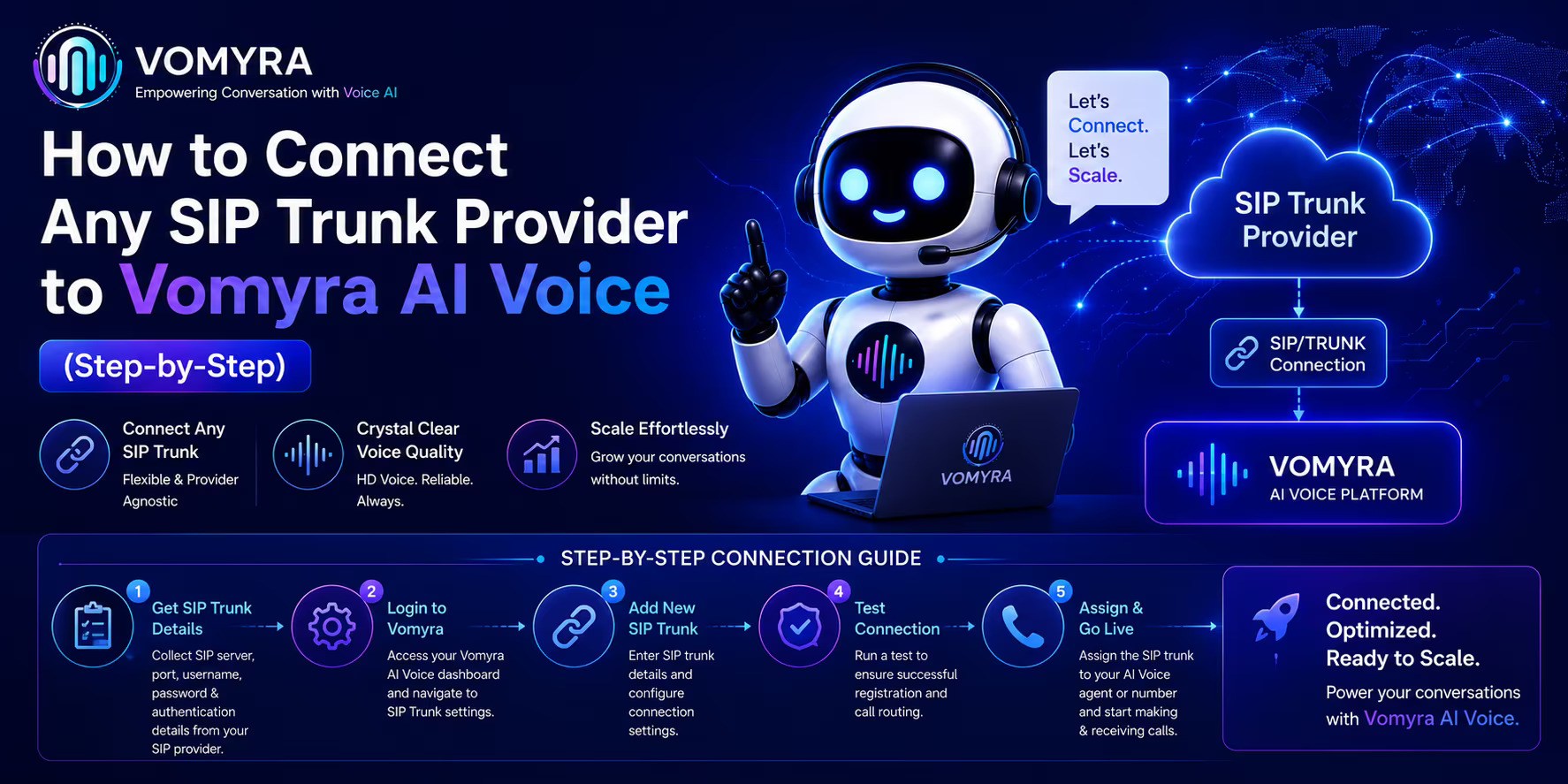
Modern business communication relies on seamless voice connectivity, intelligent automation, and scalable infrastructure. Organizations across industries are increasingly adopting AI-powered voice solutions to automate inbound and outbound conversations while maintaining high call quality and operational efficiency.
A critical component of this communication ecosystem is SIP trunking, which enables internet-based voice communication without depending on traditional telephone networks. A properly configured SIP trunk allows businesses to integrate their telephony infrastructure with advanced AI-powered calling systems, improving flexibility and reducing communication costs.
When integrated with the Vomyra AI Voice Agent, organizations can automate customer interactions, appointment scheduling, lead qualification, support calls, and business communication while maintaining reliable voice connectivity. Businesses searching for a free AI voice agent India solution also benefit from understanding how SIP integration supports scalable communication systems.
Understanding SIP Trunk Technology
Session Initiation Protocol (SIP) trunking is a technology that enables voice communication over internet connections instead of conventional telephone lines. It establishes virtual communication channels between business communication systems and service providers, allowing voice traffic to travel through IP networks.
Unlike traditional telephony systems, SIP trunking offers greater scalability, easier deployment, improved call routing, and lower infrastructure costs. Businesses can increase or decrease communication capacity based on operational requirements without installing additional physical telephone lines.
The technology has become an essential foundation for organizations implementing AI-driven voice automation because it allows intelligent voice platforms to place, receive, and manage calls efficiently.
Importance of SIP Integration for AI Voice Solutions
Artificial intelligence has transformed customer communication by enabling automated conversations that closely resemble human interactions. AI voice systems require reliable voice connectivity to function effectively, making SIP trunk integration a vital component of the overall deployment.
A properly integrated SIP trunk ensures stable call routing, clear audio quality, lower latency, and uninterrupted communication between customers and AI-powered voice systems. It also supports simultaneous call handling, making it suitable for organizations managing large call volumes.
Businesses deploying AI-powered voice automation often use SIP connectivity to improve customer service, automate repetitive conversations, increase operational efficiency, and reduce manual workload.
Prerequisites Before Configuration
Successful SIP trunk integration begins with proper preparation. Organizations should ensure that their communication infrastructure is ready before starting the configuration process.
Reliable internet connectivity plays an important role in maintaining high-quality voice communication. Network stability directly affects call clarity, connection reliability, and overall communication performance.
Accurate SIP credentials are equally important during the integration process. Authentication details, server information, communication ports, and security configurations should be verified before implementation to minimize connectivity issues.
Firewall rules and network security settings should also allow SIP traffic to pass without interruption while protecting communication infrastructure from unauthorized access.
Step 1: Verify SIP Account Information
The first stage of integration involves confirming all necessary SIP account details. Authentication credentials must be validated carefully before initiating any configuration process.
Required information generally includes the SIP username, authentication password, server address, communication ports, transport protocol, and registration settings. Ensuring the accuracy of these details helps prevent authentication failures during deployment.
Proper verification at the initial stage reduces troubleshooting efforts later and contributes to a smoother integration experience.
Step 2: Configure Voice Connectivity Settings
Once account information has been verified, the next step involves configuring communication parameters within the AI voice platform.
Voice routing settings should be configured according to organizational requirements while maintaining compatibility with SIP communication standards. Proper routing ensures that incoming and outgoing calls reach the correct destinations without unnecessary delays.
Audio codec selection also contributes to communication quality. Selecting appropriate codecs helps balance bandwidth utilization with voice clarity, allowing businesses to deliver professional customer interactions consistently.
Step 3: Complete Authentication Configuration
Authentication establishes secure communication between the SIP trunk and the AI voice platform. Credentials entered during this stage allow the communication system to register successfully and begin processing voice traffic.
Secure authentication mechanisms protect voice communication while preventing unauthorized access to business telephony infrastructure. Proper security configuration also supports long-term system stability and compliance with communication best practices.
Step 4: Test Voice Connectivity
After completing the configuration process, testing becomes essential before deploying the system into production.
Both inbound and outbound calls should be tested to verify successful registration, call routing accuracy, voice clarity, and connection stability. Organizations should also evaluate response times, simultaneous call handling, and audio performance under different operating conditions.
Early testing allows technical teams to identify configuration issues before business operations begin, reducing future disruptions and ensuring consistent communication performance.
Benefits of AI Voice and SIP Integration
Integrating SIP trunk technology with the Vomyra AI Voice Agent provides organizations with a scalable communication environment capable of handling customer interactions efficiently. Automated voice communication reduces dependency on manual call handling while improving response speed and service availability.
The integration supports intelligent call management, flexible scalability, centralized communication infrastructure, improved customer experience, and reduced operational complexity. Businesses implementing AI-driven communication strategies also gain better resource utilization and enhanced operational productivity.
Common Configuration Challenges
Although SIP trunk integration follows a structured process, organizations may occasionally encounter technical challenges during deployment. Registration failures can occur because of incorrect authentication credentials, network restrictions, or incomplete configuration settings. Similarly, poor audio quality may result from inadequate bandwidth, improper codec selection, or unstable internet connectivity.
Call routing issues may also arise if communication rules are not configured correctly. Regular system testing, accurate configuration, and continuous network monitoring help minimize these challenges while maintaining consistent communication performance. Proper infrastructure planning significantly improves long-term system reliability.
Security Considerations During SIP Integration
Communication security remains a critical aspect of every SIP deployment. Organizations should implement strong authentication practices, encrypted communication protocols, and secure network configurations to protect voice traffic from unauthorized access.
Regular password updates, restricted administrative access, firewall configuration, and continuous monitoring contribute to maintaining a secure communication environment. Periodic security assessments also help identify vulnerabilities before they impact business operations.
A secure communication infrastructure not only protects sensitive business information but also ensures uninterrupted AI-powered voice communication across different operational environments.
Best Practices for Long-Term Performance
Maintaining an optimized SIP environment requires ongoing monitoring and periodic system evaluation. Businesses should regularly review call quality, network performance, bandwidth utilization, and server health to ensure consistent voice communication.
Keeping software components updated improves compatibility, strengthens security, and enhances overall system performance. Organizations should also monitor communication logs to identify unusual patterns and resolve potential issues before they affect business continuity.
Business Advantages of AI Voice Automation
The combination of SIP technology and AI-powered communication delivers measurable operational benefits. Automated call handling reduces manual intervention while improving response times for customer inquiries. Businesses can manage larger communication volumes without proportionally increasing staffing requirements.
AI-powered voice automation also improves service consistency by delivering standardized responses across every customer interaction. Intelligent routing enables faster resolution of inquiries while reducing waiting times and improving overall customer satisfaction.
Organizations implementing advanced communication automation gain improved productivity, reduced operational costs, better resource utilization, and enhanced communication efficiency. These advantages contribute to stronger customer relationships while supporting long-term business growth.
Why Choose Vomyra for AI Voice Communication
A reliable AI voice platform should provide scalability, intelligent automation, secure communication, and seamless integration with modern business telephony systems. Vomyra enables organizations to streamline voice communication through intelligent automation while supporting efficient SIP trunk integration for reliable call management.
Businesses seeking a free AI voice agent India solution can benefit from scalable deployment options that support automated customer engagement without unnecessary infrastructure complexity. The Vomyra AI Voice Agent is designed to simplify business communication while delivering consistent performance across various operational requirements.
Conclusion
SIP trunk integration forms the foundation of modern AI-powered business communication by providing reliable internet-based voice connectivity for automated calling systems. Proper configuration, secure authentication, accurate routing, and continuous monitoring ensure stable communication performance while supporting business scalability.
Organizations implementing AI-driven voice automation should prioritize structured deployment, secure network architecture, and ongoing performance optimization to maximize operational efficiency. With intelligent communication capabilities offered by Vomyra, businesses can establish a scalable voice infrastructure that enhances customer interactions, improves productivity, and supports long-term digital transformation.
FAQs
1. What is a SIP trunk?
A SIP trunk is an internet-based communication technology that enables voice calls to be transmitted through IP networks instead of traditional telephone lines.
2. Why is SIP integration important for AI voice systems?
SIP integration enables AI voice platforms to manage inbound and outbound calls efficiently while maintaining reliable connectivity, clear audio quality, and scalable communication.
3. Can businesses connect existing SIP infrastructure with AI voice solutions?
Yes. Existing SIP infrastructure can generally be integrated with compatible AI voice platforms after proper configuration, authentication, and network verification.
4. How does AI voice automation improve business communication?
AI voice automation helps automate customer interactions, reduce manual workload, improve response times, maintain consistent communication, and increase operational efficiency.
5. Why should businesses choose Vomyra for AI voice automation?
Vomyra provides intelligent voice automation with scalable communication capabilities, helping organizations simplify customer engagement while supporting reliable SIP-based voice connectivity.
Comments
Log in or sign up to join the conversation.