

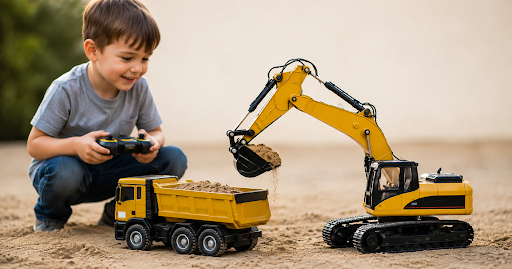
RC construction models offer a distinctive combination of remote-control operation, mechanical detail, and realistic job-site activity. From excavators and dump trucks to cranes, loaders, and bulldozers, these machines can appeal to children, beginners, experienced hobbyists, and serious collectors.
However, not every model is suitable for every operator.
A beginner may struggle with a heavy machine that has complex controls, while an experienced hobbyist may quickly outgrow a simple entry-level vehicle. Choosing the right RC construction model therefore requires more than selecting the most realistic-looking option.
The best model should match the operator’s skill level, intended use, available space, budget, and willingness to perform basic maintenance.
Why Skill Level Matters
RC construction vehicles can vary significantly in their controls, materials, power, weight, and mechanical complexity.
Some models are designed mainly for casual play. Others include multiple moving components that require careful coordination. More advanced machines may use metal parts, proportional controls, upgraded motors, or hydraulic systems.
Choosing a model that is too complicated can create frustration and increase the risk of damage. On the other hand, selecting a model that is too basic may limit long-term enjoyment.
Matching the vehicle to the operator’s ability makes it easier to develop control skills gradually and safely.
Identify the Intended Use First
Before comparing models, decide how the vehicle will be used.
A child operating a dump truck in a sandbox has different needs from an adult creating a detailed miniature construction site. A collector may value scale accuracy and metal construction, while a casual user may prefer simple controls and easy battery access.
Common uses include:
Indoor or outdoor play
Learning basic RC controls
Parent-and-child activities
Moving sand or lightweight material
Creating miniature worksite scenes
Photography and video production
Collecting realistic scale models
Modifying or upgrading vehicles
Defining the main purpose helps narrow the available options.
A buyer exploring Huina Toys can compare different types of construction vehicles before deciding whether an excavator, truck, crane, loader, or specialist model is the most suitable choice.
Best RC Construction Models for Beginners
Beginners usually benefit from a model with simple controls, moderate speed, and a manageable number of functions.
The goal should be to learn basic steering and vehicle operation without becoming overwhelmed.
Recommended Beginner Features
A suitable beginner model may include:
Straightforward forward and reverse movement
Simple left and right steering
Clearly marked controller buttons
Lightweight construction
Easy battery access
Moderate operating speed
A limited number of moving functions
Durable external components
Plastic and semi-alloy models are often practical for new users. They are usually lighter than all-metal vehicles and may be easier to carry, store, and operate.
Beginner-Friendly Vehicle Types
Dump trucks can be a good starting point because their main functions are generally easy to understand. The operator drives the truck, positions it, and raises or lowers the dump bed.
Basic loaders can also be suitable for beginners. They introduce bucket control without requiring the same level of coordination as a complex excavator.
Excavators may have a steeper learning curve because the operator must control the tracks, rotating cab, boom, arm, and bucket. However, simplified electric models can still be appropriate for careful beginners.
Parents reviewing Huina Construction Toys should check the recommended age, model dimensions, controller layout, battery requirements, and safety guidance before making a purchase.
Intermediate Models for Developing Operators
Intermediate operators are usually comfortable with basic driving and can coordinate several functions in sequence.
They may want stronger materials, more realistic movements, improved detail, or a larger number of control options.
Signs an Operator Is Ready to Progress
A user may be ready for an intermediate model when they can:
Position a vehicle accurately
Operate several controls without confusion
Load and unload material consistently
Navigate around obstacles
Understand basic battery care
Avoid placing unnecessary strain on moving parts
Follow cleaning and storage instructions
Intermediate models may include semi-alloy construction, metal buckets, improved gears, rotating cabs, working lights, sounds, and more detailed body components.
The most suitable model is not necessarily the one with the highest number of functions. The additional features should provide useful realism without making the machine unnecessarily difficult to operate.
Advanced Models for Experienced Hobbyists
Advanced RC construction models are intended for users who have developed strong control skills and understand routine maintenance.
These machines may feature all-metal construction, proportional movement, complex electronics, upgraded motors, or hydraulic operating systems.
They are often heavier, more expensive, and more technically demanding than beginner models.
Responsibilities of Advanced Ownership
Experienced operators may need to:
Inspect gears and moving joints
Check screws and fasteners
Monitor battery condition
Clean tracks and mechanical components
Identify signs of motor strain
Replace worn parts
Understand controller settings
Follow model-specific maintenance procedures
Hydraulic machines require particular care because they may contain pumps, hoses, fittings, valves, and fluid systems.
A buyer should not select an advanced model based only on appearance. The model’s mechanical complexity should match the owner’s technical ability and willingness to maintain it.
The range available through Official Huina Toys can help experienced buyers compare vehicle type, scale, construction material, and operating functions before choosing a higher-specification model.
Choose the Right Type of Vehicle
Different RC construction vehicles provide different operating experiences.
RC Excavators
Excavators are popular because they offer multiple realistic functions. Depending on the model, the operator may control:
Forward and reverse track movement
Left and right turning
Upper-cab rotation
Boom elevation
Arm movement
Bucket positioning
Excavators are best suited to users who enjoy precise control and loading tasks. Beginners should choose simplified models, while advanced hobbyists may prefer heavier metal or hydraulic versions.
RC Dump Trucks
Dump trucks are useful for transporting loose material between different parts of a miniature worksite.
Their operation is generally easier to understand, making them suitable for beginners. Larger or more detailed models can also complement advanced excavators and loaders.
RC Loaders
Wheel loaders are designed to push, collect, lift, and transport material.
They require the operator to approach a pile at the correct angle while controlling the bucket. This makes them a useful choice for intermediate users.
RC Cranes
Cranes require patience and accurate positioning.
The operator may need to control boom movement, rotation, lifting height, and load placement. Basic cranes can suit careful beginners, while more complex models are better for experienced hobbyists.
Bulldozers and Specialist Vehicles
Bulldozers, forklifts, concrete mixers, timber trucks, and other specialist vehicles can add variety to an RC collection.
The collection of Huina Toys includes several vehicle categories that can be compared according to function, scale, material, and operating difficulty.
Understand Scale and Size
Scale describes the relationship between the model and the real machine it represents.
For example, a 1:14 model is generally larger than a 1:18 model of the same type of vehicle.
Scale can affect:
Overall dimensions
Storage requirements
Transportation
Operating space
Model weight
Visual realism
Compatibility with other vehicles
The size of material the model can handle
A larger scale does not automatically mean better performance. Buyers should review the actual dimensions, weight, materials, and motor system rather than relying on scale alone.
Collectors planning a coordinated fleet should consider choosing models with compatible proportions.
Compare Plastic, Semi-Alloy, and Metal Models
Construction material can influence durability, weight, cost, and realism.
Plastic Models
Plastic models are usually lightweight and affordable. They can be appropriate for beginners, children, and casual use.
Their lower weight may make them easier to operate indoors, although users must still avoid collisions and excessive force.
Semi-Alloy Models
Semi-alloy models combine plastic with selected metal parts.
Metal may be used in the bucket, arm, gears, body panels, chassis, or tracks. This construction offers a balance between accessibility and realism.
Semi-alloy models are often suitable for intermediate operators.
All-Metal Models
All-metal models provide a heavier and more realistic feel.
Their weight can improve stability during certain tasks, but it also requires more careful handling. Heavy vehicles can damage indoor surfaces or cause injury if fingers become trapped near moving parts.
Buyers comparing Huina Construction Toys should consider whether lightweight convenience, mixed-material durability, or full-metal realism is most important.
Check the Number and Type of Controls
RC construction models may include different numbers of control channels.
However, channel counts are not always presented consistently, so buyers should study the actual function list.
Common functions include:
Forward and reverse movement
Left and right steering
Independent track control
Cab rotation
Boom movement
Arm movement
Bucket control
Dump-bed lifting
Lights
Sounds
Demonstration modes
A model with more controls is not always a better choice for a beginner.
New users generally benefit from fewer, clearly defined functions. Experienced hobbyists may prefer proportional controls that allow smoother and more precise movement.
Consider the Operating Surface
The intended environment is an important part of the buying decision.
Indoor users should choose a model that fits the available space and does not risk damaging floors or furniture.
Outdoor users should consider traction, ground clearance, vehicle weight, and the type of material being moved.
Common operating surfaces include:
Dry sand
Loose soil
Fine gravel
Wood chips
Lightweight construction blocks
Purpose-made miniature loads
RC construction models should not be forced into compact soil or used to carry loads beyond their intended capacity. Doing so can damage gears, motors, arms, and joints.
Water resistance should never be assumed unless it is clearly stated by the manufacturer.
Review Battery Performance
Battery specifications influence runtime, convenience, and operating cost.
Before purchasing, check:
Battery type
Battery capacity
Estimated runtime
Charging time
Charger type
Connector compatibility
Replacement battery availability
Whether controller batteries are included
Actual runtime may vary depending on terrain, model weight, load, temperature, and operating style.
Always use compatible charging equipment and follow the instructions provided with the model. Children should not charge batteries without adult supervision.
Look for Spare Parts and Support
Moving RC vehicles may eventually require replacement components.
Before buying, check whether parts are available for the exact model number.
Useful replacement items may include:
Batteries
Chargers
Controllers
Tracks
Wheels and tires
Buckets
Gears
Motors
Mechanical linkages
Body components
A model with good parts availability may provide better long-term value than a cheaper vehicle that cannot be repaired easily.
Buyers can review the selection from Official Huina Toys and confirm product details or part compatibility before ordering.
Set a Realistic Budget
The purchase price may not represent the full cost of ownership.
Additional costs can include:
Spare batteries
Replacement chargers
Tools
Storage cases
Replacement parts
Shipping
Maintenance supplies
Optional accessories
Beginners should avoid spending heavily on advanced functions they may not use.
Starting with a manageable model allows a new operator to learn what they enjoy before investing in larger or more technical equipment.
Experienced buyers should consider whether premium materials and added functionality justify the higher cost.
Final Buying Checklist
Before selecting an RC construction model, ask the following questions:
Is the model suitable for the operator’s age?
Does it match the operator’s current skill level?
Is the controller easy to understand?
Will the model fit the available operating space?
Is its weight manageable?
Can it operate on the intended surface?
Are battery and charging details clearly provided?
Are replacement parts available?
Does the seller provide sufficient product information?
Are the warranty, shipping, and return terms clear?
This checklist can reduce the risk of choosing a model that is too complicated, too limited, or unsuitable for its intended use.
Final Thoughts
Choosing the right RC construction model is about finding the correct balance between realism, control, durability, and usability.
Beginners generally benefit from simple controls, moderate speed, and lightweight construction. Intermediate users can explore stronger materials and additional functions. Advanced hobbyists may prefer metal, proportional, or hydraulic models, provided they are comfortable with the added maintenance requirements.
Vehicle type, scale, material, controls, operating environment, battery performance, and spare-parts availability should all be considered before purchasing.
A model that matches the operator’s current ability will be easier to enjoy, safer to use, and more likely to remain valuable as their skills improve.
Comments
Log in or sign up to join the conversation.