

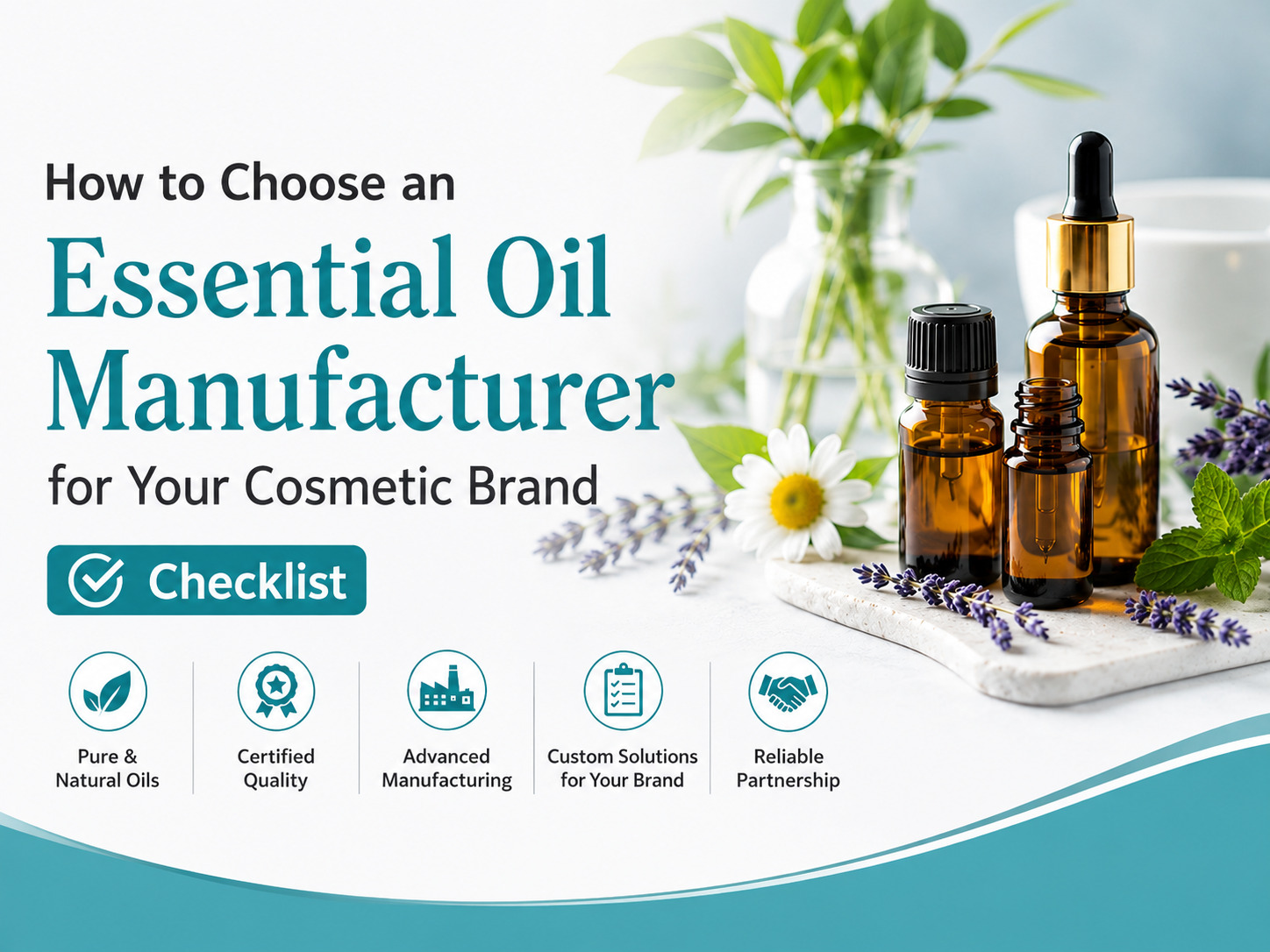
The quality of ingredients plays a major role in the success of any cosmetic product. For brands that use essential oils in skincare, haircare, personal care, or wellness formulations, choosing the right manufacturing partner is an important business decision. The right supplier can help maintain consistency, quality, availability, and smooth production, while the wrong choice may create problems with formulation, delivery, and customer satisfaction.
If you are planning to choose an essential oil manufacturer, you should look beyond pricing. A reliable manufacturer should be able to provide quality raw materials, appropriate documentation, consistent batches, flexible order quantities, and dependable support as your business grows.
Why Choosing the Right Essential Oil Manufacturer Matters
Essential oils are concentrated plant-derived ingredients commonly used in cosmetic and personal care formulations. Their characteristics can vary depending on the plant source, growing conditions, extraction process, storage, and handling.
For a cosmetic brand, inconsistency between batches can affect fragrance, appearance, formulation performance, and the overall customer experience. This makes supplier selection much more important than simply finding the lowest quotation.
A professional manufacturer should have a structured approach to sourcing, production, quality control, packaging, and order fulfillment. Brands should therefore evaluate the complete supply chain before committing to a long-term partnership.
Check the Source and Extraction Method
One of the first things to investigate is where the raw materials come from and how the oils are extracted. Different botanical materials may require different extraction techniques, and the method can influence the characteristics of the final oil.
Ask the manufacturer about raw material sourcing and whether the extraction process is suitable for the intended cosmetic application. A transparent supplier should be able to explain these processes clearly instead of providing only general information.
Understanding sourcing also helps brands assess consistency. Reliable raw materials are essential when a cosmetic company wants to maintain similar characteristics across multiple production batches.
Review Quality and Testing Documentation
Quality documentation is another important consideration when selecting a supplier. Cosmetic businesses should ask what documentation is available for the products they are purchasing.
Depending on the product and application, documents such as a Certificate of Analysis and Material Safety Data Sheet can provide useful information about quality, composition, handling, and safety considerations.
Do not hesitate to ask questions about testing procedures, batch identification, specifications, and quality control. A manufacturer that follows clear documentation practices can make procurement easier and more organized.
Consider Product Range and Customization
A cosmetic brand may require different oils for different formulations. Some products may need floral oils, while others may require herbal, citrus, woody, or fresh aromatic profiles. Working with a supplier that has a broad selection can simplify purchasing and reduce the need to coordinate with multiple suppliers.
Customization is another factor worth considering. Some brands may want a specific blend or formulation rather than purchasing a standard product. If custom blending is available, businesses can discuss their requirements with the manufacturer and determine whether the supplier can develop products according to their specifications.
Understand Minimum Order Quantities
Minimum order quantity, commonly called MOQ, is especially important for new cosmetic businesses. Ordering too much inventory in the beginning can tie up capital and create storage challenges. Before placing an order, ask about minimum quantities for standard and customized products. Also check whether the supplier can support larger quantities later.
A small cosmetic brand may initially require limited quantities for testing and market development. As demand increases, the same business may need significantly larger volumes. A supplier capable of supporting both stages can make growth easier.
Check Packaging and Storage Practices
Proper packaging is essential for maintaining the quality of essential oils. Exposure to light, heat, air, or unsuitable storage conditions can affect certain oils over time.
Brands should ask about available packaging options and recommended storage conditions. For many essential oils, protective packaging such as amber or UV-resistant containers can help reduce exposure to light.
If you are purchasing in bulk, also understand how the product is packed, labeled, stored, and prepared for transportation. These details may seem minor initially but can become important when order volumes increase.
Compare Pricing With Overall Value
Price is naturally an important part of procurement, but it should not be the only deciding factor. A lower price may not represent better value if the supplier has inconsistent quality, poor communication, limited documentation, or unreliable delivery schedules.
When comparing quotations, consider the complete package. Look at product quality, specifications, order quantities, packaging, documentation, lead time, and customer support. The objective should be to find a supplier that provides a reasonable balance between cost and reliability rather than simply choosing the cheapest option available.
Evaluate Scalability and Delivery
A cosmetic business needs dependable supply to keep production running smoothly. Delayed ingredients can affect manufacturing schedules and product launches. Before finalizing a supplier, ask about typical lead times, production capacity, repeat orders, and how the manufacturer handles changes in demand.
For growing businesses, scalability becomes even more important. A supplier may be suitable for small quantities but unable to handle larger orders later. Discuss future requirements early so both sides understand what to expect.
Look for a Long-Term Manufacturing Partner
The ideal relationship with an essential oil supplier should not be limited to one transaction. Cosmetic brands benefit from suppliers who understand their requirements and can support consistent sourcing over time.
Communication is an important part of this relationship. The manufacturer should respond clearly to questions about product specifications, samples, documentation, pricing, and delivery. Kanta Essential Oils can be considered by cosmetic businesses looking for a supplier that supports bulk sourcing, product documentation, customization discussions, and different business requirements.
Common Mistakes to Avoid
There are several mistakes businesses should avoid when selecting an essential oil manufacturer.
First, do not place a large order without evaluating a sample when sampling is available. Testing allows you to assess the product before committing significant money to inventory. Second, do not compare suppliers based only on price. Quality and consistency can have a direct impact on your final products.
Third, avoid ignoring documentation. Proper records can become important for internal quality control, retail requirements, and future business expansion. Finally, do not overlook communication. If a supplier is difficult to communicate with during the initial stage, managing larger orders may become even more challenging.
Final Thoughts
Choosing an appropriate supplier is one of the most important steps for a cosmetic business that depends on botanical ingredients. From raw material sourcing and extraction methods to quality documentation, packaging, MOQ, pricing, customization, and scalability, every factor deserves consideration.
Businesses searching for the best essential oils manufacturer and supplier should evaluate suppliers according to their actual product requirements instead of relying on price alone. A reliable manufacturing relationship can support consistent production and make it easier for a cosmetic brand to grow. Kanta Essential Oils offers businesses an option to explore when they are evaluating bulk essential oil sourcing and manufacturing support.
Before placing an order, businesses should clearly discuss their specifications, documentation requirements, quantities, packaging preferences, and delivery expectations. A careful evaluation at the beginning can save time, reduce sourcing risks, and create a stronger foundation for long-term cosmetic product development.
Frequently Asked Questions
1. What should I consider when choosing an essential oil manufacturer?
Consider raw material sourcing, extraction methods, quality testing, documentation, MOQ, packaging, pricing, delivery timelines, customization options, and production capacity.
2. Why is batch consistency important for cosmetic brands?
Batch consistency helps cosmetic brands maintain similar fragrance, characteristics, and formulation performance across different production cycles.
3. Should I request a sample before placing a bulk order?
Yes. Testing a sample before committing to a large purchase can help you evaluate quality and suitability for your intended formulation.
4. What documents should I ask an essential oil supplier for?
Depending on the product and intended application, you can ask about documents such as a Certificate of Analysis and Material Safety Data Sheet, along with relevant product specifications.
5. Can a manufacturer support a growing cosmetic business?
A suitable manufacturer should ideally be able to handle changing order volumes and discuss scalability, lead times, and repeat-order requirements as the business develops.
Comments
Log in or sign up to join the conversation.