


Real estate, industrials and energy make up some of the worst sector holdings for ETFs this quarter and there so many ETFs that hold them. Why, if they are unpopular sectors?
Answer: ETF providers tend to make lots of money on each ETF so they create more products to sell.
The large number of ETFs has little to do with serving your best interests. Below are three red flags you can use to avoid the worst ETFs, no matter the sector:
1. Inadequate Liquidity
This issue is the easiest to avoid, and our advice is simple. Avoid all ETFs with less than $100 million in assets. Low levels of liquidity can lead to a discrepancy between the price of the ETF and the underlying value of the securities it holds. Plus, low asset levels tend to mean lower volume in the ETF and larger bid-ask spreads.
2. High Fees
ETFs should be cheap, but not all of them are. The first step here is to know what is cheap and expensive.
To ensure you are paying at or below average fees, invest only in ETFs with total annual costs below 0.54%, which is the average total annual cost of the 187 U.S. equity Sector ETFs we cover.
Figure 1 shows the most and least expensive Sector ETFs. ProShares provides three of the most expensive ETFs while Vanguard ETFs are among the cheapest.
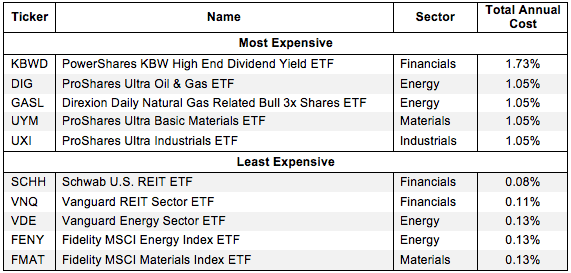
Sources: New Constructs, LLC and company filings
Investors need not pay high fees for quality holdings. State Street SPDR Consumer Staples Select Sector ETF (XLP) earns our Very Attractive rating and has low total annual costs of only 0.17%.
On the other hand, Schwab U.S. REIT ETF (SCHH) holds poor stocks. No matter how cheap an ETF, if it holds bad stocks, its performance will be bad. The quality of an ETF’s holdings matters more than its price.
- Poor Holdings
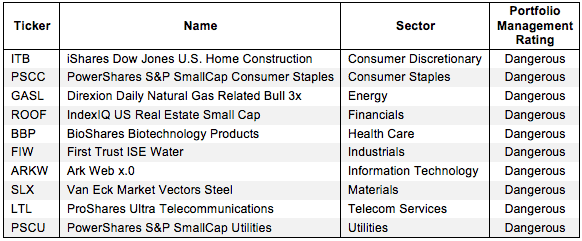
Avoiding poor holdings is by far the hardest part of avoiding bad ETFs, but it is also the most important because an ETF’s performance is determined more by its holdings than its costs. Figure 2 shows the ETFs within each sector with the worst holdings or portfolio management ratings.
Figure 2: Sector ETFs with the Worst Holdings
Sources: New Constructs, LLC and company filings
PowerShares appears more often than any other providers in Figure 2, which means that they offer the most ETFs with the worst holdings.
Our overall ratings on ETFs are based primarily on our stock ratings of their holdings.
The Danger Within
Buying an ETF without analyzing its holdings is like buying a stock without analyzing its business and finances. Put another way, research on ETF holdings is necessary due diligence because an ETF’s performance is only as good as its holdings’ performance.
PERFORMANCE OF ETF’s HOLDINGS = PERFORMANCE OF ETF
Photo Credit: Robert Couse-Baker (Flickr)
Comments
Log in or sign up to join the conversation.