

Introduction: A Shift in the Global Power Balance
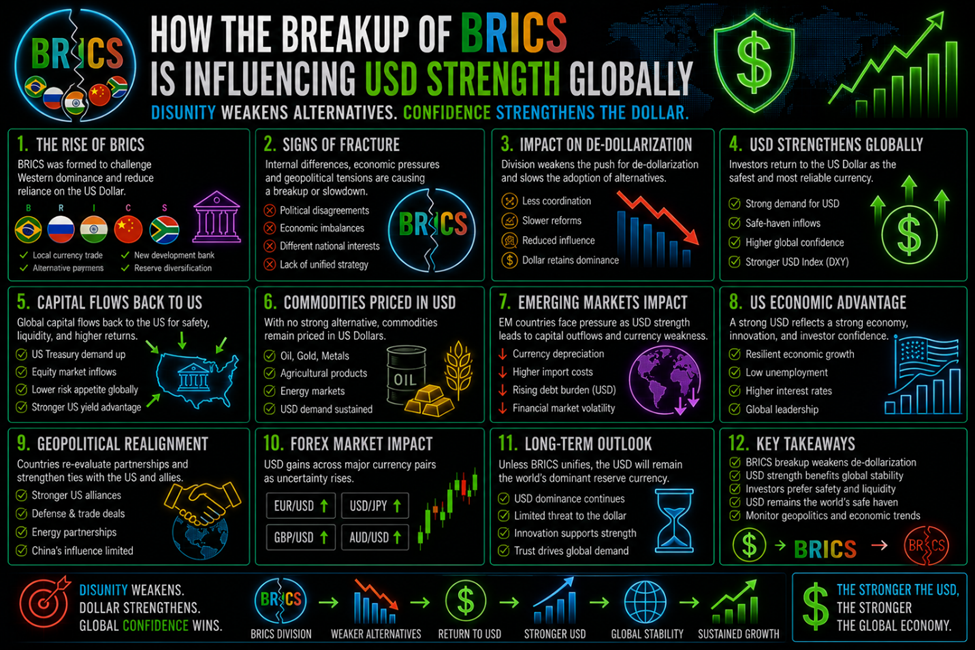
For nearly two decades, the BRICS alliance—Brazil, Russia, India, China, and South Africa—has been viewed as a rising adversary to Western economic dominance. Every country involved has a tenuous relationship at best with the United Stated. Built on the idea of shared emerging market growth and a collective push toward a multipolar financial system, BRICS has long hinted at challenging the supremacy of the U.S. dollar (USD). This had been reinforced by policies of the EU and UK that have been combative against the USD. Although media coverage of the impact of BRICS has been mediocre at best it has been a true threat to the USD, trade balances, and economic strength for the American economy.
However, cracks within the alliance are becoming increasingly visible. After overturning the Biden era destruction of the U.S. Crude Oil industry, the Petrol $$$ has returned in full force. Diverging economic interests, geopolitical tensions, and inconsistent monetary policies are weakening the cohesion of BRICS. Economic sanctions on Russia and Europe’s hatred of energy have weakened the EURUSD and the GBPUSD in ways that are making trend dynamics flow against basic fundamentals in the marketplace. Ironically, instead of accelerating the decline of the USD, this fragmentation is reinforcing its dominance. Showing once again that Free markets prevail against “planned systems”. The strength of the USDHKD is already leading the charge in China. While the USDCNH is still trending lower, That, should be ending soon. It is typical for the USDHKD to front-run the USDCNH. Mostly in part because it is harder for China to cook the books when it comes to USDHKD money flows and currency manipulation.
This article explores how the internal divisions and potential breakup of BRICS are influencing global USD strength—and what it means for traders, investors, and the future of currency markets.
The Original BRICS Vision vs. Today’s Reality
BRICS was never just an economic bloc—it was a strategic vision. The goal was clear:
Reduce dependence on the U.S. dollar
Create alternative trade and financial systems
Increase global influence for emerging markets
Reduce American dominance throughout global markets
Hold BRICS countries hostage by constant currency manipulation (Typical of emerging markets. AKA – Pump-and-dump currency moves)
Maintain nontransparent banking systems (Ripe for scams and money laundering)
Key initiatives included:
Bilateral trade in local currencies (Fixed and not set by market pricing)
Development of a BRICS reserve currency
Expansion of the New Development Bank (NDB) - The New Development Bank (formerly the BRICS Development Bank) is a multilateral institution founded by BRICS nations to fund infrastructure and sustainable development projects in emerging economies.
· · Mission: To mobilize resources for infrastructure and bridge sustainable development gaps.
· · Headquarters: Shanghai, China.
Yet today, that vision is under strain. There are many reasons for this. Most in part because of the lack of true transparency from China which is normal. There is also the Scam factor. Here are a couple to enlighten you to the true nature of the NBD and BRICS.
1. The Rs. 13.2 Billion Internal NDB Bank Scam
This massive breach is one of the largest banking scandals in Sri Lanka's history
2. External Impersonation & Spoofing Scams
For global individuals receiving unsolicited messages, fraudsters frequently impersonate the New Development Bank (NDB) in illicit financial schemes
As you can see the heart of BRICS and the money is run by quite the nefarious group of individuals.
Core Fractures Within BRICS
Geopolitical Tensions
India and China remain strategic rivals, with ongoing border disputes
Russia’s geopolitical isolation has shifted its economic priorities
Brazil’s policies fluctuate with political leadership changes
Economic Divergence
China dominates economically, creating imbalance within the group
South Africa struggles with structural economic challenges and the apartheid pendulum have now swung to be a direct reflection of its torrid past locking them into emerging market status.
India’s growth trajectory differs significantly from others. To say that India has become asset rich is an understatement. However, it is all linked to XAUUSD.
Monetary Policy Conflicts
Inflation rates, interest rate policies, and currency stability vary widely
No unified central banking vision exists
These fractures reduce the likelihood of a cohesive anti-USD strategy.
Why BRICS Fragmentation Strengthens the USD
When global alliances weaken, capital seeks stability. The U.S. dollar benefits directly from uncertainty—and BRICS fragmentation amplifies that dynamic.
1. Flight to Safety
During periods of geopolitical or economic uncertainty, investors move capital into safe-haven assets. The USD remains the primary global reserve currency due to:
Deep liquidity
Strong institutional framework
Trust in U.S. financial markets
As BRICS nations struggle to present a unified alternative, global capital flows back into USD-denominated assets. This is intuitively obvious because as commodity prices drop (especially Crude Oil) and Yields retreat the USD should be under pressure. However, this is not the case since the USD is ripping many FX pairs apart in valuations. This proves once again that the media can trash the USD with headlines and economist views, but financial realities always win. Also, nothing can control the market, and the market is Always correct. Economists would beg to differ, but so do Sunday football betters on Monday. There is a correlation that you can trade on for sure.
2. Lack of a Credible Alternative Currency
One of BRICS’ biggest ambitions was to create a competing reserve currency. However, this effort faces major obstacles:
No unified fiscal or monetary policy
Lack of trust between member nations [They function as the Enemy of my Enemy (America) is my friend]
Absence of transparent governance structures (To say the least)
Without a viable alternative, the USD remains the default choice for:
International trade settlement
Central bank reserves
Commodity pricing (oil, gold, etc.) – This is a major variable not to underestimate.
3. Trade Settlement Still Dominated by USD
Even BRICS countries continue to rely heavily on USD in global trade:
Commodities are still priced in USD
Global supply chains operate primarily in USD
Financial contracts are USD-denominated
Attempts to bypass the dollar have been limited and fragmented. Without coordinated execution, these efforts fail to significantly dent USD dominance.
4. Capital Market Superiority
The United States offers:
The world’s largest and most liquid bond market (Yields are dropping and the USD is rallying proving Bullish strength)
Transparent regulatory systems
Reliable legal frameworks
In contrast, BRICS markets often face:
Capital controls (Fixed pricing)
Political risk (Controlled and manipulated markets)
Limited transparency (The biggest Red flag)
As a result, institutional investors prefer U.S. markets—boosting demand for USD.
The Role of China and the Yuan
China is central to any BRICS challenge to the USD. However, even China faces limitations:
The yuan is not fully convertible (Basically Monopoly $$$)
Capital controls limit global adoption (CCP keeps access limited to hide inefficiencies)
Trust concerns persist among foreign investors
Additionally, other BRICS nations are hesitant to accept Chinese monetary dominance as a replacement for USD dominance. Even the participating BRICS nations know that China is the biggest nation, but the weakest link. This internal resistance further weakens the bloc’s ability to unify around an alternative system.
Russia’s Shift and Its Limited Impact
Russia has aggressively pushed for de-dollarization, particularly after facing sanctions. It has:
Increased trade in rubles and yuan
Reduced USD holdings
Promoted alternative payment systems
However, Russia’s influence is limited by:
Economic isolation
Reduced access to global markets
Dependency on a narrow set of trade partners
This reduces its ability to drive a broader global shift away from the USD. Now you know one of the real reasons behind the support of the Russia / Ukraine conflict. Strangle Russia with sanctions, drive up the price of energy in Europe, and reinforce European collectivism. These actions keep Russia isolated from global economic participation. Ironically it does not matter for Russia. The country spans 13 time zones and literally requires no access to global markets to exist. Once the conflict is over, and it will end, watch global commodity prices tank. Especially Crude Oil. This is what most of those that support the conflict fear. If you are a student of Russian / Ukrainian history this whole thing is like Déjà vu.
India’s Independent Path
India represents a unique case within BRICS:
It maintains strong ties with Western economies (This should not be underestimated)
It promotes its own currency (the rupee) for trade settlement
It avoids aligning fully with China or Russia (The “Swiss” of the East)
This independent approach further fragments BRICS’ collective strategy, making a unified anti-USD front unlikely.
The Psychological Edge of the USD
Beyond economics, the USD benefits from a powerful psychological advantage: trust.
Global markets operate on confidence. Despite political debates and fiscal concerns, the U.S. remains perceived as:
Stable
Predictable
Transparent
In contrast, BRICS nations face:
Political instability
Regulatory uncertainty
Currency volatility
This perception gap reinforces USD demand, especially during times of uncertainty. Ultimately choosing the USD over other currencies remains the most secure liquid decision for global businesses and trade.
What This Means for Forex Traders
For traders, the breakup—or continued fragmentation—of BRICS creates actionable opportunities.
1. USD Bullish Bias in Uncertain Conditions
Periods of geopolitical tension or BRICS instability often led to:
Stronger USD
Weakening emerging market currencies
2. Increased Volatility in BRICS Currencies
Expect:
Sharp moves in currencies like the Yuan, Rupee, Hong Kong Dollar, and Real
Policy-driven price action
News-sensitive volatility
3. Opportunities in Cross-Pairs
Traders can capitalize on divergence between BRICS currencies:
INR vs. CNY
BRL vs. ZAR
RUB vs. CNY
4. Macro-Driven Trading Strategies
Understanding global macro themes—like BRICS fragmentation—provides a strategic edge:
Better timing of USD entries versus specific other currencies
Improved risk management
Enhanced long-term positioning
The Future: Collapse or Evolution?
It’s important to note that BRICS may not fully “break up” in a formal sense. Instead, it may evolve into a looser, less coordinated alliance. In the short-term that is a very plausible situation to unfold. Long-term remains to be seen. You can use your own crystal ball on that one.
Possible scenarios include:
Expansion with new members, increasing complexity (Not likely anytime soon)
Continued bilateral agreements rather than unified policies (Very likely)
Partial de-dollarization efforts without full replacement (That is their goal…but on hold)
Even in these scenarios, the lack of cohesion continues to support USD dominance. Obviously, things can change. Keep an eye on U.S. politics. If political actions and sentiment return to a non-supportive policy of the American economy and industries BRICS will come roaring back with a vengeance.
Conclusion: USD Dominance Reinforced, Not Replaced
The idea that BRICS would dethrone the U.S. dollar has been a compelling narrative. No doubt the media will continue to stoke fear of BRICS and its inevitable success over the USD. But in reality, internal divisions, conflicting interests, and structural limitations are preventing the alliance from presenting a credible alternative. This is the biggest factor that the USD has in its back pocket. If you think this analysis is wrong, just put your money in the NDB and convert your USD to Yuan. Pick any of the BRICS banks, and then let us know how secure you feel. Odds are pretty good your “Angst” level will be redlining.
Rather than weakening the USD, the fragmentation of BRICS is strengthening it.
For global markets, this means:
Continued USD dominance in trade and finance
Persistent demand for USD assets
Ongoing influence of U.S. monetary policy worldwide
For traders and investors, the takeaway is clear:
Until a unified, credible alternative emerges, the U.S. dollar remains the cornerstone of the global financial system—and BRICS fragmentation only reinforces that reality. Remember that this is for educational purposes only, and there is no intention to encourage any bias of the USD versus other currencies.

Comments
Log in or sign up to join the conversation.