

For years, businesses, freelancers, and gig workers have dreaded the paperwork season that comes with issuing and receiving a Form 1099. The $600 reporting threshold — unchanged for decades — meant that even a single small project or side gig could trigger a mountain of information returns. That changed on July 4, 2025, when the One Big Beautiful Bill Act (OBBBA), often called the "Big Beautiful Bill Act," was signed into law. Among its many tax provisions, the bill delivers some of the most significant updates to 1099 reporting requirements in a generation.
If you run a small business, work as an independent contractor, or manage accounts payable for a company that regularly pays vendors, freelancers, or gig workers, these changes directly affect how — and whether — you need to file Form 1099-NEC, Form 1099-MISC, and Form 1099-K starting with the 2026 tax year.
The $600 Threshold Is Officially Gone
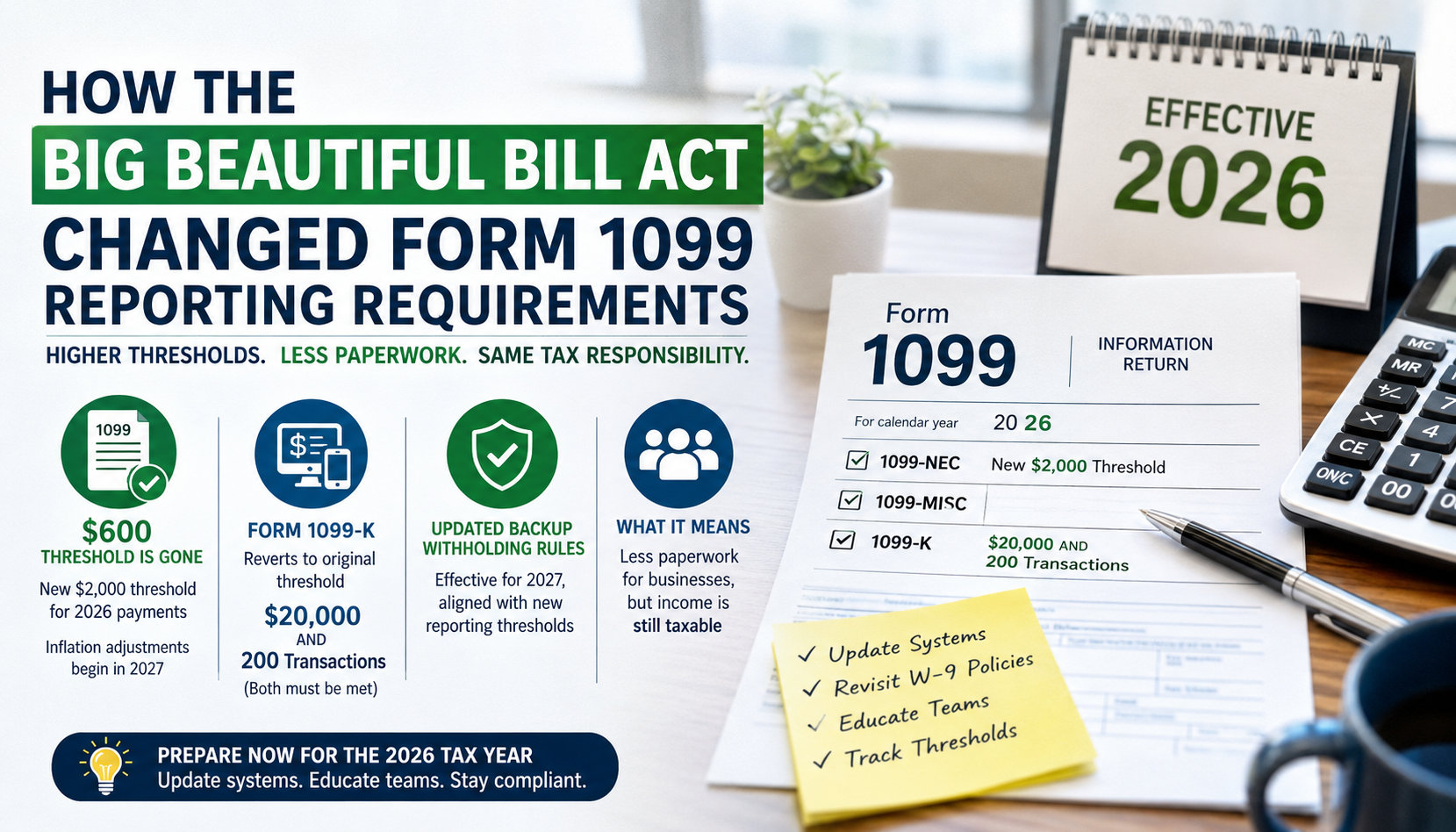
For as long as most business owners can remember, any payment of $600 or more to a nonemployee — a contractor, freelancer, or vendor — required issuing a Form 1099-NEC or Form 1099-MISC. Under the Big Beautiful Bill Act, that threshold jumps to $2,000 starting with payments made in 2026. Beginning in 2027, the IRS will adjust this new threshold annually for inflation, so the bar for filing will continue to rise gradually over time.
In practical terms, this means a company that pays a freelance graphic designer $1,500 for a one-off project in 2026 will no longer need to issue that designer a 1099-NEC. The freelancer, however, is still legally required to report and pay taxes on that income — the reporting threshold has nothing to do with whether income is taxable.
This change is expected to have a sweeping impact. Analysts estimate it could eliminate more than a third of all 1099-MISC filings industry-wide, easing the administrative burden on small businesses that previously had to track every vendor payment down to the dollar.
Form 1099-K Reverts to Its Original Threshold
Perhaps the most talked-about change involves Form 1099-K, which reports payments processed through payment apps and online marketplaces like PayPal, Venmo, Etsy, and Cash App. Under the American Rescue Plan Act of 2021, this threshold had been set to drop to just $600 — a change that caused widespread confusion among casual online sellers and side-hustlers who feared receiving tax forms for simple personal transactions like splitting a dinner bill or reselling used items.
The Big Beautiful Bill Act permanently repeals that $600 rule. Instead, it restores the original dual threshold: payment platforms are only required to issue a 1099-K when a recipient's transactions exceed $20,000 and surpass 200 transactions in a calendar year. Both conditions must be met, not just one. This rollback applies retroactively, effectively erasing years of anticipated confusion for casual sellers and gig economy workers who use third-party payment networks.
Updated Backup Withholding Rules
The legislation also fine-tunes backup withholding requirements tied to these forms. Effective for 2027, payors are only required to issue 1099-MISC and 1099-NEC forms — and apply corresponding backup withholding rules — when total payments for the year actually exceed that year's applicable threshold. This keeps the withholding framework aligned with the new, higher reporting limits rather than leaving outdated rules in place.
What This Means for Businesses and Taxpayers
While these changes reduce paperwork, they don't reduce tax obligations. All income remains taxable regardless of whether a 1099 form is issued. Contractors, freelancers, and gig workers still need to track every dollar earned, since the IRS requires reporting of net earnings over $400 for self-employment tax purposes regardless of 1099 thresholds.
For businesses, now is the time to:
Update accounts payable systems to reflect the new $2,000 threshold for 2026
Revisit W-9 collection policies, since vendors paid less than $2,000 annually may no longer require one
Educate finance teams and independent contractors about the distinction between reporting thresholds and taxable income
Prepare for annual inflation adjustments starting in 2027
For online sellers and gig workers relying on payment apps, the reversion to the $20,000/200-transaction threshold for Form 1099-K brings welcome relief and predictability, especially for those who only occasionally sell items online or receive personal reimbursements through payment apps.
Final Thoughts
The Big Beautiful Bill Act represents a meaningful simplification of Form 1099 compliance, cutting down on unnecessary paperwork for millions of small transactions while preserving the IRS's ability to track larger, more significant payments. Businesses and tax professionals should use 2025 as a preparation year, updating systems and processes so they're ready when the new thresholds take effect for the 2026 tax year and beyond.
Frequently Asked Questions
1. When do the new Form 1099-NEC and 1099-MISC thresholds take effect?
The increased $2,000 threshold applies to payments made starting in the 2026 tax year, with inflation adjustments beginning in 2027.
2. Do I still owe taxes on income if I don't receive a 1099?
Yes. The 1099 threshold only affects whether a business must report a payment — all income remains taxable and must be reported on your tax return regardless of the amount.
3. What is the new Form 1099-K threshold under the Big Beautiful Bill Act?
Payment platforms must now issue a 1099-K only when a recipient exceeds $20,000 in payments and more than 200 transactions in a calendar year, reversing the previously planned $600 threshold.
4. Do businesses still need to collect W-9 forms from every vendor?
Not necessarily. Since 1099s are only required for vendors paid $2,000 or more annually starting in 2026, businesses may skip W-9 collection for vendors below that threshold — though collecting one proactively is still good practice.
Comments
Log in or sign up to join the conversation.