

Most traders are already familiar with the webhook model through TradingView. A strategy or indicator creates an alert, the alert sends a structured message, and another system receives that message and turns it into an action.
For years, this model has worked well for traders who build their own Pine Script alerts or use TradingView strategies. The logic is clear: the signal source creates a condition, the webhook carries the instruction, and the execution layer sends the order to a broker or exchange.
But many trading signals do not start inside TradingView.
A large part of the retail trading world still operates through Telegram channels, private groups, signal rooms and analyst broadcasts. These signals are often written as plain text. They may include a symbol, direction, entry price, stop loss, take profit levels and sometimes additional context. The problem is that this format is not naturally machine-readable.
A typical Telegram signal may be clear to a human trader, but not clear enough for direct execution:
“Buy BTCUSDT around 68000, SL 67200, TP 69500 / 71000”
A person understands what this means. A broker API does not.
This is the gap AlgoWay is trying to close.
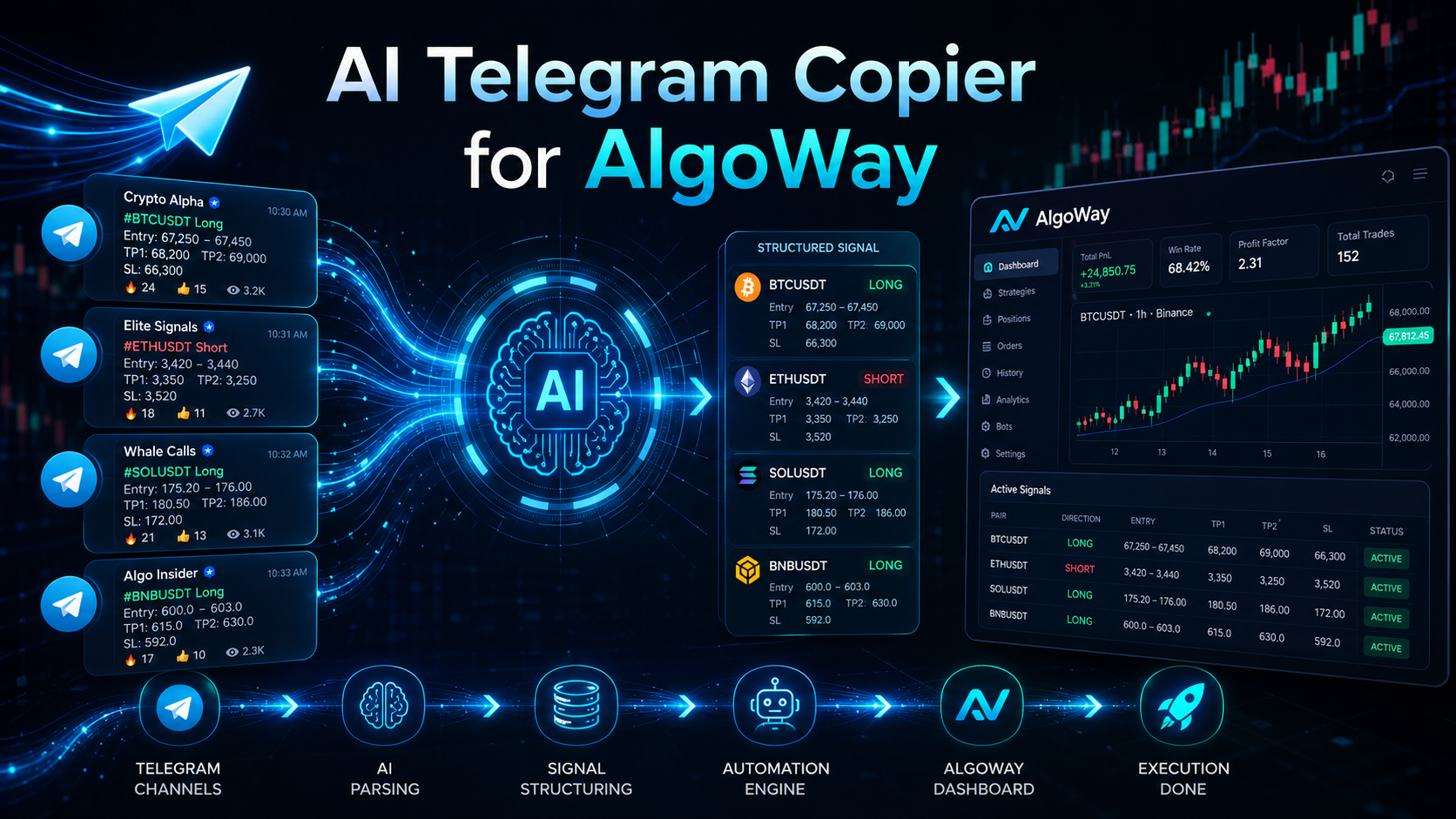
AlgoWay already works as an automation layer for TradingView alerts, JSON webhooks and multi-platform trade routing. The new direction is applying the same webhook logic traders already know to Telegram-based trading signals. Instead of treating Telegram as a separate manual workflow, Telegram can become another signal source inside the same execution pipeline.
The workflow becomes:
Telegram signal >> AI normalization >> AlgoWay JSON >> broker or exchange execution
The important part is normalization. Telegram messages are not consistent. One signal provider writes “BUY GOLD,” another writes “Long XAUUSD,” another sends multiple targets, and another uses a different format every week. A simple webhook receiver cannot reliably understand all of that.
AI makes this workflow more practical because it can read the message, understand the trading intent, and convert the signal into a structured format. That structured format can then be handled like any other AlgoWay webhook request.
For example, a plain Telegram signal can be transformed into a JSON-like trading instruction containing the platform, symbol, order direction, size, stop loss and take profit. Once the signal becomes structured, it can move through the same automation layer used for TradingView alerts.
This does not mean AI is deciding whether the trade is good. That is an important distinction. The AI layer is not a strategy, not a financial advisor and not a profit engine. It is a parser and normalizer. It helps turn messy human text into a format that software can process.
The trader still chooses the signal source. The trader still decides whether the source is worth following. AlgoWay handles the infrastructure between the signal and the destination account.
That distinction matters because automation is often misunderstood. Many traders think automation means “a robot that makes money.” In reality, automation is often much simpler and more practical. It is about removing repetitive manual steps, reducing missed alerts, keeping execution consistent and making the workflow easier to monitor.
AlgoWay is built around that idea. It does not sell a trading strategy. It provides a connector layer between signal sources and trading destinations.
The same account may use TradingView alerts for one strategy, Telegram signals for another, and manual webhook messages for a third. The destination can be MT5, cTrader, TradeLocker, DXtrade, Binance, Bybit, OKX, MEXC or another supported platform. The goal is to keep the signal logic separate from the execution infrastructure.
This is especially useful for traders who work across different markets. A crypto trader may want Telegram signals routed to Binance or Bybit. A forex trader may want structured signals sent to MT5 or cTrader. A prop-style trader may need execution on TradeLocker or DXtrade. In each case, the signal source is different, but the automation problem is similar.
The core problem is not “how do I get a signal?”
The real problem is:
How do I turn that signal into a clean, controlled, executable instruction?
That is where the webhook model remains powerful. Webhooks give traders a flexible bridge between signal generation and execution. AlgoWay expands that model beyond TradingView by allowing Telegram signals and other sources to enter the same automation flow.
There are also practical risk-management reasons to structure signals this way. Once a message becomes a normalized request, the system can handle fields like order action, symbol, order type, volume, stop loss, take profit and trade mode more consistently. It becomes easier to log what happened, debug problems, and understand whether the issue came from the signal source, the parser, the broker or the trading platform.
Without that structure, Telegram trading remains manual and fragile. A trader receives a message, reads it quickly, opens a platform, enters the order, checks the symbol, sets the stop loss, enters the take profit and hopes nothing was missed. That might work for one or two trades. It does not scale well when signals arrive quickly or across multiple accounts.
A structured automation layer does not remove trading risk, but it can reduce operational confusion.
That is the main reason I think Telegram signal automation is an important step for retail trading infrastructure. It takes a familiar concept — webhook-based execution — and applies it to a source that many traders already use every day.
For traders who already understand TradingView webhooks, the idea is simple: Telegram becomes another input. AlgoWay becomes the routing and normalization layer. The broker or exchange remains the execution destination.
More details about the Telegram AI signal workflow are here:
https://algoway.trade/blog/ai-telegram-signals-manual.html
In my view, the future of trading automation is not one single platform or one single strategy. It is a more flexible execution stack where signals can come from TradingView, Telegram, custom scripts or manual alerts, and still be routed through one controlled automation layer.
That is the direction AlgoWay is building toward: not a magic trading bot, but a practical connector between the way traders generate signals and the platforms where trades are actually executed.
Comments
Log in or sign up to join the conversation.