


Spain's monthly pay rose faster at the bottom than across much of the middle, though the largest gains were concentrated near the top. The political parties differ on how to raise incomes. Some favour a higher minimum wage and shorter working hours; others emphasise tax cuts and hiring incentives, or propose deregulation and tighter access to benefits
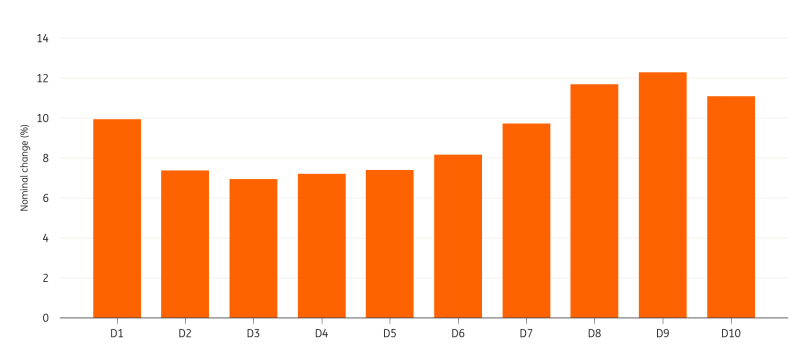
Between 2023 and 2025, average gross monthly pay rose by 10% in Spain’s lowest wage decile, compared with around 7% to 8% across deciles two to six. The three highest deciles recorded gains of 11% to 12%.
Over the longer period from 2019, the bottom decile recorded the strongest pay growth. Average gross monthly pay rose by about 33%, compared with 23% in the fifth decile and 27% in the top decile. Spain’s sharp minimum-wage increases are likely to have supported earnings near the bottom, although these figures cannot isolate their effect. Workers move between deciles, while changes in hours worked, occupation and seniority also affect average monthly pay.
Wage growth has been strongest at the bottom and top
Change in average gross monthly wage by overall wage decile, 2023-2025 (%)
Source: INE, ING Economic Research
Faster growth has not removed the large differences in pay. In 2025, employees in the lowest overall wage decile earned an average of €709 per month, compared with €1,970 in the fifth decile and €5,983 in the 10th.
With Spain voting on 29 November, the election programmes offer three different approaches to raising household incomes. The Spanish Socialist Workers' Party (PSOE) wants to continue raising statutory wages, reduce working time and expand social support. Partido Popular places more weight on tax relief, incentives for stable employment and refundable family benefits. Vox proposes broader tax cuts, less labour regulation and tighter eligibility rules for social assistance.
Low monthly wages also reflect limited working hours
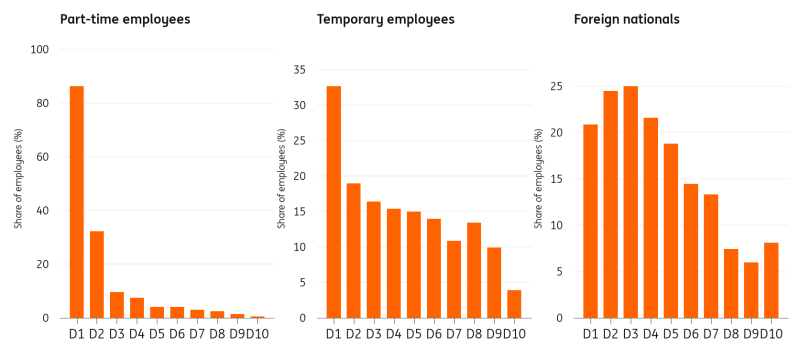
Monthly earnings depend on working time as well as wage rates. In 2025, 86.3% of employees in the lowest monthly-wage decile worked part-time. The share fell to 32.2% in the second decile and to around 9.5% and 7.5% in the third and fourth deciles, respectively. Part-time employment was uncommon from the middle of the distribution onward.
Temporary contracts followed a similar, though less extreme, pattern. They accounted for 32.7% of employees in the first decile and 18.9% in the second, compared with 3.9% in the top decile. Employees with a foreign nationality represented more than one-fifth of the first three deciles: 20.9%, 24.5%, and 25.0%, respectively.
Part-time and temporary work are concentrated in lower wage deciles
Share of employees in each overall wage decile, 2025 (%)
Source: INE, ING Economic Research
These figures put the minimum wage debate into perspective. A higher wage floor can raise hourly or full-time-equivalent pay, but it cannot guarantee enough paid hours. Someone working a short or irregular schedule can remain on a low monthly income even when the statutory rate rises. Contract stability, predictable schedules and access to full-time work therefore matter alongside the wage floor.
The programmes rely on different combinations of wage regulation, working-time rules, tax reductions, cash benefits and public services.
PSOE would continue the wage-led approach
PSOE would continue using the minimum wage as part of a broader labour market strategy. Since 2018, the monthly rate has risen from €736 to €1,221, paid 14 times a year. The programme would place the minimum wage above 60% of the average wage in law, with future adjustments reflecting prices, wages, productivity and workers’ needs.
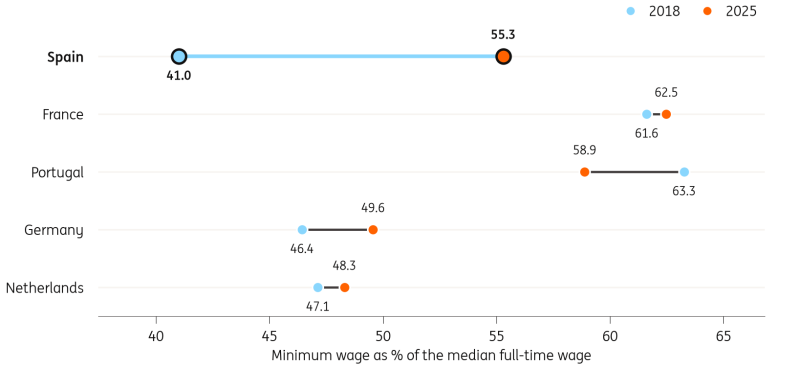
Spain has already moved substantially towards a higher wage floor. The minimum wage rose from 41.0% of the median full-time wage in 2018 to 55.3% in 2025, an increase of more than 14 percentage points. France remained above 60%, while Germany and the Netherlands recorded much smaller increases.
Spain’s minimum wage has moved much closer to the median wage
Statutory minimum wage as a percentage of the median full-time wage
Source: OECD, ING Economic Research
The chart above uses the median full-time wage, while PSOE’s proposed legal benchmark refers to the average wage, so the measures are not directly comparable. Both show that further increases would start from a much higher relative level than in 2018. Low-paid employees have recorded the strongest wage growth while employment has continued to rise, but additional increases may be harder for businesses with low productivity or narrow margins.
PSOE would also reduce the standard working week to 37.5 hours without loss of pay and encourage collective bargaining towards 35 hours. Transitional arrangements would support smaller companies, but the combination of higher wages and shorter hours would still raise hourly labour costs. Firms would need to respond through higher productivity, lower margins, higher prices or changes in employment and hours.
The party also wants employers to justify why positions are not offered on a full-time basis and would treat contracts covering more than 80% of a standard schedule as full-time. This targets an important source of low monthly earnings: insufficient paid hours.
Beyond the labour market, PSOE proposes more support for lower-income families through a progressive child benefit, a refundable child tax credit and wider access to childcare and care services. These measures could reach households that receive little from conventional tax allowances, but would also create permanent fiscal costs.
Partido Popular would focus more on disposable income
Partido Popular focuses less on statutory wage targets or shorter working hours and more on tax cuts, incentives for stable employment and support for families.
The party proposes lower personal income tax rates for low and middle-income households, higher personal and family allowances, and an automatic income tax exemption for anyone earning the minimum wage. Tax thresholds would again be adjusted for inflation. Workers and self-employed people aged 18 to 35 would receive a four-year tax reduction, beginning with a full exemption in the first year and declining thereafter.
Tax reductions can increase take-home pay without adding directly to employers’ wage bills. They may therefore carry less immediate employment risk than another large increase in the wage floor. Their reach is weaker at the bottom, however. Workers whose earnings already fall below the income-tax threshold gain little from a conventional tax cut. This includes many people with short working hours.
Partido Popular partly addresses this through refundable family support. Existing deductions would be combined into a monthly payment available even when a household’s tax liability was too low to use the full deduction. The programme also proposes free education from birth to age three, more flexible arrangements for caregivers and a deduction covering 40% of professional care expenses for an elderly dependent relative.
Employers would pay lower unemployment contributions when the stability of their workforce exceeded the average in their sector. New self-employed workers would pay no social security contributions during their first year, with a possible second year for those earning below the minimum wage.
The distributional effect would depend on the balance between conventional tax relief, which offers less to people with little taxable income, and refundable support that can reach poorer households.
Vox would cut taxes and narrow access to benefits
Vox also relies heavily on lower taxation. It proposes a simpler personal income tax system, with rates adjusted for the number of children. Self-employed workers earning below the minimum wage would pay no social security contributions, with contributions rising progressively above that threshold.
Vox would repeal the current government’s labour legislation, which it argues has failed to eliminate insecure employment. The programme promises stable jobs and higher wages, but provides little detail on the rules that would replace the existing framework or how wages would increase.
The party also proposes free education from birth to age three, childcare support and stronger care services. Access would be more restrictive, however. Spanish nationals would receive priority for housing and various social benefits, and the minimum-income scheme would be limited to them.
Foreign nationals are disproportionately represented in the lower wage deciles. These restrictions would therefore reduce support for a group with relatively high exposure to low pay, temporary employment and housing pressure.
The choice concerns instruments, recipients and financing
Gross wages are only one part of household living standards. Tax cuts can raise net earnings but offer little to people with low taxable income, while refundable benefits and public services can reach those households more directly.
The programmes follow a clear left-right divide. PSOE relies on wage regulation, shorter hours, employment protection and public provision. Partido Popular emphasises tax relief, refundable family support and employer incentives. Vox combines broader tax cuts and less labour market regulation with tighter access to benefits.
Ahead of the election on 29 November, most polls point to a parliamentary majority for Partido Popular and Vox. If that produces a government, policy would probably shift towards tax relief, employer incentives and greater labour-market flexibility. The extent of the change would depend on the seat distribution and Vox’s influence.
Spain has shown that strong wage growth at the bottom can coexist with rising employment. Repeating that performance may be harder from today’s higher wage floor, especially when many low-paid employees lack access to sufficient working hours or stable contracts. Higher wage floors and shorter working weeks carry risks for low-productivity employers, while conventional tax cuts often miss the lowest earners. The challenge for the next government will be to raise disposable incomes without weakening employment or creating unsustainable fiscal commitments.



Comments
Log in or sign up to join the conversation.