

from the St Louis Fed
-- this post authored by Paulina Restrepo-Echavarria
The volume and timing of job applications provide relevant information regarding labor market conditions. Moreover, they influence the strategies employers use to fill jobs, and those of people searching for work.

Using a database from DHI Group Inc.1linking nearly 80 million applications to almost 10 million online job postings, University of Chicago Booth School of Business Professor and Hoover Institution Senior Fellow Steven J. Davis and I (Brenda) highlight new facts about the search behavior of employers and workers.
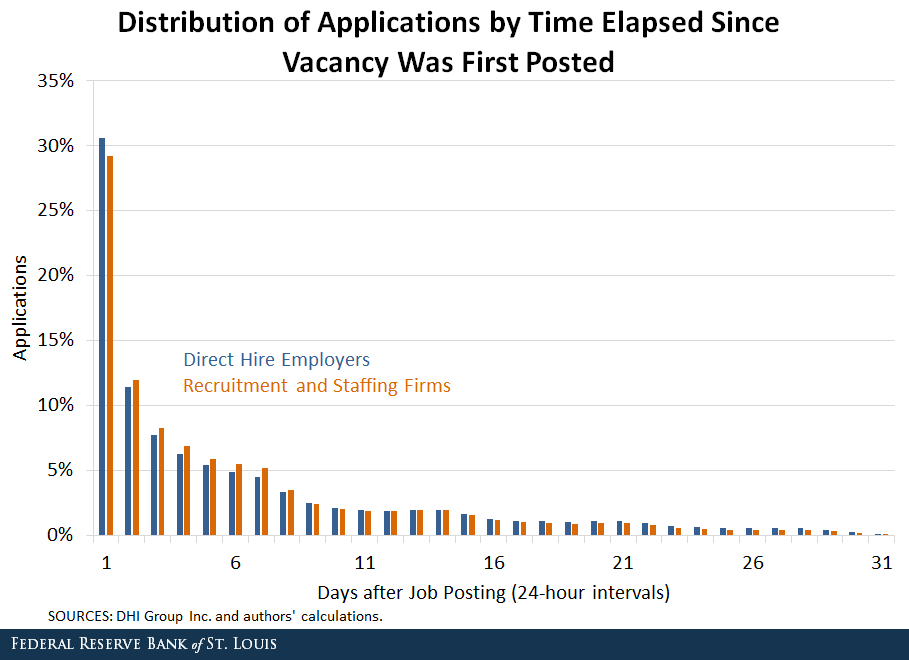
First, applications per posting drop sharply as postings age, as seen in the figure below.[2] After a job is posted:
- 41 percent of all applications are received within the first 48 hours.
- 56 percent arrive during the first 96 hours.
(Click on image to enlarge)
Furthermore, Davis and I found that postings are short-lived: Single-position postings have a mean duration of 9.8 days. The figure below shows the distribution of single-position postings by time elapsed from first to last active date.
(Click on image to enlarge)
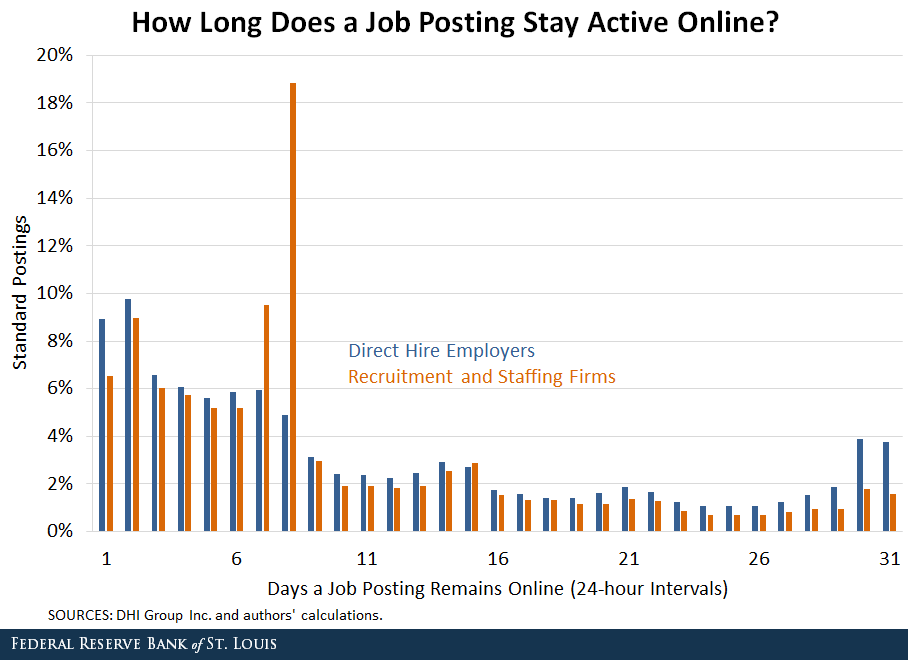
Tracking postings and applications second-by-second, Davis and I are able to offer a new, more detailed view of the hiring process. Our measure of average posting duration accounts for roughly one-fourth of mean vacancy duration for similar jobs in the Jobs Openings and Labor Turnover Survey. Thus, the “search" phase of hiring process - during which employers solicit and accept applications - is far shorter than the “selection" phase - during which employers screen and interview applicants, make and negotiate an offer, and wait for a decision.
How Employers Should Process Applications
The timing of application flows influences employers’ optimal search strategy. If most job seekers apply within a short period and there are no ongoing costs of posting a vacancy, employers should gather and review a batch of applications, rather than evaluating each one sequentially as they arrive.2
Davis and my findings regarding the concentration of applications in young vacancies, coupled with short posting durations relative to vacancy durations, weigh in favor of a nonsequential strategy.
How Job Seekers Should Apply
If employers review applications in batches, there will be delays between the submission of an application and the employer’s selection of a recruit.3 This creates incentives for job seekers to adopt a nonsequential search strategy as well, that is, to submit several applications at once rather than wait to hear back from each application before submitting the next one. Consistent with this theoretical implication, Davis and I found that job seekers submit applications for multiple job openings within the same 24-hour period.


Comments
Log in or sign up to join the conversation.