

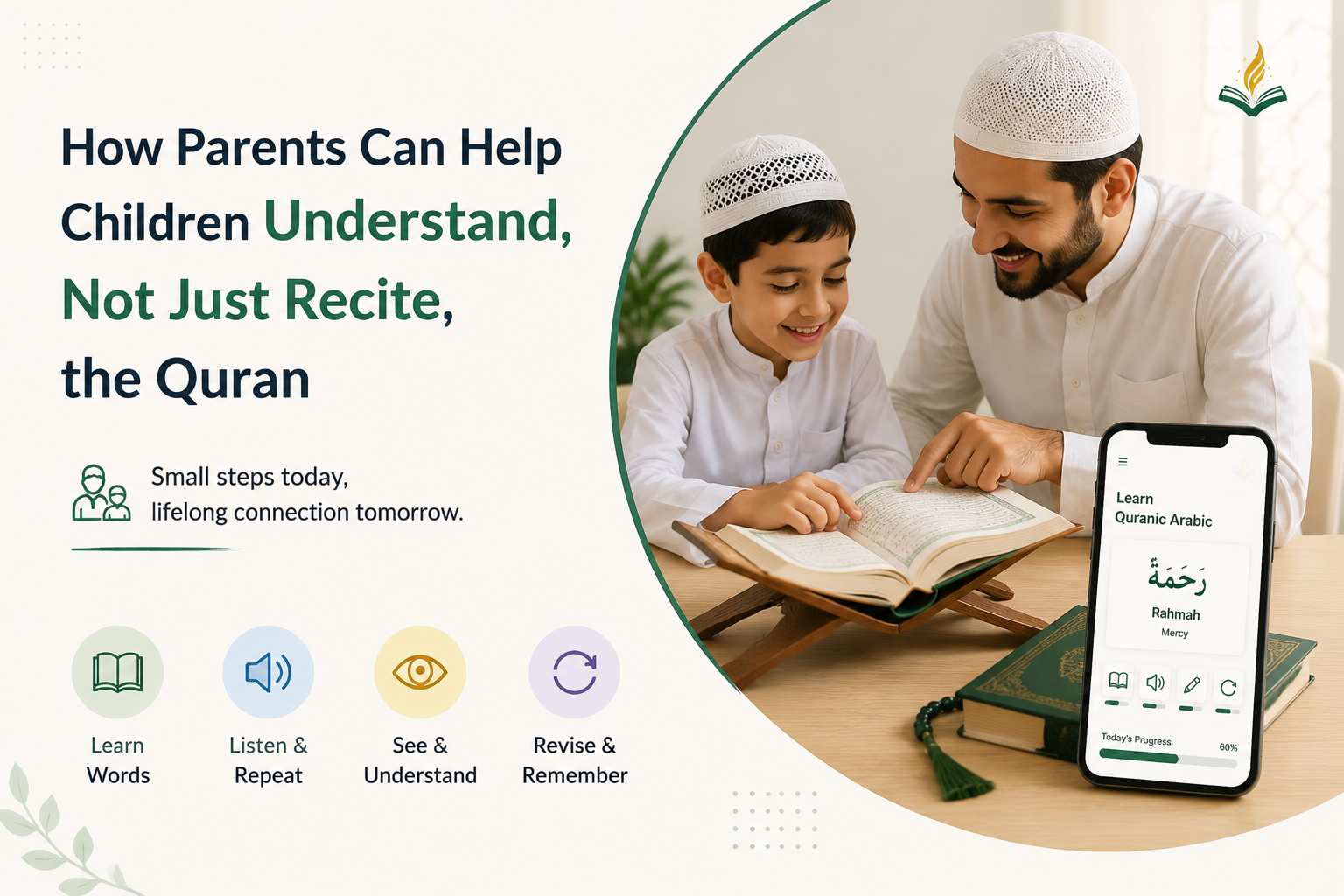
A child may be able to recite a Surah beautifully and still have only a limited idea of what many of its Arabic words mean.
For parents, this can raise an important question: once a child is becoming comfortable with recitation, how can we also help them develop an understanding of the language they are reading?
The answer does not have to involve turning Quran time into another school lesson.
For younger learners especially, understanding can begin in very small ways. A single familiar word, a simple explanation after recitation, or noticing the same Arabic term in different Surahs can gradually build curiosity about the language of the Quran.
Recitation remains important. Learning meaning simply gives children another way to engage with what they are reading.
Start with curiosity rather than pressure
Children usually respond better when learning feels like discovery rather than a test.
After reading a short passage, a parent might choose one Arabic word and ask whether the child knows what it means.
If they do not, that is fine.
Explain the meaning briefly and move on.
The next time the word appears, see if they remember it.
This approach is very different from giving a child a long list of vocabulary and expecting every meaning to be memorised by the end of the week.
The goal at the beginning is familiarity.
When children repeatedly encounter words they recognise, they begin to see Quranic Arabic as something they can gradually understand rather than a language that is permanently beyond them.
Connect words with something children already know
New vocabulary becomes easier to remember when it is connected with a familiar idea.
Take رحمة (Rahmah), for example.
Instead of simply saying that the word means mercy, a parent can briefly explain what mercy looks like in everyday life. Another word could be connected with something the child has heard in a Surah, a dua or a family conversation.
The explanation does not need to become a lengthy lesson.
Sometimes one clear sentence is enough.
Young learners often remember meaning better when a word is attached to a situation, picture, sound or previous experience.
This is also why visual and audio learning can be useful alongside traditional reading.
Let children notice words for themselves
There is a satisfying moment when a child points at a Quranic word and says, “I know that one.”
Parents can encourage those moments.
If your child has recently learned three or four words, ask them to look out for those words during their normal Quran reading.
Do not turn it into an exam.
Let it feel more like spotting something familiar.
Children may initially recognise only one word in an entire ayah. That is still progress. With continued exposure, more vocabulary begins to stand out naturally.
For families deciding which vocabulary to introduce first, NorAI's guide to common words used in the Quran offers examples of frequently encountered Quranic words that can provide a practical starting point.
Keep explanations appropriate for the child's age
A six-year-old and a fourteen-year-old will not need the same explanation.
For younger children, a short meaning and a simple example may be enough.
Older children may be ready to talk about how the same word appears in different contexts or why a translation sometimes uses slightly different English wording.
Parents do not need to explain everything themselves.
When a question involves the wider meaning of an ayah, Tafseer, grammar or religious interpretation, it is sensible to refer to reliable translations, trusted teachers and qualified scholarship.
The parent's role does not have to be that of an Arabic professor.
Often, it is simply to keep the child's curiosity alive.
Avoid turning every Quran session into vocabulary study
Children also need space to read.
If every line is interrupted by questions about meaning, a Quran session can quickly become tiring.
Choose moments carefully.
Some days may focus mainly on recitation. On another day, you might spend five minutes looking at two words the child has encountered before.
Keeping the activities separate at times can actually make both easier.
A child can enjoy reciting without feeling that a test is coming after every verse, while vocabulary practice has its own short place in the routine.
That balance matters.
Repetition works better when it does not feel repetitive
Children naturally forget things.
A word learned on Monday may be gone by Friday.
Instead of treating that as poor progress, bring the word back in a different way.
One day the child might read it.
Another day they might hear it.
Later, they could match the Arabic word with its English meaning.
Then they may spot it inside a Quranic passage.
The vocabulary is being repeated, but the activity does not feel identical each time.
This type of variety can make revision less monotonous, particularly for children who lose interest quickly when asked to repeat the same exercise.
Make Quran learning fit family life
A routine does not need to be long to be useful.
For some families, ten focused minutes after Maghrib may be realistic. Others may find weekends easier. A child may prefer a brief vocabulary activity before regular recitation.
There is no single timetable that suits every household.
What matters is choosing something the family can actually maintain.
A complicated programme that lasts for five days is less helpful than a modest routine that continues for months.
Parents can also keep expectations realistic. Younger children may only work with a few words at a time, while an older learner may comfortably manage more.
Use technology as support, not a replacement
Phones and tablets are already part of many children's lives.
Used carefully, they can support Quranic Arabic learning rather than simply adding more screen time.
The key question is what the child is doing on the screen.
An activity that asks them to recognise an Arabic word, listen to its pronunciation, recall its meaning or review something previously studied has a clear learning purpose.
This is where NorAI can fit naturally into a family learning routine.
NorAI focuses on Quranic Arabic vocabulary through structured lessons that combine word recognition with audio, visual activities and revision. Rather than expecting a child to work through a large vocabulary list independently, learning can be broken into smaller steps.
For parents, that can make it easier to add language understanding alongside the recitation routine the family may already have.
Talk about meaning outside formal study time
Understanding does not have to happen only while sitting with a book or app.
Suppose a child has recently learned a Quranic word connected with patience, guidance or mercy.
If that idea comes up naturally later in the week, the parent can mention the Arabic word again.
That simple reminder gives the vocabulary another connection.
It also shows the child that Arabic words have meaning beyond a lesson screen.
Over time, Quranic vocabulary begins to become part of familiar family language rather than something that appears only during study time.
Praise recognition, not only perfect answers
Children often notice immediately when they get something wrong.
Parents can help by also drawing attention to what has improved.
Perhaps a child remembers the meaning but cannot pronounce the word confidently.
Perhaps they recognise the Arabic but need help recalling the English meaning.
Perhaps they notice a familiar word in an ayah for the first time.
Those are all stages of learning.
If progress is measured only by perfect recall, children can easily feel that they are failing. When parents notice smaller improvements, the learning process becomes less intimidating.
Do not rush towards large targets
It can be tempting to set goals such as learning fifty or one hundred new words.
Numbers can be motivating, but they should not become the whole purpose of the exercise.
Five words a child genuinely recognises are more useful than fifty they have hurried through and forgotten.
Allow vocabulary to settle.
Return to previous words.
Give children opportunities to meet familiar language during actual Quran reading.
Once those words become comfortable, new ones can be added.
There is plenty of time.
Understanding can grow alongside recitation
Parents do not need to choose between teaching children to recite the Quran and helping them understand Quranic Arabic.
The two can support each other.
As children become stronger readers, familiar vocabulary can make certain parts of the text feel more meaningful. As they hear Quranic words repeatedly during recitation, those sounds can also reinforce what they have studied.
A child may not understand a complete verse independently for quite some time.
That should not discourage the process.
Understanding often begins much earlier, with small recognitions that gradually accumulate.
A word becomes familiar.
Then another.
Eventually, the child starts approaching Quranic Arabic with the expectation that it is something they can learn.
Give children a positive starting point
One of the most useful things a parent can give a child is not a huge vocabulary target or an intense study schedule.
It is a positive relationship with learning.
Keep sessions manageable. Allow questions. Revisit forgotten words without making mistakes feel serious. Connect vocabulary with regular Quran reading and let understanding develop at a pace the child can comfortably follow.
The purpose is not to make young learners rush through Arabic.
It is to help them grow up seeing the language of the Quran as something they can continue discovering.
Continue learning with NorAI
NorAI provides a structured way for learners to become familiar with Quranic Arabic words through visual practice, listening activities and regular revision.
Families looking to add word understanding alongside their existing Quran routine can use short lessons at a pace that fits naturally around school, home and other commitments.
Download NorAI from the App Store or Google Play and begin exploring Quranic Arabic one word at a time.
Comments
Log in or sign up to join the conversation.