
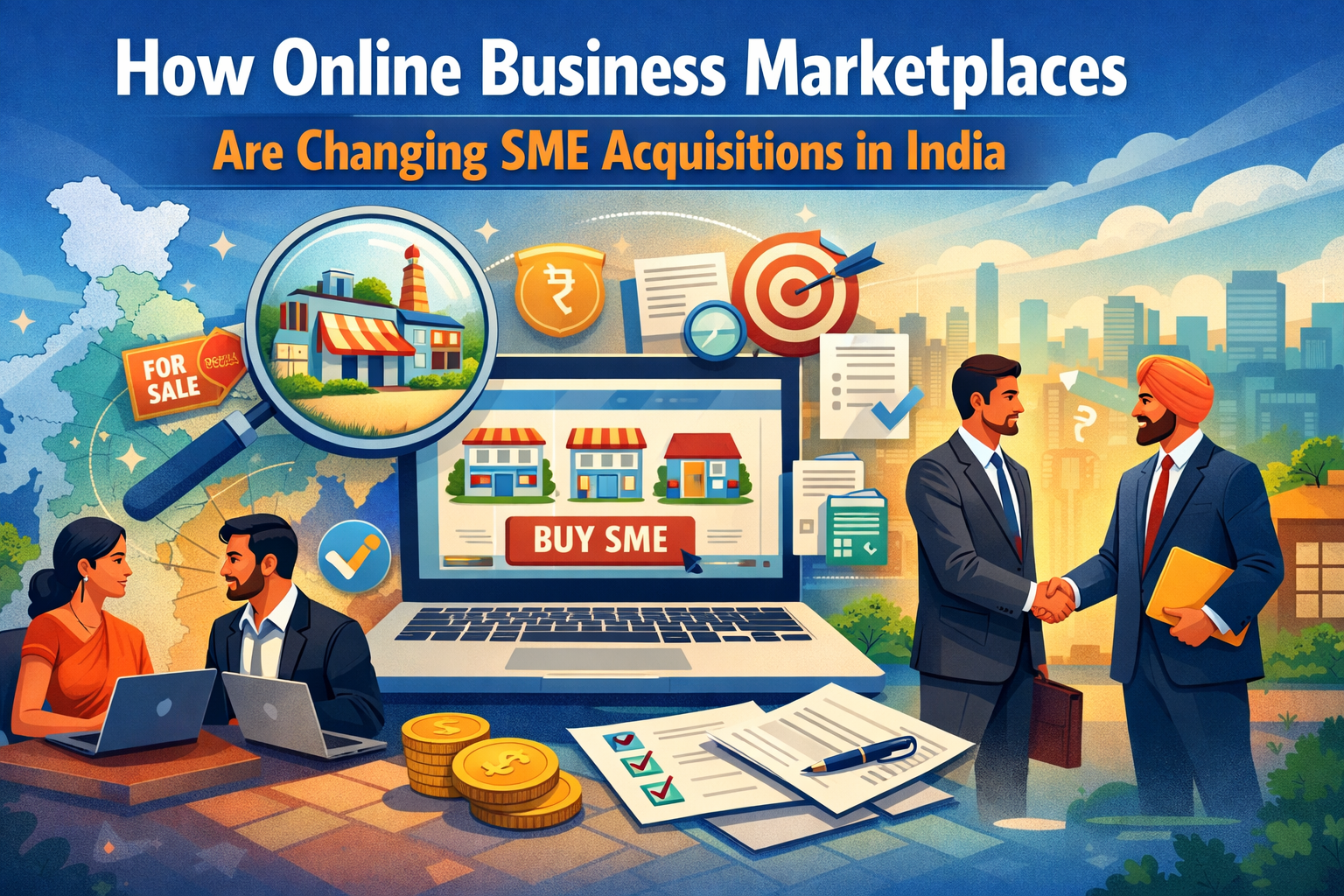
Formerly, the acquisition or disposal of a small or medium-sized enterprise in India had been a tedious process. The transactions occurred in silence by the use of brokers, local network, or referrals. Transparency was limited. Valuing could not be clear-cut. And buyers with a serious need could not find confirmed opportunities easily.
That landscape is rapidly evolving nowadays.
Online business marketplaces are radically altering sme acquisitions in India by turning the whole process more transparent, information-based, and accessible. In need of an investment or planning an exit, regardless of whether you are an investor seeking to purchase an existing company, or you are an entrepreneur, you have found yourself at a digital point of discovery, evaluation, and closing deals.
It is time to discuss how this change is transforming the ecosystem of SMEs in India.
The Traditional SME Acquisition Model: Sluggish and Secretive.
Trading in SMEs in India for decades used to depend on:
Brokers of a few local networks in the business.
Personal contacts and industry contacts.
Unstructured offline negotiation.
Paper due diligence procedures.
The biggest problem? Information asymmetry.
Sellers were not always informed to value their businesses in the right way. Buyers had difficulties accessing financials or making claims. Deals were usually crashing because of the absence of trust, holes in documentation, or impractical expectations.
This rendered sme acquisitions in India risky- particularly in the case of first-time investors.
The Emergence of the Online Business Marketplaces.
E-platforms have brought about an organized system of purchasing and selling firms. These are marketplaces that intervene as middle grounds in which:
Sellers are able to put up their businesses without a lot of publicity.
The opportunities are filtered by the buyer based on industry, revenue, location, and investment size.
Uniqueness of financial information and key metrics is normal.
The preliminary screening and recording are simplified.
Investors now access curated deal flow as opposed to following leads without any direction.
As an illustration, the normalized attitude towards digital business acquisition has been made by platforms such as SMERGERS, IndiaBizForSale, and BizBuySell (around the world).
Although both platforms do not work in the same way, the difference is apparent in structured, searchable, and scalable deal-making.
1. Increased Openness of Deals.
Transparency is one of the greatest changes that have occurred in the sme acquisitions in India.
Marketplaces in the online format usually show:
Annual revenue
EBITDA or profit margins
Industry classification
Reason for sale
The price or range of investment is asked.
This enables the buyers to filter opportunities more quickly and objectively compare businesses.
Openness enhances speculation and promotes serious deliberations. Sellers are also more watchful with the way they are showing the financials, in that they are aware that buyers can easily compare the listings.
2. Access to a Wider Buyer Pool
The owners of SMEs were restricted to local buyers in the past. A manufacturing company in Coimbatore, or a digital agency in Kochi, can now win the attention of investors anywhere in India as well as possibly elsewhere.
Geographical limits are eliminated through online platforms.
This wider exposure:
Competition among buyers increases.
Enhances valuation performance.
Lowers the time to complete deals.
This is why sme acquisitions in India are no longer restricted to family and local acquisitions. They are also integrating into an overall investment strategy.
3. Fixed Valuation and Due Diligence.
The other significant change is structured valuation.
Marketplaces tend to steer sellers in valuation frameworks that are pegged on:
Revenue multiples
EBITDA multiples
Asset value
Industry benchmarks
Other platforms go as far as providing advisory services, legal document templates, and escrows.
This makes it easier to negotiate and paper over sme acquisitions in India, which becomes more professional and investor-friendly.
The presence of formal paperwork and instructions minimizes the risk among first-time buyers in particular.
4. Greater First-Time Investor involvement.
Customarily, business acquisitions demanded extensive networks or knowledge. SME acquisitions are currently being looked into by professionals, NRIs, and startup founders as an option to acquiring instead of building.
Why?
Due to the advantages involved in acquiring an existing business, it will provide:
Immediate cash flow
Existing customers
Operational systems
Reduced market-entry risk
Online marketplaces have made these opportunities democratic. This is also hastening the increase of sme acquisitions in India as a suitable wealth-building strategy.
5. Faster Deal Cycles
Speed matters in business.
It helps to facilitate the initial phases of procurement by providing digital marketplaces that:
Facilitating safe sharing of documents.
Automating NDAs
The provision of direct communication avenues.
Sifting frivolous questions.
Buyers can spend many months on informal talks, but with discovery, they can proceed to serious negotiations in a short period of time.
Although due diligence remains a time-consuming process, the first step of stage deal-matching is now much more efficient.
6. Data-Driven Decision Making
Online platforms reveal data that was not measured in the traditional markets.
Investors can now analyze:
Industry demand trends
Acquisitive sectors that are popular.
Average deal sizes
Geographic hotspots
It is the fact-based approach that is making these sme acquisitions in India professional and aligning them with global principles of M&A acquisition.
Challenges Still Exist
Although these have been made, the ecosystem is not flawless.
Auditing of financial disclosures is not always the case.
Overvaluation is still prevalent.
There is still cultural opposition to transparency.
Different states have legal complications.
Nevertheless, the trend in general is favorable. The confidence in the internet marketplaces is also increasing, with a mounting number of deals being clinched.
The Bigger Picture: An Indian SME Landscape Change.
India has over 63 million MSMEs. Most of them are founder-born business ventures that are reaching out to succession phase. Meanwhile, there is a new breed of investors seeking operational businesses rather than beginning at the bottom.
Business marketplaces are the bridge that is being played online.
They are ensuring that their sme acquisitions are becoming more visible, structured, and accessible in India. It is not an entirely technological change, but a change of attitudes. Business exits are now regarded as tactical but not emotional among entrepreneurs. SME acquisitions are being viewed as growth prospects and not gambling by investors.
Final Thoughts
The sme acquisitions transformation in India has just started.
When digital platforms become of age, regulation frameworks will develop, financial literacy will increase, and we can anticipate:
More cross-border SME deals
Increased institutional involvement.
Better valuation effectiveness.
Quick and cleaner transactions.
To guests, the chance would be in due diligence.
Professional positioning is the opportunity for sellers.
Online marketplaces, as far as the SME ecosystem of India is concerned, are not a convenience but an accelerator of growth planned in an organized way.
Comments
Log in or sign up to join the conversation.