

“Amid rising tensions over international trade, the broad global expansion that began roughly two years ago has plateaued and become less balanced…. We continue to project global growth rates of just about 3.9 percent for both this year and next, but judge that the risk of worse outcomes has increased, even for the near term.” (IMF blog, July 2018)
The cliché that we live in perilous times certainly applies to the economy and the investment outlook. Just listing the number of risk factors on the horizon seems almost like tirade. In this uncertain economic environment, pity the economist who must prognosticate on the state of the economy and when the next economic downturn may come.
Despite the somewhat baffling aspects of the current environment, the short-term economic outlook for the U.S., the country which is at the center of the ambiguity storm, is quite strong. Indeed, the familiar refrain of the goldilocks U.S. economy, “not too hot, nor too cold, but just right” still seems adequate even when all risk factors are considered.
There are two major risk factors that apply in the U.S. case, and by extension, to the other advanced economies.
There are the financial worries that are essentially triggered by the Fed’s tightening of monetary policy and its impact on interest rates and the credit markets. Then there are the geopolitical concerns focusing mostly on the possibility that we are drifting into a trade war that will hurt all advanced economies.
Of course, there are other related risk factors. These include the current U.S. recovery which has already lasted a long time (i.e. 10 years), the equity market recovery which is also very long in the tooth, and finally, the worry that inflation may be accelerating.
When it comes to China, there are legitimate worries about the country’s fiscal and monetary management. In Europe, concerns seem to center on the Brexit exit, and whether the terms for the United Kingdom exit from the EU will be harsh or soft.
While economic growth in the advanced economies continues to be strong, nonetheless in some of the economies of the Eura area, as well as Japan and the United Kingdom, growth has slowed or plateaued.
Nonetheless, the U.S. economy’s growth rate, as well as job creation, continues to be unusually strong. Of course, the economy has been boosted dramatically by major tax cuts and increased government spending since the Trump Administration took over.
For example, in the first quarter of this year real GDP was advancing at a 2.8% year over year and the unemployment rate in June was only 4%. In other words, America’s economy continues to exceed estimates of potential growth and job creation is still quite robust this late in the business cycle.
Virtually all advanced economies are expected to grow at a slower pace in the next few years, even though an out and out recession is not part of the mainstream economic outlook.
In the U.S case, the benefit of the tax cuts will start to wane after next year. With the economy roughly fully employed, growth will have to decelerate, perhaps to even below a 2% annual range.
The IMF continues to project 2.4% growth for the advanced economies in 2018 and 2.2% growth in 2019. As for the emerging market and developing economies, the IMF projects 4.9% growth in 2018 and 5.1% in 2019.
On the commodity front, supply disruptions and geopolitical tensions have increased oil prices, benefiting the emerging market counties that are oil exporters (for example, Russia and Middle Eastern suppliers), but harming importers (for example, India).
Global Economic Projections 2018 And 2019
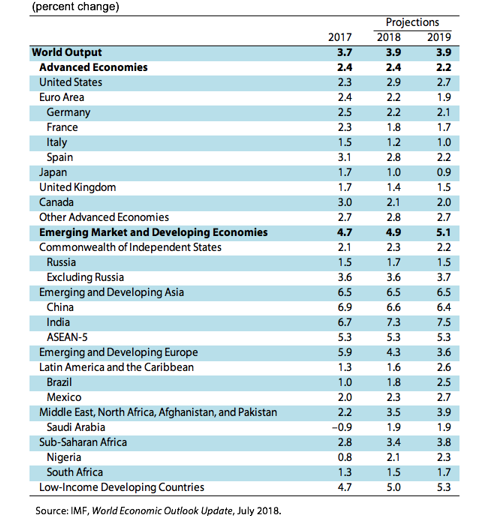
The Major World Economies At A Glance: 2017-2019
(Real GDP, Annual % Rates of Change)
1Yr.* Latest* 2018f 2019f
|
U.S. |
2.8 |
2.0 Q1 |
2.8 |
2.4 |
|
|
Japan |
1.1 |
-0.6Q1 |
1.4 |
1.2 |
|
|
Canada |
2.3 |
2.1 Q1 |
2.2 |
2.0 |
|
|
Germ. |
2.3 |
1.2 Q1 |
2.3 |
1.9 |
|
|
India |
7.7 |
10.1 1 |
7.2 |
6.6 |
|
|
China |
6.7 |
5.7 Q1 |
6.6 |
6.4 |
|
|
U.K. |
1.2 |
0.9 Q1 |
1.3 |
1.2 |
|
|
Euro19 |
2.5 |
1.5 Q1 |
2.5 |
2.0 |
|
|
World |
|
|
3.9 |
3.9 |
|
|
|
|
|
|
|
|
* 12 months change and annual % change in quarter.


Comments
Log in or sign up to join the conversation.