

Social Security's trustees released their 2026 report on what they expect for the future of the program. As with just about every one of their reports over the last decade, they foresee big benefit cuts when the program's Old Age and Survivors Insurance (OASI) Trust Fund is depleted.
The main changes in this year's report affect the timing of when the trust fund runs out of money and how big the benefit cuts will be after it does. The year of reckoning moved up to the end of 2032 from sometime in 2033, which if they divert money from the program's Disability Insurance (DI) program to it, could last until 2034.
Meanwhile, the magnitude of retirement benefit cuts when the trust fund no longer has any legal claim to money it "loaned" to the U.S. government while it had a surplus will be less than previously projected. Those cuts still aren't small - anyone receiving Social Security benefits will take a 22% hit to them. If they divert the DI trust fund money to keep the retirement benefits train going however, the cuts will be reduced to 17%.
Here is the trustees' official grim outlook:
The OASI Trust Fund is projected to become depleted in the fourth quarter of 2032, one quarter earlier than projected in last year’s report. Upon reserve depletion in 2032, projected income is sufficient to pay 78 percent of scheduled benefits. This percentage declines gradually to 62 percent by 2100.
DI Trust Fund reserves are projected to remain positive throughout the 75-year projection period, as was projected in last year’s report.
The combined OASDI fund is projected to become depleted in the third quarter of 2034, the same quarter as in last year’s report. Upon reserve depletion in 2034, projected income is sufficient to pay 83 percent of scheduled benefits. This percentage declines gradually to 65 percent by 2100.
Social Security has been draining the OASI Trust Fund since 2010. The 2026 Trustees report indicates how big that deficit has been in every year from 2010 through 2025. We tallied up those deficits to find out how much the OASI Trust Fund has shrunk over those years, which we visualized in the following chart:
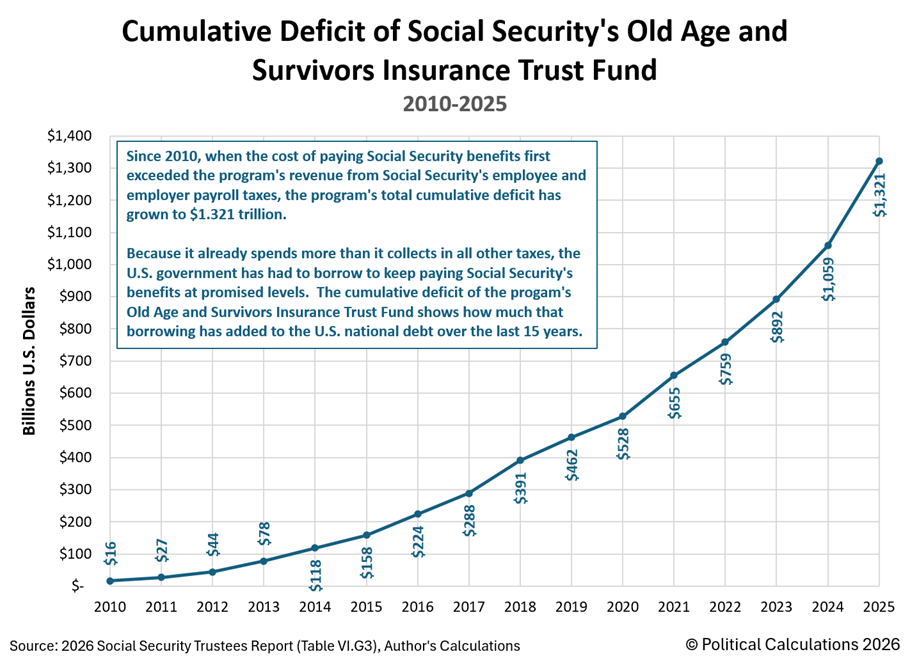
Through 2025, the OASI Trust Fund has cumulatively shrunk by $1.321 trillion. That's a lot of money, especially when you consider the U.S. government never had the cash to pay back the money it "owes to itself". Instead, it borrowed it, exchanging the debt it supposedly owed to itself for debt it owes to the public.
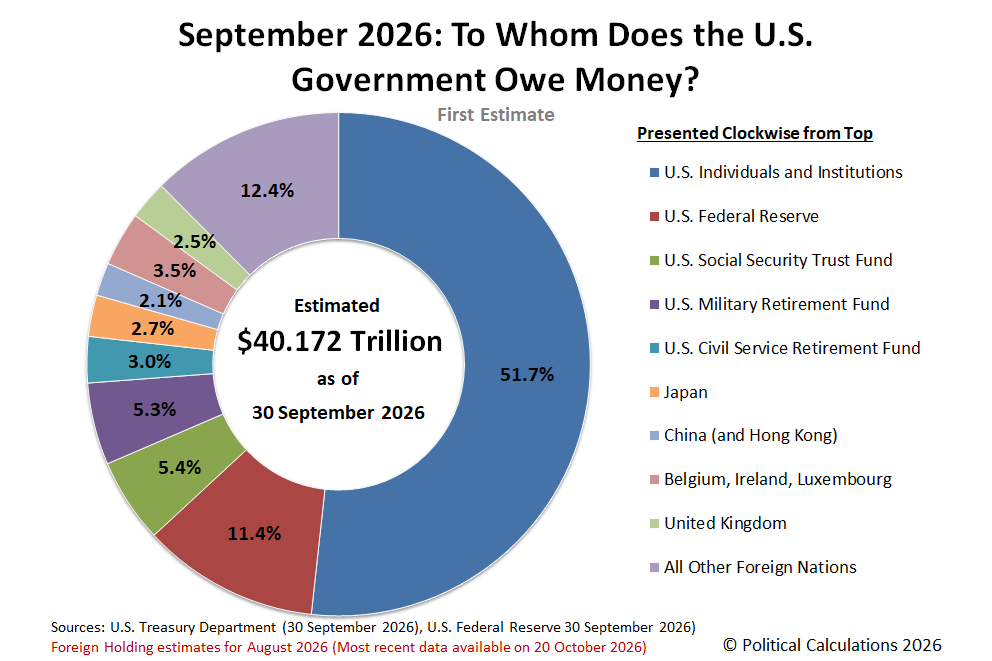
That raises a question. How much of the total U.S. national debt has gone from being counted as money the government owes to itself to instead be money the government owes to the public, which includes everyone from individual Americans who bought a savings bond to institutions like banks and insurance companies and foreign entities that loan money to the U.S. government by the truckload?
The answer to that question is visually presented in the next chart:
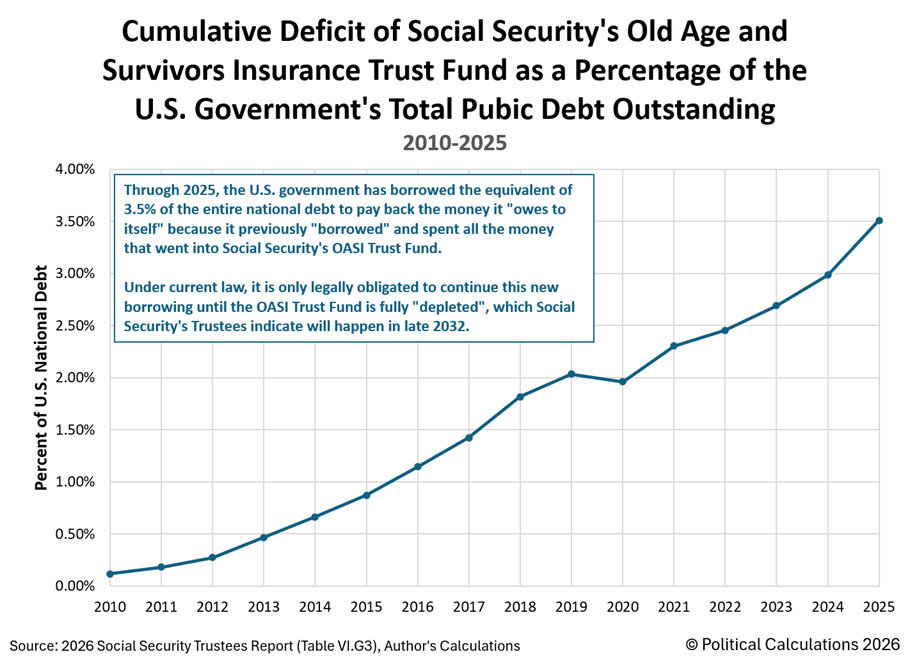
When you hear about Social Security's Trust Fund as being little more than an "accounting fiction", this transformation of debt from money the government owes to itself to be money the U.S. government owes to the public is what they mean. The trust fund debt is unavoidably becoming a general obligation of U.S. taxpayers, which is what it always was and is what it could only ever be.
Comments
Log in or sign up to join the conversation.