
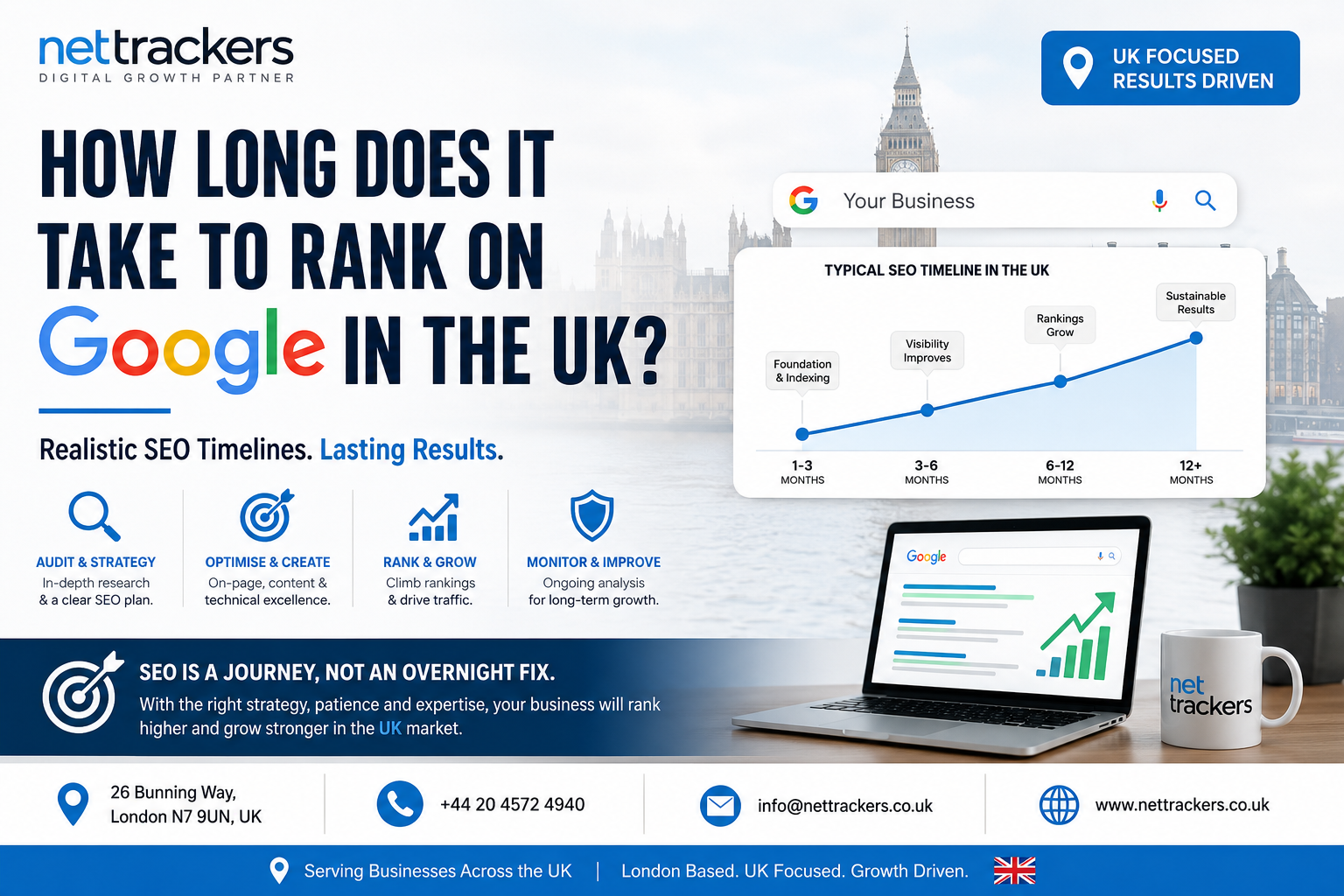
Most websites need between three and six months to show meaningful ranking movement on Google. Competitive keywords, new domains, and weak websites may require six to twelve months or longer. Less competitive local searches can sometimes improve within a few weeks when the website already has authority. However, no responsible provider of SEO services UK can guarantee a first-page position by a fixed date. The timeline depends on competition, website quality, content, technical health, authority, and how consistently the strategy is implemented.
Google must first discover, crawl, process, and index a page before it can rank it. It then compares that page with other results competing for the same search query. According to the Google SEO Starter Guide, some changes may appear within hours while others require several months. Google recommends waiting at least a few weeks before assessing whether optimisation work has produced a positive effect. SEO should therefore be measured as steady progress rather than an instant result.
What Does Ranking on Google Actually Mean?
Ranking on Google does not simply mean that a page appears somewhere in the search results. A useful ranking places the right page in front of people who are likely to become customers. Appearing first for an irrelevant phrase may bring traffic without enquiries or sales. A strong campaign connects commercial keywords with suitable service pages and helpful supporting content. This is especially important when selecting an SEO London strategy for a competitive local market.
Businesses should track more than one keyword or a single average position. Useful measures include impressions, clicks, qualified traffic, enquiries, calls, conversions, and revenue. Rankings may also differ by location, device, search history, and search intent. Google can test different results while it determines which pages satisfy users most effectively. A professional campaign monitors trends across several months rather than reacting to daily movement.
The Typical Google Ranking Timeline
Most SEO campaigns develop through several stages. Technical improvements may be noticed quickly, while authority and trust usually take longer to build. A new service page could be indexed within days but remain outside the first page for months. Established websites often respond faster because Google already crawls them regularly and understands their subject area. The following timeline provides a realistic guide rather than a promise.
Month One Research and Technical Foundations
The first month normally focuses on understanding the website, market, competitors, and search demand. An SEO team may review crawling, indexing, page speed, mobile usability, canonical tags, internal links, and structured data. Keyword research then connects each target phrase with the most relevant existing or planned page. Tracking should also be configured so future changes can be measured accurately. These foundations help SEO services UK avoid building content on a technically weak website.
Important problems may become visible immediately during this stage. A page blocked by robots rules, marked as noindex, or assigned the wrong canonical may never compete properly. Duplicate pages can also make it harder for Google to understand which URL should rank. Fixing these problems does not guarantee an instant first-page position. It simply allows later content and authority work to produce a better result.
Months Two and Three Content and Early Movement
The next stage often includes improving service pages and publishing supporting content. Existing pages may need clearer search intent, stronger headings, better internal links, and more useful information. Google must recrawl the changed URLs before it can reassess them. Some keywords may begin moving during this period, particularly when they have lower competition. Significant lead growth is still unlikely for many new or weak domains.
A strong B2B SEO agency also studies how business buyers research services before contacting a supplier. B2B searches often involve longer decision-making journeys than consumer searches. Buyers may compare expertise, pricing, case studies, processes, and industry experience across several visits. Content should therefore support awareness, comparison, and final supplier selection. Ranking an isolated blog without a clear path to a commercial page may produce little business value.
Months Four to Six Meaningful Ranking Growth
Many campaigns begin showing more meaningful progress between months four and six. Improved pages have had time to be crawled, tested, and compared with competing results. Supporting articles and internal links may also strengthen the website’s topical relevance. Quality mentions and backlinks can begin improving authority during this stage. NetTrackers states that many clients see initial movement within three months and more meaningful lead growth between months four and eight.
This does not mean every keyword will reach page one within six months. Highly competitive terms may require stronger content, more authority, and a longer publishing history. Search demand can also change during seasonal periods or major Google updates. A good SEO London campaign reviews which pages are improving and which need further work. Decisions should be based on Search Console data, conversions, and competitor movement rather than assumptions.
Months Six to Twelve Authority and Compounding Results
SEO often becomes more valuable after the first six months because improvements begin supporting one another. Helpful content can earn links, generate branded searches, and strengthen internal topic clusters. Established pages may then rank for a wider range of related searches. Conversion improvements can turn existing traffic into more enquiries without requiring every keyword to reach position one. This compounding effect is one reason SEO works best as a long-term channel.
Competitive national and B2B markets may require twelve months or more to reach their strongest performance. A capable B2B SEO agency should explain this before the campaign starts. It should also show evidence of progress before the final target positions are achieved. Rising impressions, more page-two keywords, improved non-branded traffic, and better-quality enquiries can indicate momentum. A lack of measurable progress after several months should trigger a strategic review.
What Affects How Quickly a Website Ranks?
Google rankings depend on many connected factors rather than one optimisation trick. The starting condition of the website can significantly shorten or extend the timeline. A trusted domain with strong pages may respond faster than a new website with little history. Competition also determines how much improvement is required to reach the first page. The quality and consistency of implementation remain important throughout the campaign.
Website Age and Existing Authority
New websites usually have fewer backlinks, mentions, returning visitors, and established pages. Google may also crawl them less frequently because fewer external links lead to the domain. An older website can still perform poorly when its content and technical structure are weak. Domain age alone does not guarantee authority or rankings. What matters is the quality and history built around the website over time.
An experienced provider of SEO services UK should evaluate the starting position before suggesting a timeline. It can review existing rankings, referring domains, indexed pages, organic traffic, and technical issues. A website already ranking on page two may need refinement rather than complete rebuilding. A new domain targeting national terms will usually require a longer investment. This assessment should happen before targets and budgets are finalised.
Keyword Competition and Search Intent
Broad keywords often take longer because many established companies compete for them. Location-based searches may be easier when the service area is specific and the website has strong local relevance. Commercial phrases can also be more difficult because every competing business wants the same potential customer. Informational questions may rank faster but do not always generate immediate enquiries. A balanced strategy targets different stages of the customer journey.
For example, SEO Manchester and SEO Birmingham are highly commercial location terms. Competing for them requires more than adding the city name to a generic page. The content must demonstrate relevance, useful services, expertise, and a reason for searchers to choose the business. Supporting content and authority signals may also be needed. Thin location pages created only to repeat keywords are unlikely to build lasting visibility.
Technical SEO and Indexing
Google cannot rank a page properly if it cannot access, render, or understand it. Broken links, incorrect redirects, duplicate URLs, weak navigation, and indexing rules can slow progress. A clear XML sitemap helps Google discover important pages, although it does not guarantee indexing. Google also relies on internal links to understand page relationships and importance. Technical SEO ensures that valuable content is available for evaluation.
The Google guide to crawling and indexing explains how sitemaps, canonicalisation, mobile pages, and crawler access affect discovery. Search Console can show whether important pages are indexed or encountering problems. Technical audits should therefore happen early rather than after months of content production. Fixes may produce faster crawling, but ranking gains still depend on relevance and quality. Technical health creates the conditions for performance rather than guaranteeing it.
Content Quality and Topical Coverage
A page should answer the searcher’s question better than the alternatives already ranking. This requires accurate information, clear structure, useful examples, and a strong match with search intent. Rewriting competitors without adding value gives Google little reason to promote the page. Businesses should also cover related questions that customers ask before making a decision. Connected topic clusters can show deeper subject knowledge than isolated articles.
A skilled SEO consultant London should map content around services, customer concerns, and commercial priorities. Each article should support a relevant service page through natural internal linking. Content should also be updated when facts, prices, regulations, or search intent change. Publishing frequently does not compensate for weak or repetitive material. Fewer high-quality pages can outperform a large collection of thin articles.
Backlinks and Brand Authority
Backlinks help Google discover pages and understand which websites others consider useful. However, link quality matters more than collecting large numbers from unrelated directories or low-value sites. Relevant editorial coverage, industry resources, partnerships, and genuine citations can support authority. Harmful or manipulative link schemes may waste money and create unnecessary risk. Sustainable authority building normally takes time.
Brand signals can also support search performance indirectly. People may search for the company name after seeing it through social media, events, referrals, or press coverage. A recognised brand is more likely to attract links and repeat visits. SEO, content, digital PR, reputation management, and website quality can therefore reinforce one another. NetTrackers combines these areas through its wider digital services rather than treating rankings in isolation.
Local Competition
Local campaigns can sometimes move faster than national campaigns, but this depends on the city and service. London usually has more competitors than a smaller town or tightly defined neighbourhood. Google Business Profile optimisation, local citations, reviews, service pages, and geographic relevance all influence local visibility. The website and business profile should provide consistent information. Local rankings may also vary according to the searcher’s physical position.
An SEO London campaign should not simply copy the approach used for another city. Search behaviour, competition, customer value, and available authority differ across markets. The same principle applies when planning local campaigns elsewhere in the UK. Location pages need genuine value and should not be doorway pages with only the city name changed. Strong local SEO connects accurate business information with useful services and local proof.
Can SEO Be Made Faster?
SEO cannot be forced, but unnecessary delays can be reduced. Start with a technical audit, correct indexing problems, and prioritise pages with the strongest commercial potential. Improve existing URLs before creating dozens of new ones that compete for the same intent. Build clear internal links and submit updated URLs through Search Console when appropriate. Publish content consistently enough for Google and users to recognise the website’s subject focus.
Paid advertising can provide immediate visibility while organic rankings develop. It should not be presented as a method for purchasing higher organic positions because Google keeps paid and organic systems separate. Businesses can use PPC data to understand which terms generate enquiries and apply those insights to SEO. Conversion optimisation can also improve returns from current traffic. The fastest useful strategy improves technical health, relevance, authority, and conversions together.
Why B2B SEO Often Takes Longer
B2B markets commonly have lower search volumes but much higher values per conversion. Buyers may involve directors, procurement teams, technical staff, and finance departments. They often need several pieces of content before trusting a supplier. Ranking alone will not succeed if the website lacks evidence, clear services, or a strong next step. This makes B2B SEO both a search and sales-support process.
A specialist B2B SEO agency should map keywords to different buying stages. Educational content can attract early research, while service pages and case studies support comparison. Technical articles may reassure expert decision-makers who need more detailed information. Strong calls to action then help visitors book consultations, request audits, or contact the team. This structure may take longer to build but can generate more qualified opportunities.
NetTrackers provides dedicated B2B SEO services for companies seeking qualified organic leads. Its strategy can include technical work, content, keyword mapping, authority development, and performance measurement. Businesses should still expect time for Google to process and evaluate those improvements. The campaign should report progress at each stage rather than hiding behind a twelve-month promise. Commercial outcomes remain the final measure of success.
What Should an SEO Report Show?
A useful report should explain what changed, why it changed, and what happens next. It should include organic traffic, impressions, clicks, rankings, conversions, and completed work. Reporting only a list of selected keyword positions can hide wider problems. The business should understand which pages produce enquiries and which need improvement. Clear reporting also makes the timeline easier to judge.
Early reports may focus more on technical fixes, indexing, and impression growth. Later reports should show stronger rankings, traffic, engagement, and conversions. An effective SEO services UK campaign should connect tasks with measurable outcomes. It should also explain outside factors such as seasonality, site changes, and Google updates. Transparent reporting helps businesses distinguish genuine progress from activity without results.
When Should You Review an SEO Campaign?
The first meaningful review usually happens after three months. By then, technical work should be completed and early ranking or impression changes may be visible. A deeper performance assessment can take place around six months. At that point, the team should understand which topics, pages, and keywords are responding. The next strategy should build on evidence rather than repeat the original plan unchanged.
A campaign should not wait six months to fix clear mistakes. Indexing failures, declining conversions, broken pages, or irrelevant content require earlier action. Daily ranking changes should not cause constant strategy shifts either. Google’s systems need time to recrawl and reassess changes. A balanced process responds quickly to genuine problems while allowing good work enough time to mature.
How to Choose the Right SEO Partner
Ask potential agencies how they calculate timelines and what evidence they will report. Avoid any provider promising a guaranteed position-one ranking within a few weeks. Google states that payment cannot secure better organic crawling or rankings. A reliable agency should explain technical work, content, links, conversions, and expected milestones clearly. It should also understand the commercial goals behind the target keywords.
NetTrackers offers organic SEO services and broader SEO services for UK businesses. Its website states that many campaigns show initial ranking movement within three months. Meaningful lead growth commonly develops between months four and eight, depending on the market and starting point. These are working expectations rather than guarantees for every website. Businesses can request an assessment before committing to a campaign.
Frequently Asked Questions
Can a New Website Rank Within Three Months?
A new website can rank for lower-competition or highly specific searches within three months. Competitive commercial keywords will normally require longer. The site must first be crawled, indexed, and evaluated against established competitors. Content, technical quality, internal links, and external authority all influence progress. Early impressions can appear before strong traffic or enquiries arrive.
Why Is My Website Indexed but Not Ranking?
Indexing only means that Google has added the page to its searchable database. It does not mean Google considers the page the best result for a target query. The content may lack relevance, quality, authority, or a clear match with search intent. Stronger competitors may also provide more complete answers or better user experiences. Review the page, query, internal links, and competing results before making changes.
Does Publishing More Blogs Improve Rankings Faster?
Publishing more content only helps when each page serves a clear and useful purpose. Repetitive blogs can create keyword overlap and weaken the website’s structure. Quality, relevance, internal linking, and commercial alignment matter more than volume alone. A content plan should identify genuine gaps in the customer journey. Every article should support a broader topic or service goal.
How Long Should I Pay for SEO?
SEO should continue while it produces profitable growth and supports business goals. Many websites require at least six to twelve months to build meaningful momentum. Stopping immediately after rankings improve may allow active competitors to catch up. Ongoing work can include updates, new opportunities, technical monitoring, and conversion improvement. The correct duration depends on competition, targets, budget, and return.
Set Realistic Expectations for Google Rankings
Most websites need three to six months to show meaningful SEO progress. New domains and competitive sectors may require six to twelve months or longer. Strong SEO services UK should provide early evidence through technical improvements, indexing, impressions, and ranking movement. An experienced B2B SEO agency can then connect that visibility with content designed for longer buying journeys. Contact NetTrackers to discuss a realistic timeline for your market and website.
Comments
Log in or sign up to join the conversation.