

Improve CNC Surface Finish and Accuracy with the Right Grooving Inserts
Achieving an excellent surface finish and maintaining dimensional accuracy are two of the most important goals in CNC machining. Whether manufacturing automotive components, aerospace parts, or precision engineering products, the quality of the machined surface directly impacts product performance and customer satisfaction. One cutting tool that plays a crucial role in achieving these results is the grooving insert.
Designed for precision grooving, parting, and profiling operations, grooving inserts deliver consistent cutting performance while minimizing vibration and tool wear. Their advanced geometry and carbide construction allow manufacturers to machine clean grooves with superior dimensional control, making them an essential solution for modern CNC operations.
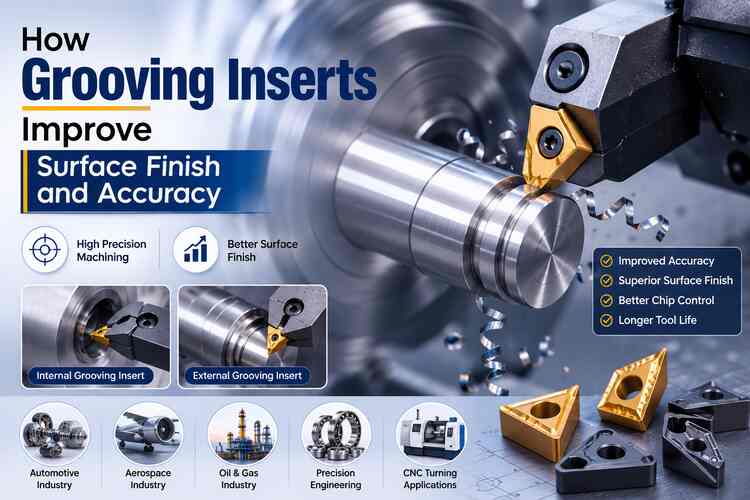
What Is a Grooving Insert?
A grooving insert is an indexable cutting insert specifically designed to create grooves, slots, and narrow recesses on a workpiece. Unlike conventional cutting tools, grooving inserts are engineered with specialized cutting geometries that ensure precise material removal while maintaining excellent chip control.
These inserts are widely used in CNC lathes and turning centers for machining both internal and external grooves with high repeatability.
Why Surface Finish Matters in CNC Machining
Surface finish is more than just appearance. A smoother surface improves product quality, assembly accuracy, and component life.
A high-quality surface finish offers several benefits:
Better dimensional accuracy
Reduced friction between moving parts
Improved wear resistance
Better sealing performance
Lower maintenance requirements
Enhanced product reliability
Poor surface finish can result in rejected components, additional machining operations, and increased production costs.
The Importance of Machining Accuracy
Precision is critical in industries where even the smallest dimensional variation can affect performance.
High machining accuracy helps manufacturers:
Reduce production errors
Minimize material waste
Maintain tight tolerances
Improve assembly efficiency
Increase customer satisfaction
Selecting the right cutting tool plays a significant role in achieving these objectives.
How Grooving Inserts Improve Surface Finish
One of the primary reasons manufacturers choose a grooving insert is its ability to produce smooth and consistent grooves.
Several design features contribute to better surface quality.
Optimized Cutting Geometry
Modern inserts feature specially engineered cutting edges that reduce cutting resistance and produce cleaner cuts.
This leads to:
Reduced chatter
Better chip formation
Smoother machined surfaces
Improved dimensional consistency
Better Chip Control
Poor chip evacuation often damages machined surfaces.
A high-quality carbide grooving insert includes advanced chip-breaker designs that efficiently direct chips away from the cutting zone.
This helps prevent:
Chip scratching
Heat buildup
Surface defects
Tool damage
Reduced Vibration
Vibration is one of the biggest causes of poor surface finish.
Precision insert geometry combined with rigid tool holding minimizes vibration during machining, resulting in cleaner grooves and better overall quality.
How Grooving Inserts Improve Accuracy
Accuracy depends on several machining factors, including tool rigidity, cutting stability, and insert quality.
A properly selected CNC grooving insert improves dimensional control through:
Stable Cutting Performance
High-quality inserts maintain consistent cutting action throughout the machining cycle.
This results in:
Uniform groove width
Accurate groove depth
Consistent dimensional tolerances
Better repeatability
Higher Rigidity
Indexable inserts mounted securely in precision tool holders reduce tool deflection during cutting.
Less deflection means:
Straighter grooves
Improved concentricity
Better machining precision
Superior Wear Resistance
Modern carbide grades remain sharp for longer periods.
A sharp cutting edge maintains dimensional accuracy across multiple machining cycles, reducing variation between components.
Types of Grooving Inserts
Different machining operations require different insert designs.
Internal Grooving Insert
An internal grooving insert is designed to machine grooves inside bores and internal diameters.
Common applications include:
Bearing housings
Hydraulic cylinders
Valve bodies
Automotive components
These inserts provide excellent access while maintaining machining accuracy in confined spaces.
External Grooving Insert
An external grooving insert is used for machining grooves on the outer diameter of cylindrical workpieces.
Typical applications include:
Shafts
Rollers
Bushings
Industrial machine parts
These inserts offer excellent stability during external turning operations.
Choosing the Right Grooving Insert Tool
Selecting the correct grooving insert tool depends on several machining factors.
Manufacturers should evaluate:
Workpiece material
Groove dimensions
Machine rigidity
Cutting speed
Feed rate
Coolant availability
Production volume
Using the correct tooling improves machining quality while extending insert life.
Grooving Inserts for CNC Machining
Today's grooving inserts for CNC machines are engineered for high-speed production environments.
Their advantages include:
Faster machining cycles
Better repeatability
Excellent chip control
Reduced setup time
Higher productivity
Lower operating costs
Combined with modern CNC tools, these inserts help manufacturers achieve outstanding machining performance while maintaining consistent quality.
Best Practices for Better Surface Finish and Accuracy
Even the best cutting insert cannot deliver optimal results without proper machining practices. Following the right techniques helps improve tool life, machining quality, and production efficiency.
Here are some recommended practices:
Select the correct cutting speed and feed rate.
Use the appropriate coolant to reduce heat generation.
Ensure proper workpiece clamping.
Replace worn inserts before they affect surface quality.
Use high-quality carbide inserts for demanding applications.
Perform regular machine maintenance.
Choose the correct insert geometry for the machining operation.
These practices help maintain consistent machining quality while reducing production costs.
Common Mistakes That Affect Surface Finish
Many machining problems occur because of incorrect tooling or machining parameters.
Some common mistakes include:
Using the wrong insert grade
Incorrect cutting speed
Excessive feed rate
Poor chip evacuation
Worn cutting edges
Improper tool setup
Machine vibration
Avoiding these issues helps manufacturers achieve better dimensional accuracy and smoother surface finishes.
Applications of Grooving Inserts
Grooving inserts are widely used across multiple industries because of their precision and reliability.
Automotive Industry
Manufacturers use grooving inserts for machining shafts, gears, brake components, bearings, and transmission parts where high precision is essential.
Aerospace Industry
Aircraft components require tight tolerances and excellent surface quality. Grooving inserts help machine lightweight alloys with consistent accuracy.
Oil & Gas Industry
Precision grooves are essential for sealing components, valves, and pipe fittings used in demanding environments.
Heavy Engineering
Construction equipment, mining machinery, and industrial machines require durable components with accurately machined grooves for reliable performance.
General Manufacturing
From precision engineering workshops to large-scale production facilities, grooving inserts are used to improve machining efficiency and maintain consistent product quality.
Why Carbide Inserts Are Preferred
Modern carbide inserts provide several advantages over conventional cutting tools.
They offer:
Excellent wear resistance
Higher cutting speeds
Better heat resistance
Longer tool life
Improved machining stability
Lower tooling costs over time
These benefits make carbide inserts the preferred choice for high-performance CNC machining.
How CNC Tools Improve Overall Machining Performance
Modern CNC tools are designed to deliver precision, repeatability, and higher productivity.
When combined with quality grooving inserts, manufacturers benefit from:
Improved machining accuracy
Better surface finish
Reduced cycle times
Lower production costs
Consistent component quality
Increased manufacturing efficiency
Investing in reliable cutting tools ultimately leads to better product quality and long-term operational savings.
Conclusion
Surface finish and dimensional accuracy are critical factors in modern CNC machining, directly influencing product quality, performance, and manufacturing efficiency. Selecting the right grooving insert helps manufacturers produce cleaner grooves, maintain tight tolerances, and reduce machining errors while improving overall productivity.
By choosing the correct insert geometry, carbide grade, and machining parameters, businesses can achieve consistent results, extend tool life, and lower production costs. Whether working in automotive, aerospace, oil & gas, or general engineering, high-quality grooving inserts remain an essential part of precision machining.
Jaibros offers a wide range of premium CNC cutting solutions, including carbide inserts, grooving tools, turning inserts, measuring instruments, and other high-performance machining products. With a commitment to quality, innovation, and reliability, Jaibros helps manufacturers achieve greater precision, improved productivity, and long-term machining success.
Frequently Asked Questions
1. What is a grooving insert used for?
A grooving insert is used to machine precise grooves, slots, and recesses on internal and external surfaces during CNC turning operations.
2. Why are carbide grooving inserts preferred?
Carbide grooving inserts offer excellent wear resistance, longer tool life, higher cutting speeds, and improved machining accuracy compared to conventional cutting tools.
3. What is the difference between internal and external grooving inserts?
Internal grooving inserts machine grooves inside bores, while external grooving inserts are designed to cut grooves on the outer diameter of a workpiece.
4. How can I improve surface finish during grooving operations?
Using the correct insert geometry, proper cutting parameters, effective coolant, and stable workpiece clamping helps achieve a smoother surface finish.
5. Are grooving inserts suitable for all CNC machines?
Yes, grooving inserts are compatible with most CNC lathes and turning centers when the correct insert holder and machining parameters are selected.
Comments
Log in or sign up to join the conversation.