
Introduction:
Understanding how search engines work is the foundation of successful SEO. Every day, billions of people use Google to find information, products, services, and answers to their questions.
If you want your website to appear in search results, you must understand how Google Search Algorithm Works for Beginners and the systems behind it. The search engine uses advanced algorithms and ranking signals to determine which pages deserve top positions in the results.
This guide explains the entire process in a simple way so beginners can understand how Google discovers, evaluates, and ranks websites.
What Is the Google Search Algorithm?
The Google search algorithm is a sophisticated system designed to retrieve and rank the most relevant web pages for a user’s search query.
Instead of relying on one factor, the algorithm evaluates hundreds of ranking signals to determine which pages provide the best answer.
Key goals of the algorithm include:
Delivering the most relevant search results
Providing accurate and trustworthy information
Understanding user search intent
Ranking high-quality content above low-quality pages
These systems constantly evolve to improve search quality and user satisfaction.
The Three Core Stages of Google Search:
Before any webpage appears in search results, it passes through three main processes.
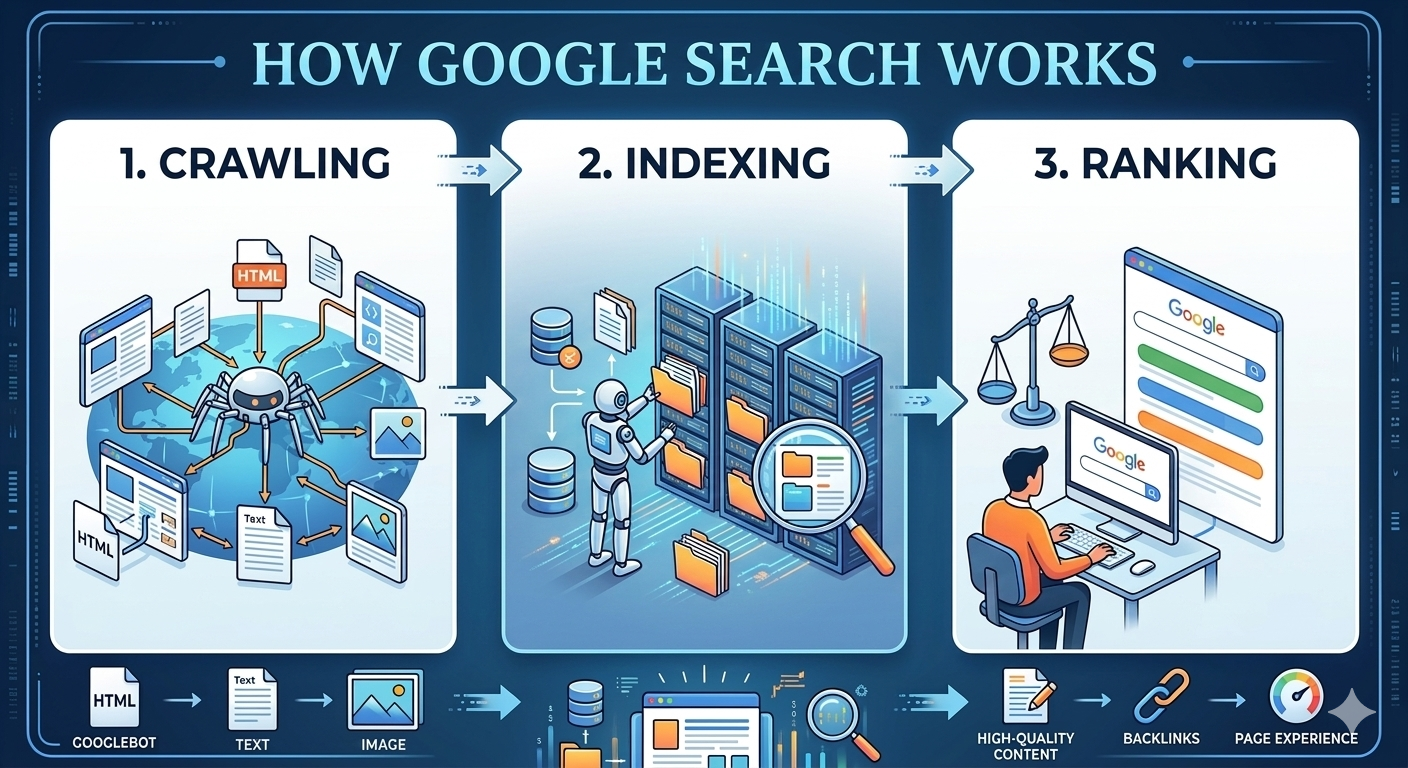
Indexing
Ranking
Each stage plays an essential role in how search engines organize and present information.
Crawling: How Google Discovers Content
Crawling is the first step in the search process.
Google uses automated programs called Googlebot to explore the internet and discover new or updated pages.
These bots move through websites by following links and analyzing page elements.
During crawling, Google examines:
Website content
Page structure
Images and media
Internal links
External links
If a website is well structured, Google can easily discover and scan its pages.
Factors that improve crawlability:
Clear website architecture
Internal linking between pages
XML sitemaps
Fast loading pages
Proper robots.txt configuration
If a page cannot be crawled, it cannot appear in search results.
Indexing: Storing Information in Google’s Database After crawling a webpage, Google analyzes the information and stores it in its massive database called the Google Index.
Indexing helps search engines understand the topic and relevance of each page.
During indexing, Google evaluates:
Content relevance
Keyword context
Page quality
Multimedia elements
Structured data
Content freshness
Only pages that meet quality standards are stored in the index.
Common reasons pages are not indexed:
Thin or duplicate content
Noindex tags in the code
Poor website structure
Blocked crawling permissions
Low-quality pages
Proper optimization ensures your pages are included in search results.
Ranking: Determining Search Result Positions:
Ranking is the final stage where Google decides which pages appear at the top of search results.
When someone searches for information, the algorithm evaluates all indexed pages and ranks them based on relevance and quality.
Important ranking signals include:
Content relevance to the search query
Website authority and credibility
Backlinks from other websites
Page experience and usability
Page loading speed
Mobile optimization
Pages that best match the search intent and provide high-quality information usually rank higher.
Important Google Ranking Factors:
Although the algorithm evaluates many signals, several factors have the strongest impact on rankings.
High-Quality Content:
Content remains the most important element of SEO.
Google favors pages that:
Provide helpful and accurate information
Answer user questions clearly
Cover topics comprehensively
Maintain originality and value
High-quality content improves trust and engagement.
Backlinks and Website Authority:
Backlinks are links from other websites pointing to your content. These links act as signals of credibility and trust.
Benefits of strong backlinks:
Higher domain authority
Improved ranking potential
Greater search visibility
Increased organic traffic
However, quality backlinks matter more than quantity.
Search Intent Optimization:
Search intent refers to the purpose behind a user’s query. Google aims to provide results that best match the user’s intention.
Four common types of search intent:
Informational – learning about a topic
Navigational – searching for a specific website
Commercial – comparing products or services
Transactional – ready to purchase
Content aligned with user intent performs better in search results.
Page Experience and Usability:
Google also evaluates how users interact with a website.
Important page experience factors:
Fast page loading speed
Mobile-friendly design
Secure HTTPS connection
Easy navigation
Readable content layout
A positive user experience encourages longer visits and lower bounce rates.
Key Elements That Help Websites Rank Higher:
Beginners should focus on a few essential strategies to improve search performance.
Create helpful content:
Answer real user questions
Provide detailed explanations
Focus on accuracy and clarity
Use relevant keywords:
Include related search terms naturally, such as:
Google search algorithm
how Google search works
search engine ranking factors
SEO basics
Google indexing
Improve website structure:
Use clear headings and subheadings
Create internal links between pages
Maintain organized categories
Maintain technical SEO:
Optimize page speed
Ensure mobile responsiveness
Fix crawl errors
These practices help search engines understand and rank your content more effectively.
Why Understanding Google Search Matters:
Learning how search engines evaluate websites provides a powerful advantage.
Benefits include:
Higher organic traffic
Better search visibility
Stronger online authority
Long-term digital growth
Businesses and content creators who understand SEO fundamentals can attract consistent traffic without relying heavily on paid advertising.
Future of Search Algorithms:
Search technology continues to evolve as artificial intelligence and machine learning improve.
Modern search engines analyze:
User behavior
Context of search queries
Content expertise
Authority signals
As algorithms become smarter, the focus shifts toward trustworthy, helpful, and experience-driven content. Websites that prioritize quality will always perform better in search rankings.
Frequently Asked Questions (FAQs):
What is the Google search algorithm?
The Google search algorithm is a system that retrieves and ranks webpages based on relevance, quality, and usefulness to users searching for information.
How does Google find new websites?
Google uses automated bots called crawlers that follow links across the web to discover new pages and updated content.
What are the three main steps of Google search?
The three main stages are crawling, indexing, and ranking. These processes help Google discover, store, and organize web pages.
How long does it take for a page to rank on Google?
Ranking time varies depending on competition, website authority, and content quality. It can take days, weeks, or months.
Can beginners rank websites on Google?
Yes. Beginners can rank by targeting low-competition keywords, creating helpful content, improving site structure, and following SEO best practices.
Comments
Log in or sign up to join the conversation.