

If you are a foreign manufacturer planning to sell products in the Indian market, obtaining BIS Certification is often a mandatory requirement. The Bureau of Indian Standards (BIS) regulates product quality and safety through various certification schemes, ensuring that products sold in India meet the prescribed Indian Standards.
Whether you manufacture electronics, electrical appliances, chemicals, steel products, toys, or other regulated products, understanding the BIS certification process can help you avoid import delays, penalties, and market restrictions.
What is BIS Certification?
BIS Certification is a conformity assessment issued by the Bureau of Indian Standards (BIS). It verifies that a product complies with the applicable Indian Standard (IS) and meets the required quality and safety parameters.
Depending on the product category, manufacturers may need certification under:
ISI Certification Scheme
BIS CRS (Compulsory Registration Scheme)
Scheme X
Foreign Manufacturers Certification Scheme (FMCS)
Foreign manufacturers must apply under the appropriate scheme based on their product type.
Is BIS Certification Mandatory for Foreign Manufacturers?
Yes. If your product is covered under a Quality Control Order (QCO) or the Compulsory Registration Scheme (CRS), BIS certification is mandatory before the product can be imported, distributed, or sold in India.
Common product categories include:
Electrical appliances
Electronic products
Steel products
Cement
Chemicals
Toys
Footwear
Household products
LED lighting
Industrial equipment
Before applying, confirm whether your product falls under a mandatory BIS certification requirement.
Who Can Apply?
Only the manufacturer can apply for BIS certification.
Importers, distributors, traders, or retailers cannot obtain BIS certification in their own name. However, they may assist the manufacturer during the certification process.
Foreign manufacturers are also required to appoint an Authorized Indian Representative (AIR) to communicate with BIS and manage regulatory matters in India.
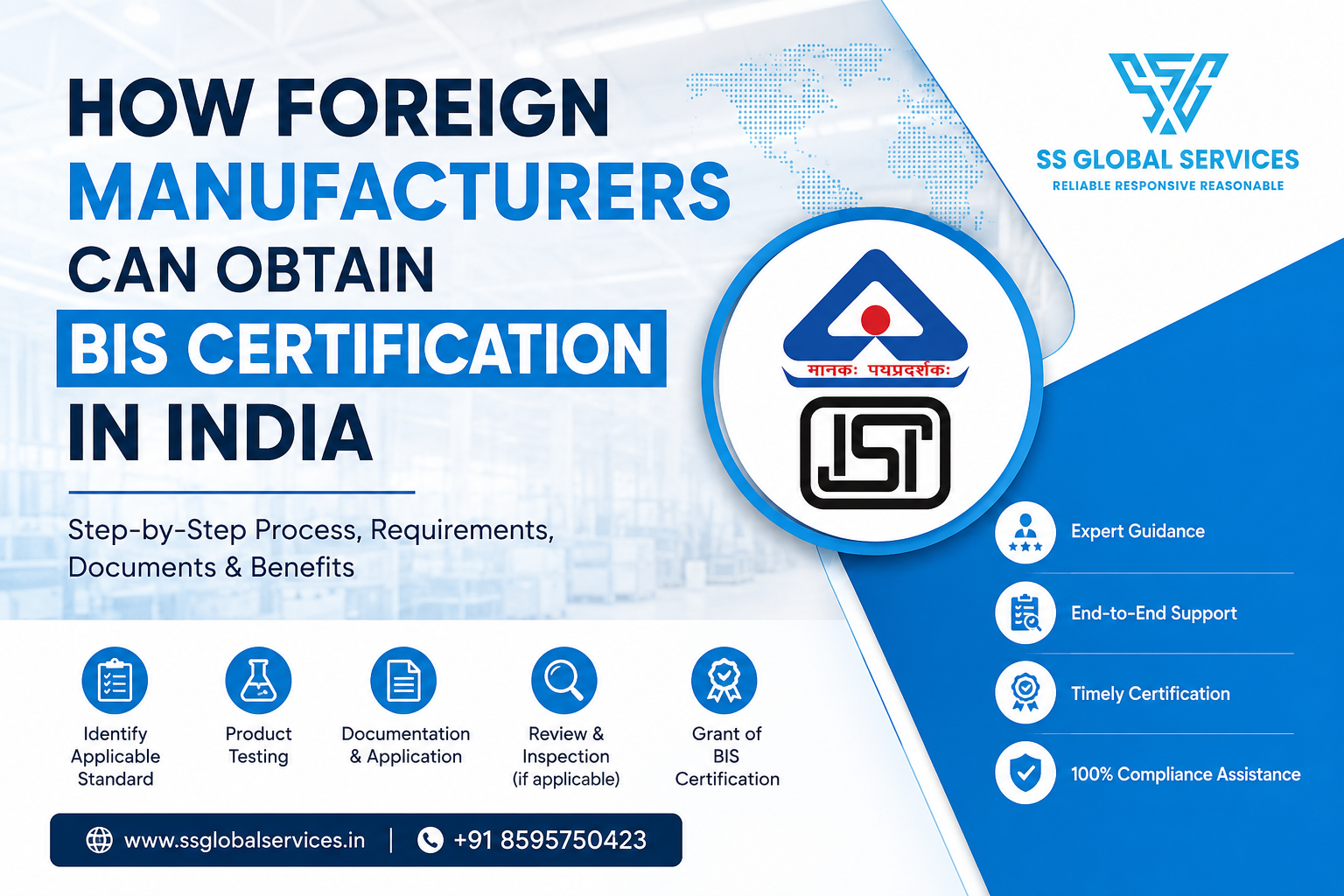
Step-by-Step BIS Certification Process for Foreign Manufacturers
1. Identify the Applicable Standard
Determine the correct Indian Standard (IS) and certification scheme applicable to your product.
Selecting the wrong standard can lead to application rejection or additional testing.
2. Product Testing
The product must be tested according to the applicable Indian Standard.
Testing may be carried out in BIS-recognized laboratories, depending on the certification scheme and product category.
3. Prepare Documentation
Prepare all required technical and legal documents before submitting the application.
Typical documents include:
Business registration certificate
Manufacturing licence
Factory address proof
Product specifications
Manufacturing process details
Test reports
Quality management documents
Authorized Indian Representative (AIR) documents
Trademark authorization (if applicable)
Additional documents may be required depending on the product category.
4. Submit the BIS Application
Submit the application through the BIS portal along with the required documents, declarations, and applicable government fees.
Ensure all information is accurate to avoid unnecessary queries.
5. Factory Inspection (Where Applicable)
For certain certification schemes, BIS officials may inspect the manufacturing facility to verify:
Manufacturing infrastructure
Quality control system
Testing facilities
Production process
Product consistency
The inspection helps confirm that products can consistently meet the required Indian Standards.
6. Grant of BIS Certification
After successful document verification, testing, and inspection (if applicable), BIS grants the certification.
The manufacturer can then use the applicable BIS mark and legally supply the certified products in India.
Documents Required for BIS Certification
Although document requirements vary by product, commonly required documents include:
Company registration documents
Factory licence
Manufacturing process details
Product specifications
Test reports
Quality control documents
Brand authorization letter (if applicable)
AIR appointment documents
Product photographs
Product labels and markings
Preparing complete documentation in advance helps reduce processing time.
Common Challenges Faced by Foreign Manufacturers
Many manufacturers experience delays because of:
Choosing the incorrect Indian Standard
Incomplete documentation
Incorrect product classification
Testing from non-recognized laboratories
Delayed responses to BIS queries
Inadequate factory quality systems
Errors in the online application
Understanding these requirements beforehand can significantly improve approval timelines.
Tips for a Smooth BIS Certification Process
Verify whether your product requires mandatory BIS certification.
Confirm the applicable Indian Standard before testing.
Ensure technical documents are complete and accurate.
Use BIS-recognized laboratories where required.
Appoint an experienced Authorized Indian Representative (AIR).
Respond promptly to any BIS clarification requests.
Keep product specifications consistent throughout the application process.
Benefits of BIS Certification
Obtaining BIS certification offers several advantages:
Legal access to the Indian market
Compliance with government regulations
Improved product credibility
Increased customer confidence
Reduced customs clearance issues
Better business opportunities with distributors and retailers
Demonstrates commitment to product quality and safety
Conclusion
India has one of the world's fastest-growing consumer markets, but regulatory compliance is essential before products can be sold. For foreign manufacturers, obtaining BIS Certification involves selecting the correct certification scheme, completing product testing, preparing documentation, appointing an Authorized Indian Representative, and complying with BIS requirements.
Planning the certification process early can help avoid delays and ensure a smoother product launch in India.
If your products require BIS Certification, working with experienced compliance professionals can simplify documentation, testing coordination, and the overall application process, allowing you to focus on expanding your business in the Indian market.
Comments
Log in or sign up to join the conversation.